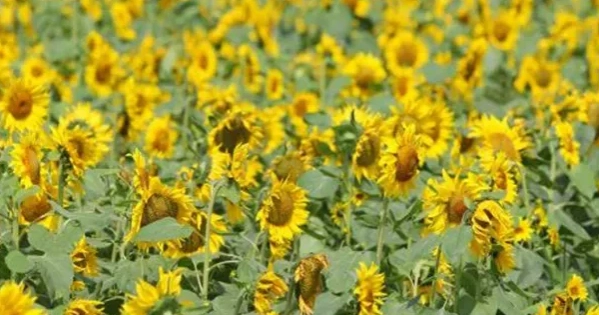
As spring breathes life into the hills of Khagrachhari, vast stretches of sloping land and crop fields are turning golden with blooming sunflowers, offering a striking visual spectacle and a promising economic opportunity for local farmers.
The bright yellow blossoms, standing tall under the soft spring sun, are not only adding colour to the hill landscape but also signalling a shift towards a potentially profitable crop.
With relatively low production costs and encouraging yields, sunflower cultivation is emerging as a viable alternative that could strengthen the economy of the district.
Bangladesh, known for its six distinct seasons, is now in the heart of spring—a time when nature rejuvenates itself with vibrant flowers and gentle breezes.
Amid this seasonal transformation, the hills of Khagrachhari are witnessing a quiet agricultural revolution led by sunflower farming.
Primarily an oilseed crop, sunflower is valued for producing high-quality edible oil, as well as for use in bird feed and ornamental purposes.
The plant’s unique characteristic of following the sun from east to west during the day adds to its appeal.
Each sunflower head is not a single flower but a cluster of over 2,000 tiny florets forming a large bloom.
According to the Department of Agricultural Extension (DAE) in Khagrachhari, sunflower cultivation has expanded to around 36 hectares across all nine upazilas this season, maintaining last year’s coverage.
Around 300 farmers have been supported with hybrid TSF-275 sunflower seeds and necessary fertilisers under government initiatives.
Matiranga, Dighinala and sadar upazilas have seen the highest concentration of cultivation.
In Sapmara area of Matiranga, farmer Keshor Ranjan Tripura said he cultivated sunflower on 40 decimals of land for the first time, following guidance from agricultural officials.
“I irrigated the field four times, and the total cost was around Tk 6,000. The yield looks promising—I expect about 10 maunds if everything goes well,” he said.
Another farmer, Anjana Tripura from Notun Para, shared a similar experience. She invested around Tk 10,000 per bigha and is hopeful of harvesting between 8 to 10 maunds.
“Seeing my success, neighbouring farmers are becoming interested in sunflower cultivation,” she said, adding that she plans to expand farming with further government support.
Golden Shift on Teesta: Sunflowers replace tobacco in Lalmonirhat’s char lands
Upazila Agriculture Extension Officer Md Selim Rana said farmers in the hill region are being trained and assisted to adopt sunflower as an alternative oilseed crop. “It has strong potential to meet local edible oil demand in the future,” he added.
Deputy Director of DAE in Khagrachhari, Nasir Uddin Chowdhury, said the climate and soil are well-suited for sunflower farming. “We are providing seeds, incentives and technical support. Farmers are responding positively, and the crop can play a significant role in boosting the rural economy while reducing dependence on imported edible oil,” he added.