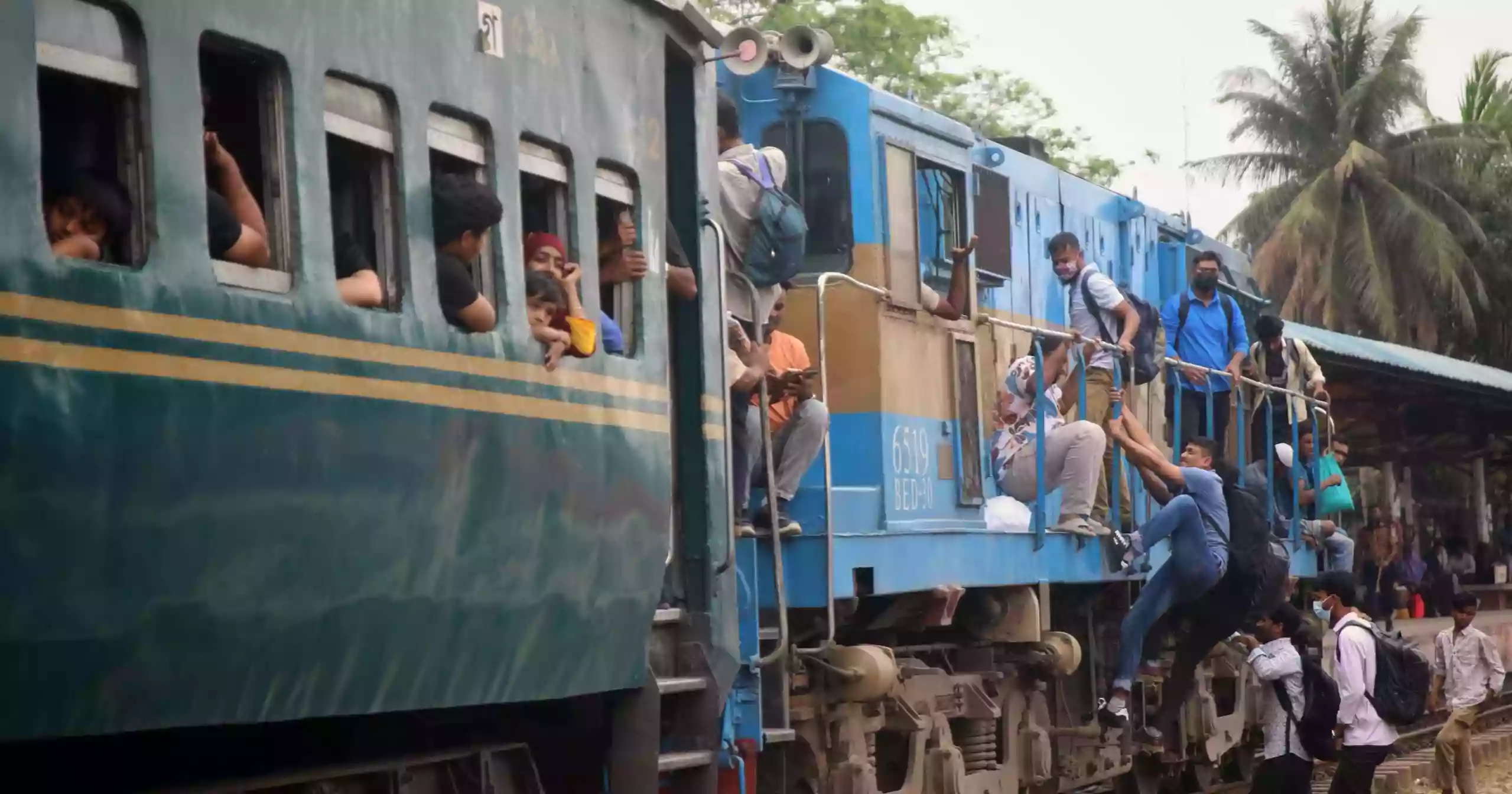
As the festive calm of Eid-ul-Fitr settles over the capital, a different kind of movement has taken hold across Dhaka’s major transport hubs.
Thousands of homebound people—many of whom spent the final days of Ramadan and even Eid day itself working long hours—are now leaving the city, clutching modest earnings and Eid bonuses, hoping to reunite with families they could not join in time for the festival.
From the crowded platforms of Kamalapur Railway Station to the chaotic bus counters at Gabtoli, Kalyanpur and Shyamoli, the scenes reflect both relief and quiet exhaustion.
These travellers are not holidaymakers returning from celebration, but workers who sacrificed their Eid to secure extra income in a time of rising living costs.
At Shyamoli bus counter, 32-year-old worker Abdul Halim waited with a small travel bag and a packet of sweets for his children in Rangpur. He said he had worked double shifts in the week leading up to Eid and even stayed on duty the day before the festival to qualify for a bonus.
“I could have left earlier, but then I would miss the bonus,” he told UNB. “My children were upset, but I promised them I would come just after Eid. This money will help us for the next month.”
The bus counters in Shyamoli were busy with similar stories. Men and women, many visibly fatigued, queued for tickets or sat on luggage, waiting for delayed coaches. Transport workers said the post-Eid rush this year appeared more intense than usual, driven largely by those who stayed back to work until the last possible moment.
At Kalyanpur bus counter, rickshaw puller Shahid Mia, 45, said he earned nearly double his usual daily income in the last three days before Eid. “People were shopping, travelling, hiring rickshaws all the time,” he said. “If I left early, I would lose that chance. I prayed Eid in Dhaka and started working again the same day.”
Shahid is now heading to his village in Kurigram, carrying new clothes for his wife and grandchildren. “It is not the same as celebrating together,” he admitted. “But at least I can take something for them.”
Transport workers themselves were among those delaying their journeys home. Bus helpers, drivers and ticket sellers said they remained on duty throughout the holiday period due to high demand.
At Gabtoli bus terminal, one of the busiest in the capital, bus supervisor Mizanur Rahman said he had not had a proper break in over a week. “We worked day and night,” he said. “Even on Eid day, buses were running full. Now I am taking leave for two days to go home.”
The terminal was slightly crowded with passengers trying to board buses to northern districts. Many complained of long waits and limited availability of tickets, as transport services struggled to cope with the sudden surge.
Among them was domestic worker Rokeya Begum, who had spent Eid day cooking and cleaning in her employer’s home in Dhanmondi. She said she was allowed to leave only after completing her duties.
“I started work early in the morning on Eid day,” she said. “There were guests all day. I could not even call my family properly. Today I am going home with my salary and a small bonus.”
Her destination is Thakurgaon, where her two young daughters are waiting with relatives. “They wore their Eid dresses without me,” she said quietly. “Now I will go and celebrate with them, even if it is late.”
At Kamalapur Railway Station, the situation was equally intense. Trains departing for Rajshahi, Khulna and Chattogram were filled to capacity, with many passengers standing in aisles or sitting on the floor.
Railway officials said the post-Eid pressure is a familiar pattern but has grown more pronounced in recent years as more low-income workers delay travel to maximise earnings during the festive period.
Among the crowd was Mohammad Sohel, a food delivery rider who worked throughout Ramadan evenings and continued on Eid day. “Eid is actually one of the busiest days for us,” he said. “People order food for guests. I made good money, but I could not go home.”
Sohel is now travelling to Cumilla, carrying a new mobile set he bought for his younger brother. “This is my way of celebrating,” he said. “It is late, but still meaningful.”
Many small businessmen also stayed back in Dhaka to capitalise on last-minute Eid shopping. Nur Alam, who runs a fruit shop on footpath at Shyamoli cinema hall area, said he sold a considerable size of various types of fruits on Eid day also which gives him a good amount of profit.
“Sales were very good, so I decided to stay and sell. Now I am going home with more money than I expected.”
Economists say such behaviour reflects the economic pressures faced by low-income urban workers, who often prioritise income over social rituals.
“Eid is both a religious and economic event,” said a Dhaka-based labour analyst works for an international organisation. “For many marginal workers, the scope to earn extra income during this period is too important to miss. They delay their returning home, even if it means missing the core celebration.”
However, the delayed journey home comes with its own challenges. Extra pressure of passengers, higher fares in some cases, and physical exhaustion sometimes make the trip difficult.
At Gabtoli, several passengers alleged that some buses were charging above the standard fare, taking advantage of the demand. Although authorities said monitoring teams were active, enforcement remained uneven.
Despite the hardships, there was a sense of quiet determination among travellers. For many, the journey home—even after Eid—remains deeply significant.
Back at Shyamoli, Abdul Halim finally boarded a crowded bus after hours of waiting. As the vehicle slowly pulled away, he looked visibly relieved.
“Eid is not only one day,” he said with a faint smile. “When I reach home and sit with my family, that will be my Eid.”
Across Dhaka’s transport hubs, similar journeys were unfolding—stories of labour, sacrifice and delayed joy. While the city returns to its routine, these Working people carry with them the different kinds of Eid experience, shaped not by celebration, but by the need to earn, endure and eventually return home.