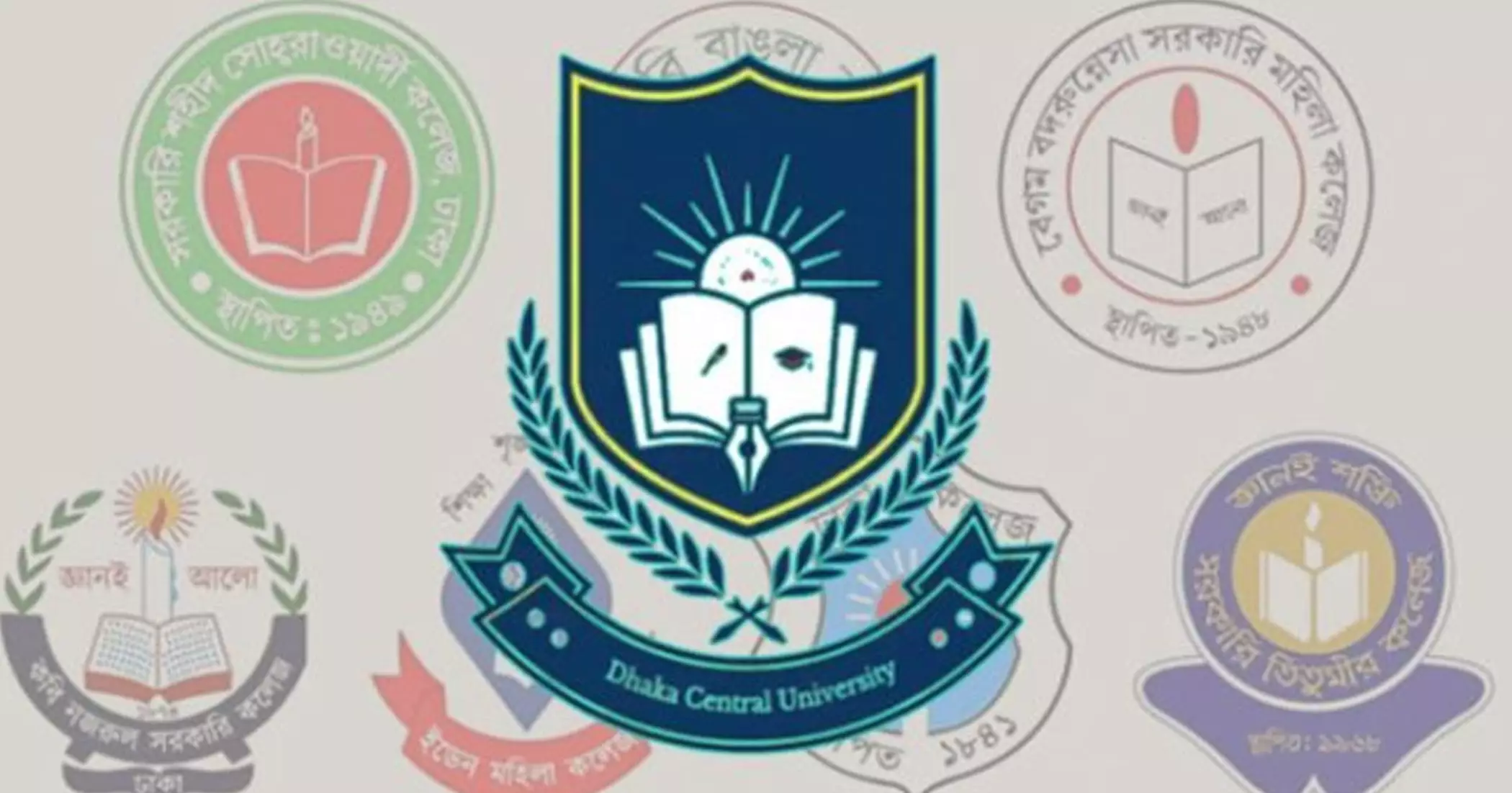
The sun rises over the capital’s seven historic colleges, casting long shadows across empty classrooms and silent corridors. Soon, they are meant to combine their resources to form the Dhaka Central University (DCU), a dream wrought from years of student protests. Yet the air is thick with uncertainty.
The ordinance that would breathe life into the university is yet to be issued, debates flare over the role of BCS Education Cadre teachers, and structural concerns for female students echo through the deserted halls. The fate of the revered higher secondary programs hangs by a thread.
DCU’s story is yet to unfold, a drama of ambition, conflict, and hope waiting to ignite - that may yet be left in the lurch.
Journey to a new University
The seven colleges—Dhaka College, Eden Mohila College, Govt. Shaheed Suhrawardy College, Kabi Nazrul Govt. College, Begum Badrunnesa Govt. Mohila College, Mirpur Govt. Bangla College, and Govt. Titumir College—were brought under Dhaka University (DU) in February 2017 after decades under the National University system.
Nearly 200,000 students study in these colleges. Claiming academic discrimination and delayed sessions under DU, students renewed their longstanding demand for a separate university during the 2024 student movement. Following the success of that movement, that seemingly opened the doors for various groups to realise their demands through street protests, the seven colleges' own movement gained momentum.
In response, the Education Ministry formed a four-member expert committee under the University Grants Commission (UGC) to design a structural framework for the colleges.
Following student agitation and clashes with DU students on January 27, steps were initiated to formally detach the colleges from DU. The UGC proposed an interim structure under which a principal-level administrator, supervised by a UGC member, would run the institution until a full university system was set.
While the world embraces music education, Bangladesh seen stepping backwards
The name Dhaka Central University was finalized after consultations. On May 18, 2025, retired Dhaka College principal Prof. A.K.M. Ilias was appointed as interim administrator for two years. Admission notices followed in July, and results for the first undergraduate batch were released on August 26. Around 72,000 students applied for 11,150 seats across Science, Arts & Social Sciences.
A draft ordinance, prepared by a committee led by Prof. Mohammad Tanzimuddin Khan—was released on September 24, seeking feedback from teachers, students, and other stakeholders. More than 6,000 responses poured in, sparking heated debate and divisions.
On November 18, the Education Ministry said it had decided in principle to establish DCU, claiming the move would ensure quality education, timely exams, fast results, and improved administration.
Born into session jams
Despite completing admissions for the 2024–25 academic year and announcing that classes would begin on November 23, no classes commenced. Most universities have already been in session for months, and DU has finished 2 units admission tests for the next academic year.
Consequently, DCU’s first batch has suffered what amounts to a one-year session delay, even without attending a single class.
Human trafficking, instability erode global trust in Bangladesh’s passports
On November 30, students blocked the Shahbagh intersection demanding immediate commencement of classes after another postponed start date passed. Earlier, the ministry had extended the admission deadline and rescheduled classes to November 30, but no progress followed.
Academic schools and growing controversy
The draft ordinance divides the colleges into four academic schools:
School of Arts & Humanities at Govt. Bangla College
(Journalism, Economics, Development Studies, Film Studies, International Politics)
School of Science at Dhaka College, Eden Mohila College, Badrunnesa College
(Biochemistry, Data Science, Zoology, Physics, Psychology, etc.)
School of Business Studies at Titumir College
(Accounting, HRM, Marketing, Banking & Insurance, Hospitality)
School of Law & Justice at Kabi Nazrul College and Shaheed Suhrawardy College
A segment of students reject the hybrid, multi-campus schooling system, fearing it will diminish their college identity and autonomy. Dhaka College alumni have demanded full cancellation of the draft to preserve institutional independence.
Where heroes rest, dealers roam as drug trade overtakes Mausoleum at DU
The ordinance proposes a hybrid teaching model, with 35–40% instruction online but all exams in person. University activities would run from 1pm to 7pm on existing college campuses.
Students’ concerns over autonomy
Female students from Eden Mohila College and Begum Badrunnesa College argue that the proposed schooling threatens the purpose of women-only institutions. On December 2, Eden students held a press conference demanding the college remain exclusively for women. The next day, students blocked roads and marched toward Dhaka College, joined by faculty members.
Even now, a segment of students has yet to applaud the initiative to convert the seven colleges into a university.
Rudro Sheikh, a fourth-year student of the Department of Philosophy at Dhaka College, told UNB, “The proposal is not fully aligned with reality. Without proper infrastructure, research facilities, and permanent faculty, university status adds value in name only, not in education quality. The priority should be maintaining stability and transparency in existing colleges rather than expanding a name without ensuring quality.”
Mystery behind Bandarban travel bans: Who’s pulling the strings?
Teachers’ alarm over career security
Teachers remain deeply concerned. Under the draft, BCS General Education Cadre members are not considered DCU faculty and cannot conduct first-year classes or exams, raising fears that around 1,500 teaching posts, including 1,100 permanent—may lose status or be abolished. Faculty members argue that this threatens their promotions and fundamental rights.
Tensions escalated on October 14 when teachers and students clashed at Dhaka College. On December 2, the “Seven Colleges' Identity Protection Committee” demanded cancellation of the hybrid system and insisted on permanent inclusion of BCS cadre members in all academic and administrative roles. They warned of possible indefinite strikes if the ordinance proceeds.
HSC students enter the debate
Five of the seven colleges— Dhaka College, Shaheed Suhrawardy, Badrunnesa, Kabi Nazrul, and Bangla College—run higher secondary programs.
Students from these programs fear DCU will eventually eliminate HSC sections, despite the draft ordinance stating they would remain. They also fear that the proposed DCU structure threatens college autonomy.
On December 1, Dhaka College HSC students blocked Science Lab and New Market intersections demanding the ordinance be withdrawn and college autonomy preserved.
Ordinance deadline looms
On October 15, the ministry called the ordinance’s finalization “time-sensitive” and urged responsible public engagement.
But student frustration has intensified. On December 3, students blocked roads in front of Dhaka College and issued an ultimatum: the ordinance must be released by December 6. Failing that, they vowed to begin a continuous sit-in in front of the Education Building from December 7.
Interim administrator Prof. A K M Elias said, “The Ministry of Education is closely monitoring the situation, and we hope the issues will be resolved very soon.”
Dhaka to get state-of-the-art special needs school
UGC member Prof. Tanzim Uddin Khan, said to UNB, “We do not have the authority to make comments regarding the seven colleges. According to our terms of conditions, we have completed the responsibilities assigned to us.”
He added that they no longer have any role in this matter; it is now entirely under the jurisdiction of the Ministry of Education.
For now, Dhaka Central University remains suspended between aspiration and deadlock, a project weighed down by mistrust, administrative vacuum, and unresolved questions of identity, autonomy, and inclusion.