Iran’s Supreme Leader Ayatollah Ali Khamenei on Sunday warned that any military attack by the United States would spark a “regional war,” sharply escalating rhetoric amid rising tensions following Washington’s threats over Tehran’s violent crackdown on nationwide protests.
The warning, delivered as US aircraft carrier USS Abraham Lincoln and accompanying warships operate in the Arabian Sea, marked Khamenei’s most direct threat so far. The vessels were deployed by President Donald Trump after Iran’s security forces moved forcefully to suppress weeks of unrest across the country.
It remains uncertain whether Washington will resort to military action. Trump has repeatedly said Iran is interested in negotiations, while also raising concerns about Tehran’s nuclear programme as a key unresolved issue.
Addressing a crowd at his Tehran compound during events marking the anniversary of Iran’s 1979 Islamic Revolution, the 86-year-old leader accused the United States of seeking to dominate Iran’s natural resources.
“The Americans must know that if they start a war this time, it will be a regional war,” Khamenei said. He added that Iran did not seek conflict, but warned that any attack or harassment would be met with a severe response from the Iranian nation.
Trump, asked about the warning, told reporters that US naval forces were positioned nearby and expressed hope for a negotiated settlement. He said if no deal was reached, it would become clear whether Khamenei’s threat was credible.
Khamenei also hardened his stance on the protests, describing them as “sedition” akin to a coup attempt. While he had earlier acknowledged that some protesters were driven by economic grievances, he now accused demonstrators of targeting state institutions, security forces, banks and religious sites in an effort to destabilise the country.
Human Rights Activists New Agency, a US-based group that tracks developments inside Iran, said more than 49,500 people have been detained since the protests began in late December and estimated at least 6,713 deaths, mostly among demonstrators. The Associated Press has not been able to independently verify the figures, citing Iran’s restrictions on internet access.
Iranian authorities have put the death toll far lower, reporting 3,117 fatalities as of Jan 21, including civilians and security personnel, while labelling others “terrorists.” Past unrest has seen official figures widely questioned.
Meanwhile, Iran had planned live-fire military drills in the Strait of Hormuz, the strategic waterway through which about one-fifth of the world’s oil supply passes. The US military warned Tehran against threatening American forces or disrupting commercial shipping during the exercises.
In a separate development, Iran’s parliament speaker Mohammad Bagher Qalibaf said Tehran now considers all European Union militaries to be terrorist organisations. The move came after the EU designated Iran’s Islamic Revolutionary Guard Corps as a terror group over its role in the crackdown.
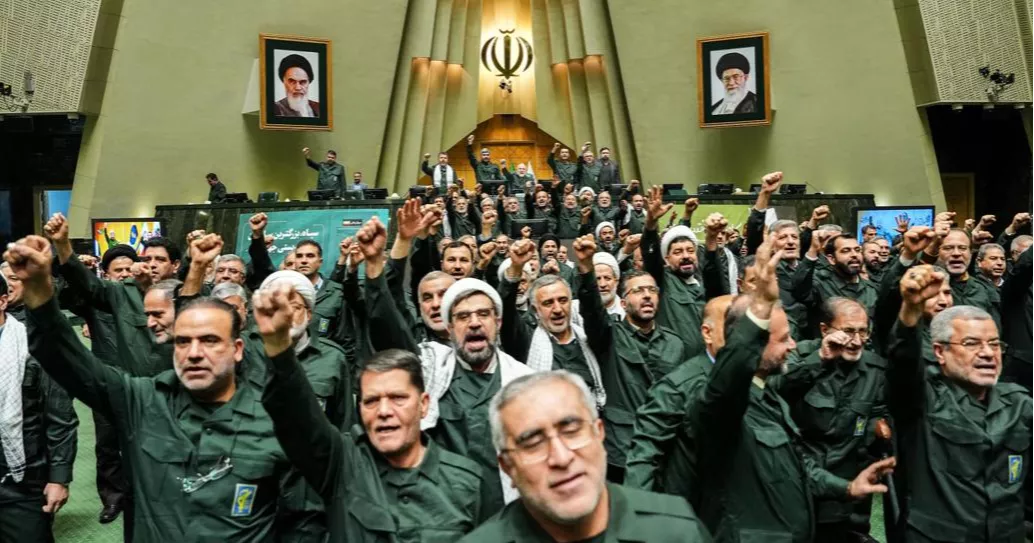
Qalibaf, a former Guard commander, made the announcement as lawmakers wore Guard uniforms in solidarity. The designation is largely symbolic, mirroring a 2019 Iranian law used after the United States labelled the Guard a terrorist organisation.
Lawmakers later chanted anti-US and anti-Israel slogans in parliament.
Trump has outlined two red lines that could trigger US military action: the killing of peaceful protesters or mass executions of detainees. He has also renewed focus on Iran’s nuclear programme, which the US struck during a brief war with Iran last June.
Speaking over the weekend, Trump declined to say whether he had decided on a course of action, but said Iran was “seriously talking” to the United States about reaching a deal to prevent it from acquiring nuclear weapons.