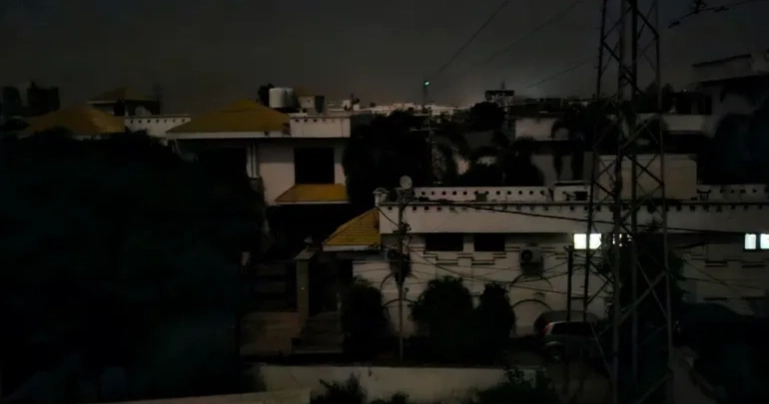
Millions of people in cities along India’s border and in Indian-administered Kashmir are living in fear as blackouts and explosions shake their communities.
New Delhi, India — Aqib Parray, a resident of Jammu in Indian-administered Kashmir, was standing at a local shop near his home when the power suddenly went out late on Thursday, May 8. Moments later, loud explosions echoed in the air.
Parry recalled the panic that swept through the streets as people rushed to their homes. “From my rooftop, I saw missiles streaking across the sky,” he said, describing the scene. “Then the internet went out. We’ve never seen anything like this in Jammu.”
For two generations of Indians and Pakistanis, the sight of missiles in the sky and the threat of war—coupled with blackouts and the looming danger of missiles, even far from the frontlines—was unprecedented. In 1999, the two countries fought over the contested Kargil region, but the conflict was contained.
Now, as tensions escalate between India and Pakistan, millions of people in both countries are witnessing a situation they have never experienced before. This includes the 750,000 residents of Jammu, along with millions more in other cities that were struck on Thursday evening, according to the Indian government.
The Indian Ministry of Defence reported that eight missiles were fired from drones originating from Pakistan towards Jammu and surrounding areas, including Satwari, Samba, Udhampur, and even targets in Pathankot, Punjab. India claims all missiles were intercepted, and no casualties were reported.
However, Pakistan’s Information Minister Attaullah Tarar denied any attacks on Indian-administered Kashmir or across the international border.
India and Pakistan trade fire and accusations as fears of a wider military confrontation rise
Despite official statements, the growing anxiety is palpable in cities near the frontier, particularly in Indian-administered Kashmir, following the death of 26 civilians in Pahalgam and two days after India launched missile strikes on several Pakistani cities. The threat of war looms heavy, especially in communities close to the border.
‘Sleepless Nights’
In Indian Punjab, authorities imposed blackouts in multiple districts, including Chandigarh, Jalandhar, Pathankot, and Mohali, after dusk. Sabarpreet Singh, a 46-year-old businessman from Amritsar, said he is struggling to cope with the situation. “Things are changing so fast. I haven’t been able to sleep. I’m thinking of leaving the city with my family—my wife and children are terrified when the sirens go off,” he said.
On the evening of Wednesday, a similar blackout was enforced in parts of Gujarat’s Kutch region and in border areas of Rajasthan, where the India-Pakistan frontier cuts through the Thar Desert.
The situation is even more dire along the Line of Control, the de facto border dividing disputed Kashmir between India and Pakistan. Both sides have exchanged heavy artillery, resulting in civilian casualties. India has evacuated thousands of residents, who now sleep in shelters at night.
“There were attempts to target military sites in Jammu, including the defense airport,” a local intelligence officer told Al Jazeera, requesting anonymity. “While we have confidence in our defense systems, the security situation is worsening. We are closely monitoring the situation.”
Praveen Donthi, a senior analyst at the International Crisis Group, explained that India's current unease is understandable. “After India struck deep inside Pakistan and Pakistani-administered Kashmir on May 7, killing at least 31 people—whom India labeled terrorists, but Pakistan called civilians—Pakistan is under immense pressure to retaliate,” he said. “The government and civil society in Pakistan were unwilling to de-escalate without a response.”
‘Senseless Belligerence’
On Thursday, New Delhi accused Pakistan of attempting to target military sites in several cities, including Srinagar and Amritsar, using drones and missiles. While Indian officials claimed to have “neutralized” these attacks, India retaliated by targeting Pakistan’s air defense systems in multiple locations, including Lahore, Pakistan’s second-largest city.
Pakistan’s military, however, stated that its air defense system brought down 25 Indian drones overnight, including in Lahore and Karachi. Pakistani officials confirmed at least one civilian death and five injuries.
Pakistan says it intercepted 25 Indian drones; India claims it neutralised attacks
Indian Foreign Secretary Vikram Misri reaffirmed that any future Pakistani attack would be met with a swift response from New Delhi. He insisted that India was merely acting in self-defense after the escalation initiated by Pakistan, which he identified as stemming from the Pahalgam attack.
Pakistan’s Ministry of Foreign Affairs denied any involvement in attacks on India or Indian-administered Kashmir and warned that any escalation based on false pretenses would be met with “full resolve and determination.”
Political scientist Sumantra Bose emphasized the urgent need for international intervention. “The situation requires immediate diplomatic action to prevent further escalation,” he said. “This conflict is senseless and has been poorly managed. It should never have escalated to this point.”
Bose warned that the situation was quickly spiraling out of control. “It is a continuous loop of retaliations from both sides. If this goes on, it could lead to an even greater conflict.”
US State Department spokesperson Tammy Bruce confirmed on Thursday that the US is actively engaged with both India and Pakistan at multiple levels. She acknowledged Pakistan’s call for an independent investigation into the Pahalgam attack, adding that the US supports efforts to hold the perpetrators accountable.
However, Indian Foreign Secretary Misri had already rejected calls for an independent investigation, citing a lack of confidence in Pakistan’s willingness to cooperate.
Praveen Donthi observed that the Trump administration, until May 7, appeared to be allowing the situation to play out without significant interference. He warned, “Unless the US and other global powers intervene more actively, the situation could spiral into a full-scale war.”
Tensions escalate as India, Pakistan exchange drone and missile strikes
Bose, for his part, argued that “it is already a state of war.” He added, “Things are quickly getting worse. The key decision-makers in both India and Pakistan must be compelled to stop this senseless belligerence and end the cycle of escalation before it’s too late.”
Source: With inputs from Al Jazeera