BNP Chairman Tarique Rahman on Saturday said law and order and corruption would be the two top priorities if his party forms the next government, saying that addressing these issues would help solve many other national challenges.
“Our first priority is to ensure law and order. People have said it, and you have said it too that everyone must feel safe on the streets. We have to make sure of that,” he said while interacting with the winners of a national reel-making competition titled ‘Amar Bhabnay Bangladesh’.
The BNP chairman said corruption must also be addressed in every possible way.
“There are different types of corruption at different levels. We have to deal with it in whatever form it exists. If we can properly address these two issues (law and order and corruption) many other problems will be solved to a large extent. This is my plan,” he said.
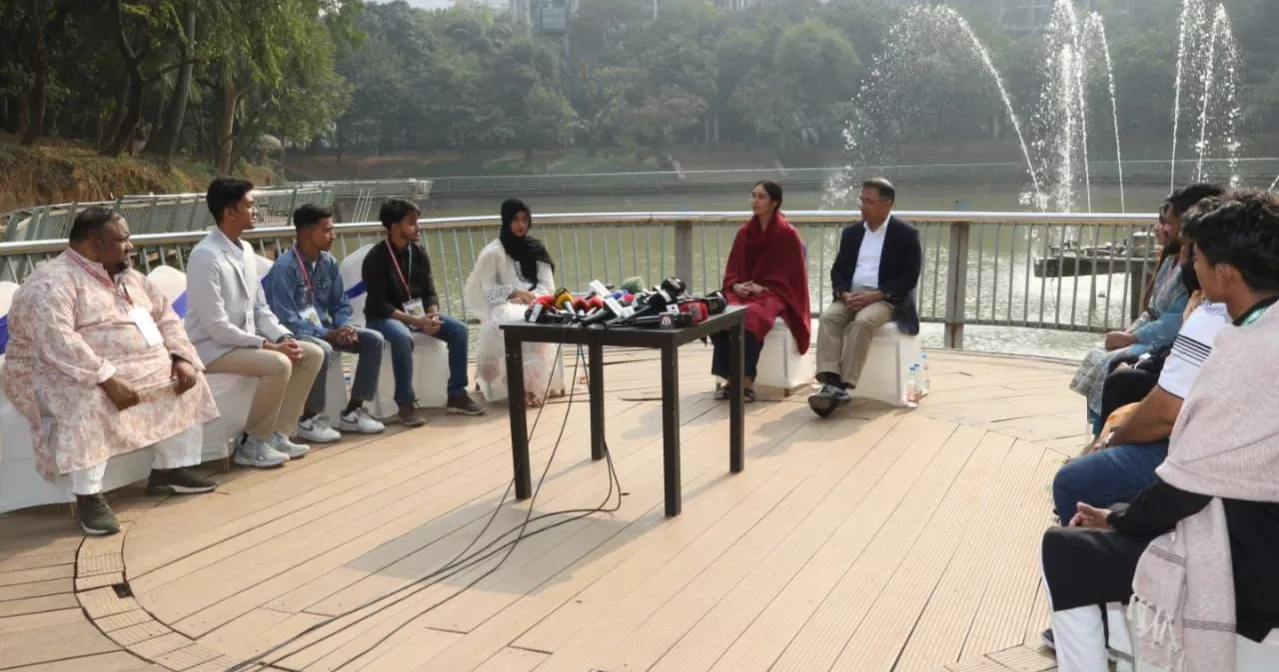
The interaction was held at an open space in Justice Shahabuddin Ahmed Park in the capital’s Gulshan area.
Tarique Rahman spoke with 10 winners of the national reel-making competition. His daughter, Barrister Zaima Rahman, was also present at the event.
During the session, the winners asked him various questions, and he responded in an open and friendly manner.
On the issue of BNP’s proposed Family Card, Tarique Rahman said the support would be universal, rather than limited to narrow categories.
Replying to a question, he said single mothers, including women whose husbands had left them or widows, will be brought under the proposed Family Card facility.
The BNP chief said the government currently runs around 138 social safety net programmes under different ministries and departments, but these are poorly coordinated, leading to misuse of resources.
As a result, he said, some people receive support from multiple schemes, while others receive nothing at all.
Tarique said his party wants to organise the welfare system through a family-based approach and make the Family Card universal, covering wives of farmers, van pullers and office workers.
He also said the system will be designed to keep benefit levels reasonable and reduce corruption as much as possible.
Replying to a question about online harassment and the lack of discussion on the issue in the media, Tarique said the issue should be viewed from a broader perspective, particularly through education and social values.
Referring to a reel made on education, he said it highlighted two important aspects, including the need to start value-based learning from the primary level.
To explain his point, the BNP chief shared an anecdote about a family he knew. “A 12- or 13-year-old boy once asked his father to wear a seat belt while travelling in a car, warning that his teacher had told students they should not ride with someone who ignored traffic rules.”
He said the incident showed how social values could influence behaviour when taught at an early age.
Tarique said schools must play a key role in teaching children social and moral values, which is why his party wants to put greater emphasis on primary education.
He also said focus will not be on constructing new multi-storey school buildings, but on using the budget to make primary school teachers more qualified by providing proper training.
According to him, such training will include academic instruction as well as lessons on social and religious values, so that children grow up with a strong sense of responsibility.
Tarique said the BNP’s proposed education reforms will include greater emphasis on sports, third language learning, arts, recitation, and cultural activities, which help children channel energy positively and reduce harmful digital engagement.
He also said four ministries--Education, Cultural Affairs, Science and Technology, and Youth & Sports –will be tasked to work jointly to implement such reforms. “We want to keep children productively engaged for around ten months of the year through competitions, sports and cultural programmes.”
Replying to a question about online harassment, Barrister Zaima Rahman said both girls and boys face harassment online. S
She highlighted the need for digital literacy, reporting systems and community structures to counter online harassment.
Zaima said it is important to understand how system hacking and reporting works and proposed setting up a proper reporting system, possibly with a community desk, so that incidents in local areas could be managed locally.
She said that if children are taught from an early age what is right and wrong, the problem of online harassment could be significantly reduced. “Everything needs to be done together,” she said.
At one-point Tarique said Zaima’s ideas are under consideration, though they are not yet included in the party’s plans.
He said some recent incidents seen on social media are deeply troubling, including one in which a dog was tied to a tree and beaten to death in a district in Bangladesh. “It is very sad. A helpless animal was tied up and beaten. What kind of behaviour is this?”
Tarique said BNP is thinking of introducing value-based education. “We are thinking whether to introduce it at primary or secondary level. The idea is to build social empathy and responsibility from a young age.”
He explained that students work in small teams to care for animals such as cows, goats, chickens, or dogs, and record their experiences. “
Responding to a question on Dhaka’s chronic traffic crisis, Tarique said the capital’s size, population density and concentration of facilities were major drivers of congestion.
He said part of BNP’s thinking involves building satellite towns around neighbouring districts such as Mymensingh, Manikganj, Munshiganj and Tangail, connected by fast rail links running at 60-70 miles per hour.
After two decades, Ctg’s Polo Ground awaits Tarique’s return
These towns will not require acquiring new land, the BNP chief said, but will expand existing district towns with adequate schools, healthcare, markets and security. “If living costs are lower and facilities exist, people will move voluntarily. This is how other countries eased mega-city pressure.”
On public transport, Tarique said experts he consulted suggested the adoption of monorail systems for neighbourhood connectivity, arguing they are cheaper and more flexible than large metro projects, and can be installed and removed more easily.
“This is not easy work, and it will take time. But it is not impossible. If we try, it can be done,” he said.
Tarique also said BNP is exploring whether Facebook can establish an office in Bangladesh, noting the importance of local engagement on digital governance and content issues.