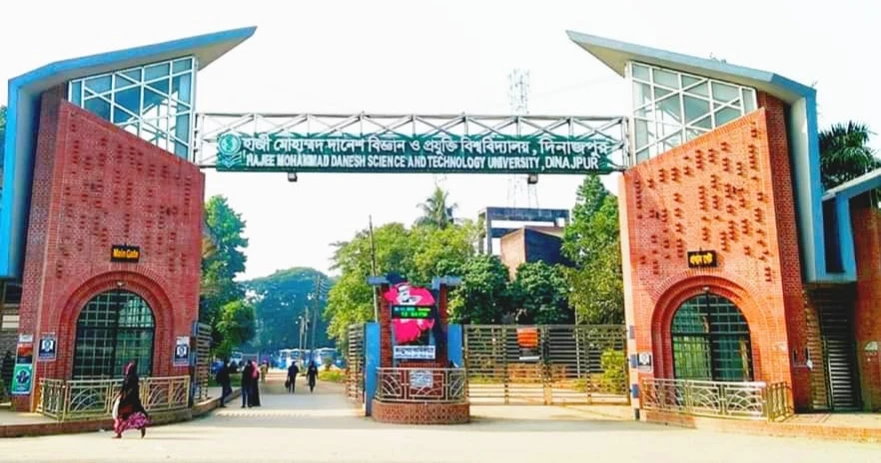
The government has taken up a Tk 576.96 crore development project for Hajee Mohammad Danesh Science and Technology University (HSTU) in northern Bangladesh, aiming to strengthen higher education, expand research capacity and improve campus facilities in line with international standards.
A major initiative has been undertaken to modernise infrastructure and enhance academic and research facilities at Hajee Mohammad Danesh Science and Technology University in Dinajpur.
The project, titled Development of Hajee Mohammad Danesh Science and Technology University, will be implemented under the Secondary and Higher Education Division, with the University Grants Commission (UGC) and the university jointly serving as implementing agencies.
Fully funded by government resources, the project will run from January 2026 to December 2028 in Dinajpur Sadar Upazila under Rangpur Division.
Officials said the initiative aims to establish modern, sustainable and technology-driven infrastructure to ensure improved academic and research facilities for both students and teachers.
Under the project, several key infrastructure facilities including a 12-storey male student dormitory, a 12-storey female student dormitory and a 12-storey academic building will be built.
The initiative also includes the procurement of modern laboratory instruments and research equipment to strengthen scientific research and academic activities at the university.
Besides, information and communication technology (ICT) equipment will be installed to support digital learning, research and administrative efficiency.
Officials involved in the project said universities in developing countries like Bangladesh must play a critical role in producing skilled human resources and advancing science and technology amid changing global economic dynamics.
Education Minister ANM Ehsanul Hoque Milon recently called upon the University Grants Commission of Bangladesh (UGC) to take effective steps to develop internationally competitive universities stressing that quality higher education and research are key to transforming Bangladesh into a knowledge-based nation.
They HSTU has long contributed to national educational goals, particularly through science and technology-based education, training and research.
A senior official of the Planning Ministry said the project would significantly improve the academic environment of the university.
“If implemented successfully, the project will help create modern and internationally recommended infrastructure facilities at the university, improving the quality of education, developing human resources and strengthening research capacity,” the official said.
The expanded residential facilities are expected to ease accommodation shortages on campus, while improved academic buildings and laboratories will help create a more conducive environment for teaching and learning.
Enhanced laboratory and ICT facilities will also support advanced research and innovation, particularly in science and technology disciplines.
Education experts say investments of this scale are crucial for public universities outside the capital to reduce regional disparities in higher education and attract talented students and faculty members.
Once completed, the project is expected to strengthen HSTU’s position as a research-oriented institution capable of contributing more effectively to Bangladesh’s long-term socio-economic development.
Located about 13 kilometres north of Dinajpur town along the highway connecting the district with Dhaka, HSTU is the first science and technology university in the northern region of Bangladesh.
The institution began its journey as the Agricultural Extension Training Institute (AETI), offering a three-year diploma in agriculture. It was later upgraded to Hajee Mohammad Danesh Agricultural College in 1988 under the affiliation of Bangladesh Agricultural University in Mymensingh.
HSTU penalises nine students for breaching code of conduct
The college was eventually elevated to the status of a university, admitting its first batch of students in the 1999–2000 academic session.
The act establishing the university was passed in parliament on July 8, 2001, followed by a gazette notification on April 8, 2002.
With the new development project, the university is expected to expand its academic capacity and play a stronger role in producing skilled graduates and advancing science and technology education in the country.