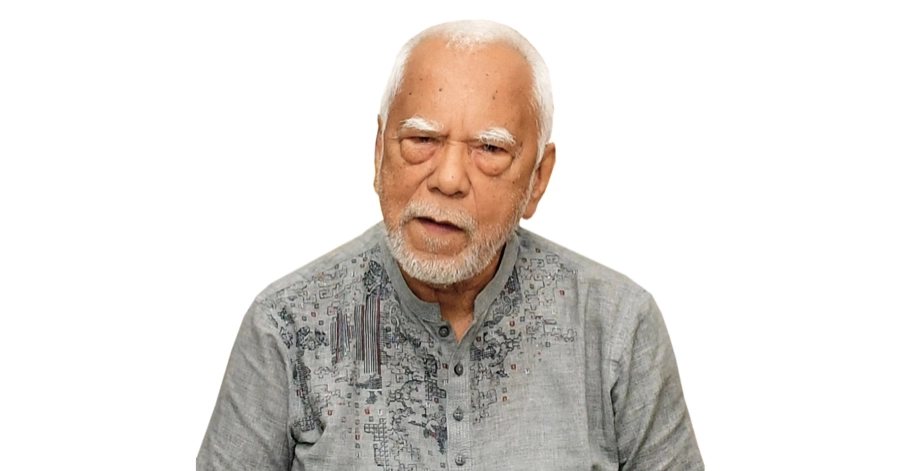
Eminent economist Professor Abu Ahmed has warned the country’s economy might witness depression due to the tight monetary policy of the central bank to fight inflation.
“This is not a good policy for our economy,” he said while talking to UNB over telephone.
He mentioned that Bangladesh Bank has increased the interest rate heavily aiming to control the inflation which was in the double digit recently.
“Investment has already been lowered along with lowering consumption, as a result the revenue collection has been dropped,” he said.
Abu Ahmed, who serves as director and chairman of the Investment Corporation of Bangladesh, clearly said that in the current scenario the revenue collection will not increase to the desired level.
“Economic gowth rate is downward, so far no investment, there is no employment generation,” he said.
He criticised central bank’s policy to contain inflation through increasing repo rate and interest rate.
“This step might work for the advanced economy, but this will not work in economies like Bangladesh,” he said.
The senior economist of the country said that this step of the central bank is causing irreparable loss to the country.
“This is also discredit for the government, which resulted in less revenue collection, reduced budget size. This is not a good policy for our country,” he added.
He suggested that the chief adviser sit with the finance adviser and Bangladesh Bank governor to fix the matter.
Economist Abu Ahmed questions logic behind complying with all IMF conditions
He also pointed out that due to this step the capital market of the country is suffering a lot.
“The root cause is this step of the central bank. This resulted in higher interest rate of the bond market that pushed money to flow there,” he said.
The Bangladesh Bank maintained its tight monetary policy for the January–June 2025 period, aiming to control persistent inflation, stabilise the foreign exchange market, and strengthen the banking sector.
In its latest Monetary Policy Statement (MPS), the central bank has kept the key policy (repo) rate unchanged at 10%, alongside maintaining the Standing Lending Facility (SLF) rate at 11.5% and the Standing Deposit Facility (SDF) rate at 8.5%, establishing a policy rate corridor of ±150 basis points.
Inflation has been a significant concern, with the rate peaking at 11.38% in November 2024 before easing to 9.94% in January 2025.
The central bank has set an inflation target of 7–8% by June 2025, anticipating that measures such as monetary-fiscal coordination, exchange rate stability, and increased agricultural production will contribute to achieving this goal.
To address exchange rate volatility, BB has continued implementing a crawling peg exchange rate mechanism, enhancing both flexibility and stability in the foreign exchange market.
The banking sector remains under pressure due to rising non-performing loans (NPLs) and sluggish credit growth. In response, the central bank is conducting asset quality reviews and pursuing the recovery of misappropriated assets to restore public confidence in the financial system.
Meanwhile, Bangladesh’s economic growth projections for the fiscal year 2024–25 (FY25) have been revised downward by major international financial institutions, reflecting the country’s ongoing economic challenges.
The International Monetary Fund (IMF) has adjusted its GDP growth forecast for Bangladesh to 3.76% for FY25, slightly down from its previous estimate of 3.8%. This revision marks the lowest growth rate since the COVID-19 pandemic in FY2019–20. The IMF attributes this slowdown to factors such as public unrest, flooding, and the impact of tighter monetary policies. However, it anticipates a rebound to 6.5% growth in FY26 as these issues are addressed and policies are relaxed.
The World Bank has also revised its growth projection for Bangladesh, now estimating a 3.3% increase in GDP for FY25, down from an earlier forecast of 4.1%. This adjustment represents the lowest growth rate in 36 years. The World Bank cites subdued investment, industrial activity, and heightened political uncertainty as key factors contributing to the economic slowdown.
Monetary Policy: Private sector unhappy with lower credit flow target
Similarly, the Asian Development Bank (ADB) has lowered its GDP growth forecast for Bangladesh to 3.9% for FY25, a decrease from its previous estimate of 5.1%. The ADB attributes this revision to weaker domestic demand amid ongoing political and economic challenges. Despite the slowdown, the ADB projects a recovery to 5.1% growth in FY26.
These downward revisions underscore the significant economic headwinds Bangladesh faces, including high inflation, political instability, and external shocks. The convergence of these factors has led to the most substantial growth slowdown in decades.
Nevertheless, all three institutions express cautious optimism for a medium-term recovery, contingent on the implementation of effective policy measures, restoration of investor confidence, and stabilization of the macroeconomic environment. The IMF and ADB, in particular, highlight the potential for growth acceleration in FY26, provided that current challenges are adequately addressed.
As Bangladesh navigates these economic challenges, the government’s commitment to structural reforms and prudent fiscal management will be crucial in restoring growth momentum and ensuring long-term economic stability.