
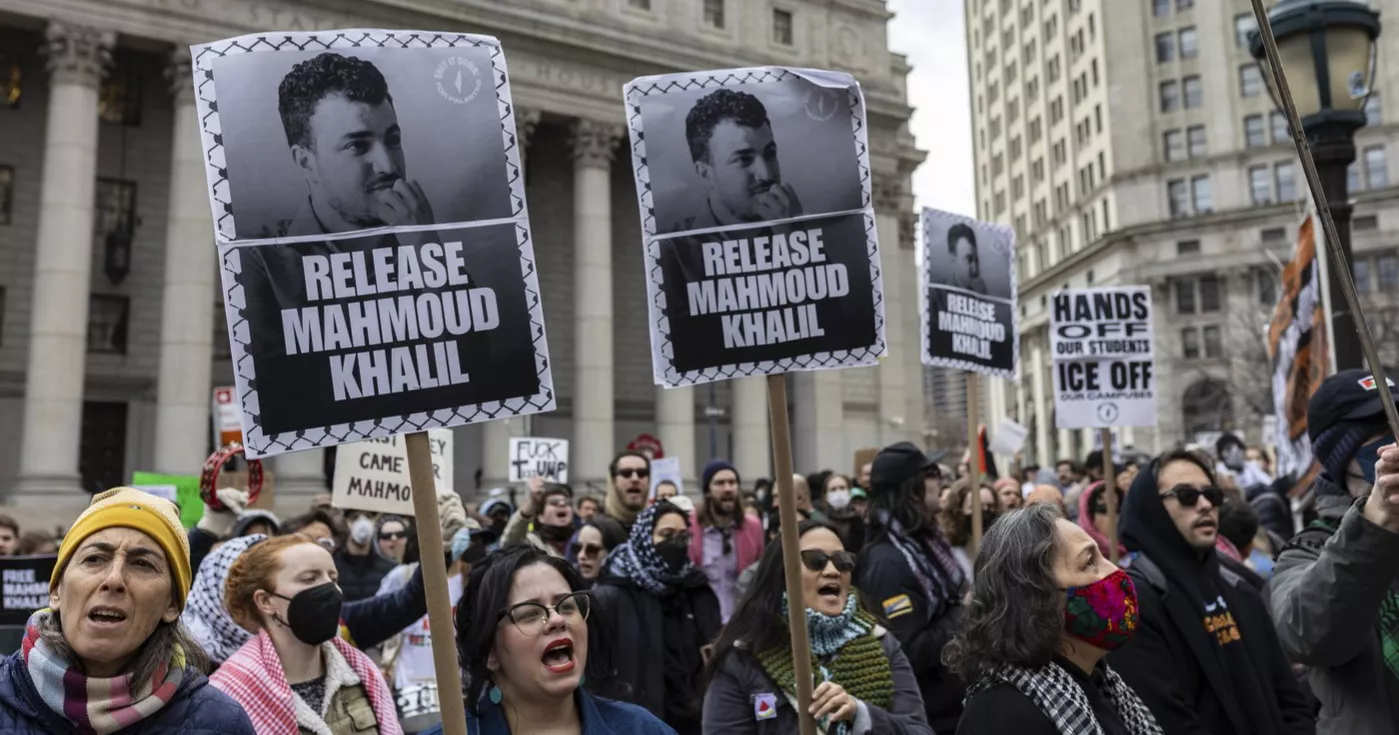
A federal trial is set to begin Monday over a lawsuit challenging the Trump administration's efforts to arrest and deport students and faculty who took part in pro-Palestinian protests and political activities.
The lawsuit, brought by several university associations against President Donald Trump and his administration, is among the first of its kind to reach trial. The plaintiffs are asking U.S. District Judge William Young to declare the policy unconstitutional, arguing that it violates both the First Amendment and the Administrative Procedure Act, which governs how federal agencies create and enforce regulations.
“The policy’s effects have been swift. Noncitizen students and faculty across the United States have been terrified into silence," the plaintiffs stated in their pretrial brief.
“Students and faculty are avoiding political protests, purging their social media, and withdrawing from public engagement with groups associated with pro-Palestinian viewpoints,” they added. “They’re abstaining from certain public writing and scholarship they would otherwise have pursued. They’re even self-censoring in the classroom.”
Several academics are expected to testify, explaining how the policy and related arrests have forced them to abandon their advocacy for Palestinian rights and their criticism of Israeli government policies.
Since Trump assumed office, immigration enforcement has increasingly targeted international students and scholars at American universities.
Trump and his administration have accused some demonstrators and others of being aligned with “pro-Hamas” sentiments, referring to the Palestinian militant group behind the October 7, 2023, attack on Israel. Protesters, however, have said their demonstrations focus on opposing Israel’s conduct in the war.
The plaintiffs name several activists in their complaint, including Palestinian activist and Columbia University graduate Mahmoud Khalil, who spent 104 days in federal immigration custody before being released last month. His detention has become emblematic of Trump’s broader crackdown on campus activism.
Israeli airstrikes kill 14 Palestinians in Gaza, another 10 people die seeking food
The case also mentions Tufts University student Rumeysa Ozturk, who spent six weeks in immigration detention after being arrested in a Boston suburb. Ozturk claims she was unlawfully detained following an op-ed she co-authored criticizing Tufts’ response to Israel’s actions in Gaza.
The lawsuit alleges that the Trump administration provided universities with lists of individuals to target, initiated surveillance of social media, and used Trump’s own public remarks — including his statement after Khalil’s arrest that it was the “first arrest of many to come” — to back their claims.
The government has countered that the plaintiffs are challenging a policy that doesn't formally exist.
“They do not try to locate this program in any statute, regulation, rule, or directive. They do not allege that it is written down anywhere. And they do not even try to identify its specific terms and substance,” the government stated in court filings. “That is all unsurprising, because no such policy exists.”
Officials also argue that the plaintiffs misunderstand how the First Amendment applies in the context of immigration, noting that constitutional protections differ for noncitizens under established Supreme Court precedent.
In response, plaintiffs maintain that evidence presented at trial will show the administration implemented the policy in multiple ways, including formal guidance on revoking visas and green cards and creating mechanisms to identify those involved in pro-Palestinian demonstrations.
"Defendants have described their policy, defended it, and taken political credit for it," plaintiffs argued. “It is only now that the policy has been challenged that they say, incredibly, that the policy does not actually exist. But the evidence at trial will show that the policy’s existence is beyond cavil.”