color mystery
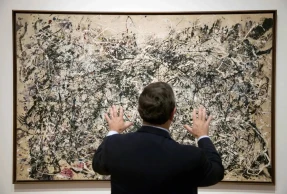
Researchers unravel color mystery in Jackson Pollock’s iconic painting
Scientists have finally solved a decades-old puzzle surrounding the origins of the striking turquoise blue in one of Jackson Pollock’s masterpieces. They confirmed that the abstract expressionist used a synthetic pigment known as manganese blue.
The breakthrough came from a new study published Monday in the Proceedings of the National Academy of Sciences. Researchers scraped samples of the blue paint from Pollock’s “Number 1A, 1948”, a nearly 9-foot-wide canvas now displayed at the Museum of Modern Art in New York, and analyzed them using lasers to measure molecular vibrations. The process produced a unique chemical fingerprint, identifying the pigment as manganese blue—the first confirmed evidence of Pollock using it.
The painting, which features Pollock’s trademark drips and splatters, also bears his handprints near the top. While scientists had previously identified the reds and yellows on the canvas, the source of the vivid turquoise remained elusive until now.
“It’s really interesting to understand where some striking color comes from on a molecular level,” said study co-author Edward Solomon of Stanford University.
Manganese blue, once popular among artists and even used to tint swimming pool cement, was phased out in the 1990s over environmental concerns. Earlier research had suggested Pollock’s turquoise could be manganese blue, but the new study confirms it directly from canvas samples.
Beyond identification, researchers examined the pigment’s chemical structure to understand how it produces such a vibrant hue. Experts say these studies not only preserve historic works but also help detect forgeries.
Because Pollock often poured paint directly onto canvas instead of mixing on a palette, scientists were able to access more precise samples for testing.
“I actually see a lot of similarities between the way we worked and the way that Jackson Pollock worked on the painting,” said Abed Haddad, co-author and assistant conservation scientist at MoMA.
Pollock, often described as chaotic, insisted his method was deliberate and structured—a view echoed by researchers who finally decoded one of the artist’s colorful mysteries.
1 year ago