Kim Jong Un’s daughter Kim Ju Ae
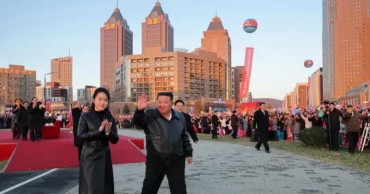
Debate grows over whether Kim Jong Un’s teenage daughter could succeed him
Speculation is mounting over whether North Korean leader Kim Jong Un is preparing his teenage daughter to become the country’s next ruler, following her increasingly prominent appearances alongside him at major state events.
The question gained fresh attention during North Korea’s recent ruling party congress, where Kim threatened Seoul and reaffirmed plans to expand the country’s sanctioned nuclear weapons programme. While no official announcement on succession was made, the visibility of his daughter, widely believed to be 13-year-old Kim Ju Ae, has fuelled debate among analysts and intelligence agencies.
South Korea’s intelligence service recently briefed lawmakers that it believes Kim has chosen his daughter as his heir, noting that she has been seen expressing views on policy matters. Although North Korea has never officially confirmed her name or age, she has appeared repeatedly in state media, often positioned at the centre of images and described using honorific language typically reserved for the supreme leader.
Kim Ju Ae first appeared publicly in 2022 during an inspection of a missile test, holding her father’s hand. Since then, she has accompanied him to military parades, weapons inspections and large public ceremonies, including the inauguration of new housing projects in Pyongyang’s Hwasong area.
Cheong Seong-chang, vice-president of the Sejong Institute and a long-time North Korea analyst, said the language and imagery used by state media point strongly to her being groomed as the official successor. He noted that senior military officers have been shown bowing or kneeling near her during events, underscoring efforts to associate her with the armed forces, the foundation of Kim Jong Un’s power.
Cheong believes Kim is deliberately introducing his daughter early to both elites and the public to avoid the abrupt transition that followed the death of his own father. Kim Jong Un appeared publicly only about a year before inheriting power in 2011.
There is no public indication that Kim Jong Un is suffering from serious health problems, but analysts say naming an heir early could help prevent internal power struggles in a tightly controlled system.
Others remain sceptical. Former North Korean diplomat Ryu Hyun-woo, who defected in 2019, argues that the country’s deeply patriarchal political culture makes it unlikely a woman would be accepted as supreme leader. While Ju Ae belongs to the ruling bloodline, Ryu says the system has historically favoured male successors, and female military commanders remain extremely rare.
Ryu believes Kim’s decision to showcase his daughter may be aimed more at softening his image and reinforcing the idea of continued dynastic rule than at signalling an imminent female succession.
However, some researchers point to social changes inside North Korea since the devastating famine of the 1990s, known as the Arduous March. During that period, women increasingly became breadwinners through informal markets and small businesses, gradually expanding their roles in society.
Song Hyun-jin, who has interviewed more than 120 North Korean defectors on women’s leadership, says it is no longer unusual to see women managing factories or holding party positions. Recent state television programmes have even depicted men doing housework, suggesting shifting social norms.
Song argues that if Kim Jong Un decides his daughter should rule, her gender is unlikely to be a decisive obstacle. Raised in privilege within a rigidly hierarchical system, she could be readily accepted by the population as part of what Song likens to a modern-day royal dynasty.
This week’s promotion of Kim Jong Un’s sister, Kim Yo Jong, to a senior propaganda role has further added to speculation. Analysts suggest she could act as a powerful guardian or regent figure should Kim Ju Ae be formally designated as heir.
Kim Jong Un assumed power at the age of 27, briefly raising hopes abroad that he might open up the isolated state. Those expectations faded quickly after he executed his uncle in 2013 and continued to tighten control while accelerating North Korea’s nuclear and missile programmes.
Analysts say there is little reason to expect a future leader from the same family, regardless of gender, would pursue a different path. Some believe the current debate itself may serve Kim Jong Un’s interests by reinforcing his centrality and the inevitability of hereditary rule.
As speculation continues, North Korea has offered no official confirmation, leaving the question of succession open while the leader’s teenage daughter remains firmly in the global spotlight.
With inputs from BBC
3 hours ago