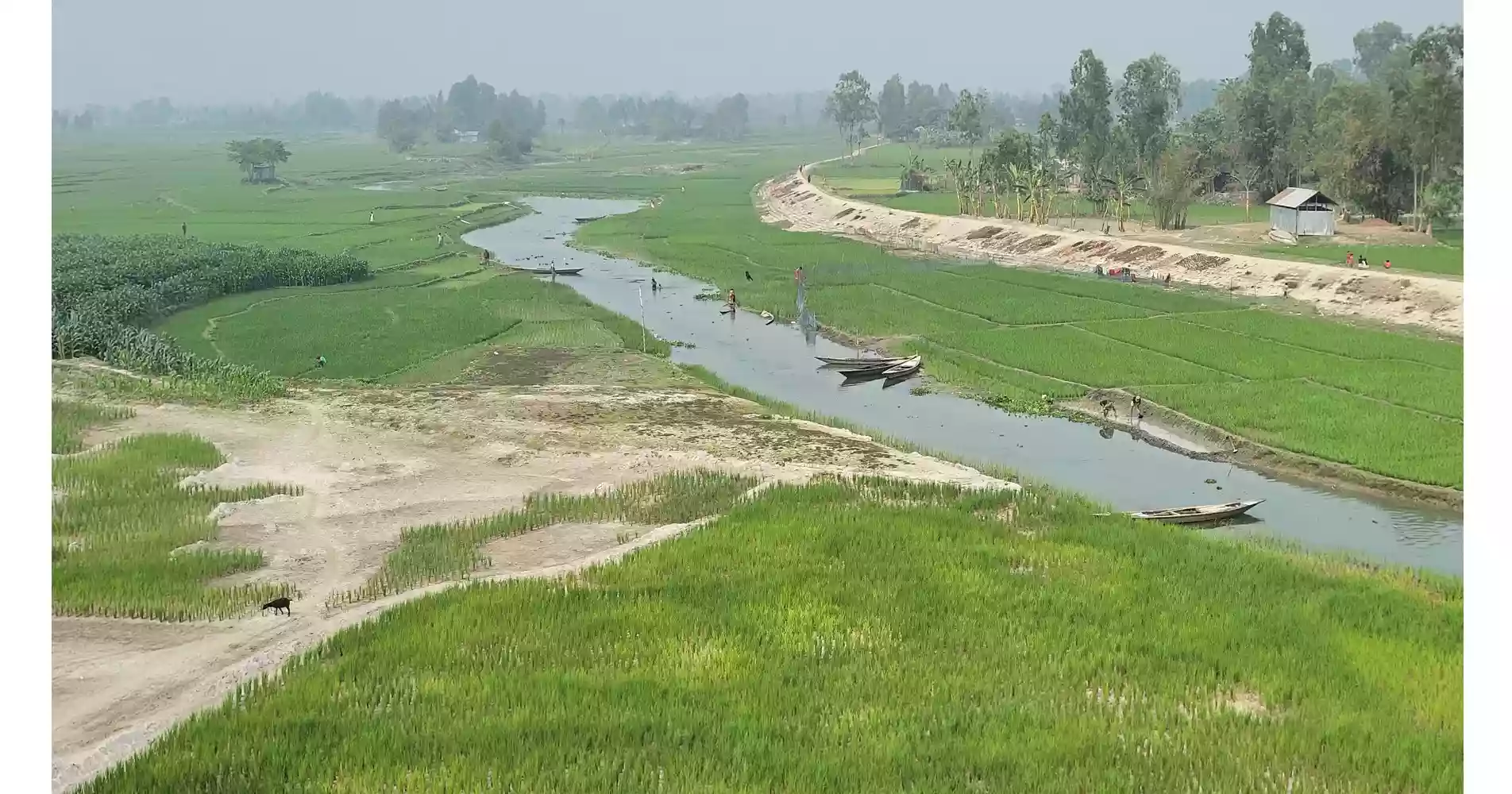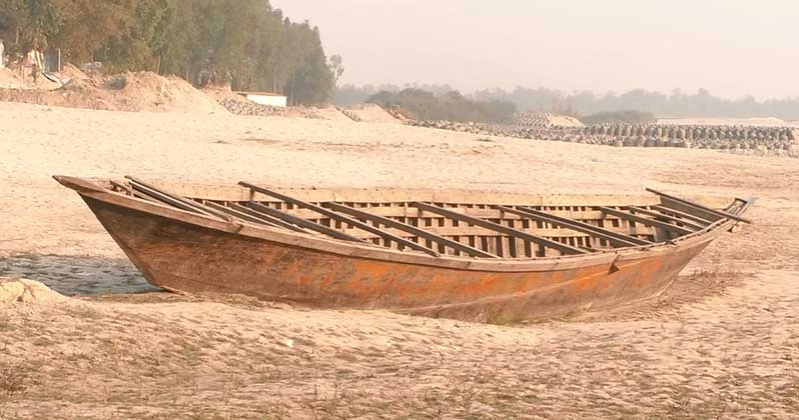
The once-turbulent Dharla and Baromasia rivers in northern Bangladesh have quietened, leaving behind scores of new river islands, or ‘chars,’ now turning green with crops.
The transformation has opened new opportunities for farmers but has sent ripples of concern through the local fishing community.
Over the past decade, climate change and sediment buildup have reduced the rivers’ navigability, exposing nearly 250 hectares of new char land in the floodplains.
Farmers in Phulbari Upazila, Kurigram district, are now growing boro rice, maize, tobacco, peanuts and other crops on these fertile riverbeds, creating a striking green landscape.
With water levels low, locals can now walk across stretches of river that were once navigable only by boat. Farming on these chars has been ongoing for the past 10 to 15 years, yielding good harvests annually.
Altaf Hossain and Mojibur Rahman, farmers from the Sonaikazi area along the Dharla river, recalled the river’s destructive past. This river once swallowed our homes and farmland, leaving countless people destitute, they said.
“Now it has dried up, and we are cultivating boro rice on the exposed riverbeds,” Altaf Hossain said, adding, “We expect to produce 25 to 28 maunds of rice per bigha this year. But rising production costs and fluctuating market prices pose a risk of loss.”
Local UP member Mozsed Ali said that farmers have long cultivated boro rice and maize on the Dharla char lands and remain optimistic about another good harvest.
Farmers along the Baromasia River, including Amzad Hossain, Rashid Mia, Chan Mia and Abdul Majid, said they have brought four to five bighas of land under maize cultivation.
They are hopeful for a bumper crop and favourable market prices, citing good weather conditions.
Yet, as farmers rejoice, fishermen face increasing hardship. Communities once reliant on the Dharla and surrounding rivers for fish such as boal, katla, rui, tengra and vetki are struggling. Reduced water flow and declining river depth have made these species increasingly scarce.
Nilufa Yasmin, Phulbari Upazila Agriculture Officer, said the target for boro cultivation this season was 10,205 hectares, of which 10,050 hectares have already been achieved.
Twelve hectares of boro rice have been planted in the catchment areas of the Dharla–Baromasia and Neelkamal rivers, she said.
Kurigram looks to new government for solutions to river erosion, jobs crisis