Campus
Six DU students injured at campus after being hit by car
At least six students of the Marketing Department of Dhaka University (DU) were injured after being hit by a private car in front of a gate near the Faculty of Business Studies (FBS) and Mal Chattar on the campus.
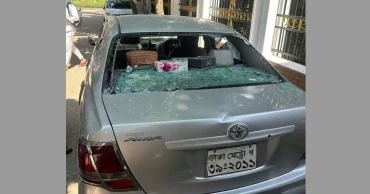
The accident occurred around 11:30am on Tuesday. The injured students were rescued and taken to Dhaka Medical College Hospital (DMCH). Angry students reportedly vandalized the car following the incident.
All six injured students are from the 2025-26 academic session of the university's Marketing Department. Eyewitnesses said some of them were in critical condition.
The car involved in the accident belongs to Professor Dr Md Shahidul Islam of DU's Department of Mathematics. His son, Sadman Sakib, was driving the vehicle.
According to eyewitnesses, Sadman was driving his father's car around the campus while learning to drive for the first time. At one point, as he reached the gate near the Faculty of Business Studies and Mal Chattar, the car hit students travelling in a rickshaw and others standing on the road, throwing them off and injuring them. Two of the injured students reportedly suffered cuts to their legs and were bleeding.
In a short video recorded after the incident, Sadman Sakib was heard saying, “I was driving a car for the first time today. While trying to brake, I mistakenly pressed the accelerator. I'm sorry.”
Fahim Rahman, a student of the Marketing Department's 2022-23 academic session and an eyewitness, said, “Hearing a loud noise, I came out onto the road and saw the car hit the rickshaw hard. The students inside the rickshaw were thrown out, and several of them were injured.”
Eyewitnesses said angry students beat two people who were in the car and vandalized the vehicle following the accident. Sadman Sakib was later taken to the university's proctor's office. Classmates of the injured students staged a sit-in outside the office, demanding justice.
DU Proctor Md IsrafiI Ratan confirmed the accident, saying several students had been injured and given primary treatment.
He also said the driver did not have a driving licence at the time of the accident. Sadman was still at the proctor's office, he added, assuring that the punishment prescribed by law for such incidents would be ensured.
Professor Dr Md Shahidul Islam, Sadman's father, said, “I will accept whatever decision the university administration makes.”
1 day ago
CUET VC enters office after breaking padlock amid student protests
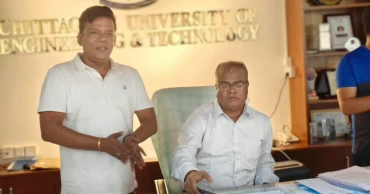
Newly appointed Vice-Chancellor of Chittagong University of Engineering and Technology (CUET) Professor Sheikh Shariful Alam entered his office on Monday morning after breaking a padlock on the office gate amid an ongoing indefinite shutdown enforced by students.
The VC arrived on the campus around 9:45 am and entered his office after breaking the lock.
The protesting students expressed anger over his entry and reiterated their refusal to accept him as VC.
Afif Kabir, a third-year student of the Department of Electrical and Electronic Engineering, said reinstating former Vice-Chancellor Prof Dr Abu Shadat Muhammad Sayem is one of their key demands.
3 days ago
Fuel oil, coal, and liquid fertilizer to be poduced from human waste
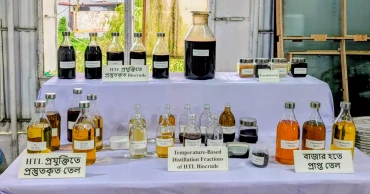
Researchers at Khulna University of Engineering & Technology (KUET) have unlocked the potential to produce fuel oil, coal, and liquid fertilizer from human waste.
With their developed technology, it is possible to process one ton of human waste to produce approximately 60 to 70 liters of fuel oil and 45 to 50 kilograms of coal. The researchers also stated that liquid fertilizer can be produced through the same process by recovering nitrogen, phosphorus, and organic components from the waste followed by necessary purification.
The research team claims that no part of the waste remains unusable in this technology. As a result, alongside human waste management, opportunities are being created for the production of energy and agricultural inputs. They view this research as a "zero-waste technology."
Led by Dr. Md. Khalekuzzaman, Professor of the Department of Civil Engineering at KUET, the research has been conducted continuously since March 2016. Although the work initially began as academic research, it later became more structured and evolved into the "Sludge to Oil" project. The project officially commenced in April 2022.
During the formal research phase of the "Sludge to Oil" project, the primary government funding agency was the Bangladesh Energy and Power Research Council under the Ministry of Power, Energy and Mineral Resources. The budget for this project was approximately 20.7 million BDT (2 crore 7 lakh taka).
In addition, two projects titled "Sludge to Asphalt" and "Multi-Stage Co-HTL" were implemented with funding from ITN-BUET and the Bill & Melinda Gates Foundation. Conducted from 2023 to 2025, the total budget for these projects was approximately 4.3 million BDT (43 lakh taka).
Currently, the research is being conducted on a broader scale under the "Bangladesh Biorefinery and Biocrude Innovation Centre." It is operating under sub-project number 13733 of the Higher Education Acceleration and Transformation Project of the University Grants Commission. The Higher Education Acceleration and Transformation Program is jointly funded by the Government of Bangladesh and the World Bank.
The current project has a budget of approximately 56.7 million BDT (5 crore 67 lakh taka) and a tenure running until June 2028. Furthermore, the researchers mentioned that discussions are underway with the Bangladesh Energy and Power Research Council regarding another project worth approximately 50 million BDT (5 crore taka) for laboratory development.
How Much Oil per Ton of Waste
Through the technology developed by the researchers, human waste is processed under high temperature and pressure to be converted into bio-crude oil. Waste drying is not required in this process; consequently, wet human waste can be processed directly.
According to the data provided by the researchers, it is possible to obtain approximately 60 to 70 liters of fuel oil from every ton of human waste. From the same amount of waste, about 45 to 50 kilograms of coal can also be produced.
However, the process is not limited to oil and coal production alone. After separating the oil and solid fraction, it is possible to recover nitrogen, phosphorus, and various organic compounds from the remaining aqueous phase. Following necessary purification, there is an opportunity to use these elements to produce liquid fertilizer.
In other words, after processing one ton of human waste, there is the potential to obtain fuel oil on one hand, and coal as well as liquid fertilizer from the aqueous phase on the other. In the words of the researchers, the entire process is designed in such a way that no major portion is discarded as waste again.
The initial economic analysis by the researchers also presents an encouraging outlook. According to data from the current experimental stage, they estimate that if production is scaled to a commercial level, it may be possible to keep the production cost per liter of fuel oil under 100 BDT.
However, this is not yet the final commercial production cost. The actual cost will be determined after long-term production in a pilot plant, taking into account large-scale production, raw material collection, transportation, electricity and heat demand, machinery costs, and other operational expenses.
According to the researchers, if approximately 25 to 50 percent of the country's suitable waste can be brought under this technology, it could contribute to meeting an estimated 10 to 30 percent of national energy demand.
Along with reducing dependence on fuel imports, this holds the potential to save foreign currency equivalent to approximately 65 billion to 130 billion BDT (6,500 crore to 13,000 crore taka) annually.
Nonetheless, this calculation will depend on how much waste can be collected nationwide, how much of it can be brought under the technology, and how efficiently commercial-scale production can be executed.
From Laboratory to Pilot Plant
As an essential next step in the research, plans are in place to establish a continuous pilot plant capable of processing 1 to 3 tons of waste per day. Based on the researchers' current estimates, an investment of approximately 1 billion to 1.2 billion BDT (100 to 120 crore taka) may be required to set up such a commercial-standard plant.
Once this plant is established, the technology will be operated continuously for 12 to 18 months to verify its efficacy. At the same time, production costs, energy efficiency, safety, equipment durability, and regular operational capacity will be tested.
The researchers' blueprint also includes a mechanism to preheat the waste using solar thermal energy prior to processing. Through this, a portion of the heat required in the production process can be supplied from a renewable source. As a result, there is potential to further reduce overall production costs and energy demand.
In the long run, large-scale commercial plant designs and investment plans will be formulated based on the results of the pilot plant. If successful, opportunities could emerge to establish such plants across various regions through public-private partnerships (PPP) and private investments.
From Waste to Wealth
Enormous amounts of human waste, sewage treatment plant sludge, kitchen waste, and agricultural residues are generated daily in Bangladesh. If a large portion of this waste is not managed properly, it poses grave risks to the environment and public health.
The technology developed by the researchers utilizes that very waste as raw material. Alongside producing fuel oil and coal from human waste, the opportunity to generate agricultural liquid fertilizer from its aqueous portion creates the prospect of obtaining multiple products from the same waste source.
According to the researchers, if the technology succeeds at a commercial scale, it will alleviate waste management pressure on one hand and open up opportunities for local energy production on the other. Concurrently, it holds the potential to create new employment, advance domestic machinery and engineering industries, and foster a new waste-based industrial sector.
Nevertheless, the researchers emphasize that moving from laboratory- and experimental-stage success to the commercial level requires more long-term testing. In particular, ensuring continuous large-scale production, determining actual production costs, verifying fuel quality, maintaining safety standards, and securing reliable raw material supply chains are now the most vital tasks.
The "Made in Bangladesh" Hydrothermal Liquefaction (HTL) technology developed by KUET researchers shows the path toward converting human waste into a promising domestic source of fuel and agricultural inputs. Developed through local talent and engineering expertise, this technology, if commercially successful, can contribute to waste management, reduce reliance on energy imports, generate employment, and drive local industrial growth. What is needed now is to test production costs, fuel quality, and safety in a continuous pilot plant to advance the technology toward a large-scale reality.
4 days ago
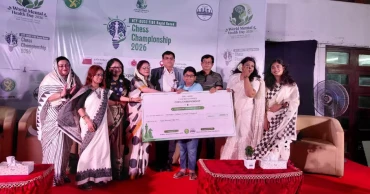
Chess competition held at DU marking World Mental Health Day
Brighter Tomorrow Foundation (BTF), a suicide prevention volunteer organization, and the Dhaka University Chess Club (DUCC) jointly organized a chess competition at Dhaka University on the occasion of World Mental Health Day 2026.
Around 100 students from different schools, colleges and universities took part in the daylong competition titled “BTF-DUCC FIDE Rapid Rated Chess Championship 2026” at the university’s Teacher-Student Centre (TSC) on Friday.
The event aimed to raise mental health awareness among young people and promote intellectual development and positive thinking.
The competition was held in two categories — university and school-college. The top 10 players in each category were awarded prizes based on their scores and final standings.
Brighter Tomorrow Foundation Founding President Joyshree Zaman presided over the prize-giving and closing ceremony held in the afternoon.
Among others, Bangladesh Chess Federation Vice-President and DIG Dr Shoeb Reaz Alam, the federation’s Senior Joint Secretary and FIDE Master Mehedi Hasan Parag, mental health specialist Dr Farzana Rahman, Inner Wheel Club of Lobelia President Sajeda Akter and DUCC President Fariha Sumona attended the event.
DUCC General Secretary Md Sajidul Islam moderated the program.
Speaking at the event, mental health specialist Dr Farzana Rahman said chess plays an important role in maintaining mental well-being and improving brain function.
Regular chess practice helps improve concentration, thinking abilities, problem-solving skills and decision-making capacity, she added.
In her presidential address, Joyshree Zaman said engaging in sports, recreation and cultural activities is essential for mental well-being. Creating a healthy and positive environment can help reduce depression among people, she said, adding that the competition was organized with this objective in mind.
Zaman said questions had been raised about the connection between sports and suicide prevention while working on mental health issues. However, she believes that encouraging positive and creative activities in everyday life is essential to ensuring mental well-being.
Calling for greater support for intellectual games like chess, she urged everyone not to overlook the importance of promoting such activities.
Addressing the participating students, Joyshree said life decisions should be made thoughtfully, much like moves in a chess game, to avoid serious consequences resulting from wrong choices.
Zaman also stressed the importance of rejecting suicide and depression and maintaining mental resilience.
Advising students not to keep their emotional distress to themselves, Zaman said, “Never keep your pain bottled up inside. Sharing it with someone can help you feel much lighter.”
5 days ago

DU IBA awards certificates to 22nd batch of ACBA program
Institute of Business Administration (IBA) of Dhaka University has held a certificate awarding ceremony for the 22nd batch of its Advanced Certificate in Business Administration (ACBA) program.
The certificates were handed over to 55 professionals who successfully completed the course at a ceremony held at the Nabab Nawab Ali Chowdhury Senate Bhaban on Friday evening.
Prof Dr Abdur Rab, former director of IBA and vice-chancellor of the International University of Business Agriculture and Technology (IUBAT), attended the event as the chief guest.
He emphasised the importance of leadership skills, integrity and continuous self-development in achieving professional success. He also urged the graduates to apply their acquired knowledge in their respective workplaces and play an effective role in organisational development.
In his presidential address, IBA Director Prof Dr Abu Yosuf Mohammed Abdullah said IBA was working to develop skilled managers and competent business leaders through quality executive education program. He also highlighted the important role of ACBA in enhancing the management knowledge and practical skills of professionals from different sectors.
Abedur Rahman Sikder, managing director of Combined Islamic Bank PLC and an alumnus of the second batch of ACBA, spoke as the guest of honour. He highlighted the long-term significance of executive education and the need for continuous learning for professional development.
ACBA program moderator Prof Dr Md Mohiuddin and co-moderator Prof Dr Md Iftekharul Amin were also present at the ceremony.
Organizers said the program is conducted under IBA's Management Development Program (MDP), with a minimum of five years of professional experience required for applicants. The participants of the 22nd batch had an average of more than 13 years of professional experience.
More than 350 applicants applied in November and December 2025, from whom 60 candidates were selected. Of them, 55 successfully completed all seven modules of the six-month course.
Participants were assessed in each module through assignments, quizzes, case-solving exercises and examinations. A minimum attendance rate of 70 per cent was mandatory.
IBA currently has more than 1,000 ACBA alumni, many of whom serve as chief executive officers (CEOs), managing directors (MDs), senior military officials and high-ranking officials in the civil administration.
5 days ago
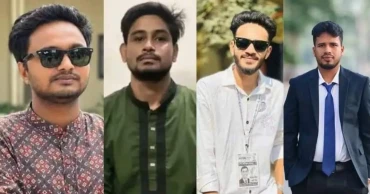
Attack on journos at RU: Probe panel recommends suspension of 4 students
A probe committee at Rajshahi University (RU) has recommended suspending four students over an attack on journalists at Shaheed Ziaur Rahman Hall.
The committee has also recommended further investigation into allegations against four other students before taking action and issuing warnings to three others.
A five-member probe committee was formed to identify those involved in the incident at Shaheed Ziaur Rahman Hall on October 4, said Vice-Chancellor Prof Dr Md Faridul Islam while reading out the investigation report to journalists at the VC's conference room on Friday.
The university administration received the probe report around midnight on Thursday, he added.
The probe panel recommended suspending Vice President of RU unit of Jatiyatabadi Chhatra Dal (JCD) Ahsan Habib, Joint General Secretary Hasibul Hasan, General Secretary of Ziaur Rahman Hall Students' Union Ariful Islam and JCD activist Bishal Chakraborty, the VC said.
He said the committee recommended further investigation into the allegations against Rakibul Islam, assistant cultural affairs secretary of the RU Central Students' Union (RUCSU); Takbir Ahmed Emon, vice president of RU unit JCD; Syed Sajharul Islam, joint general secretary; and JCD activist Tanim Rahman before taking action.
The committee also recommended issuing warnings to Bulbul Rahman and Shariful Islam, vice-presidents of the university unit of JCD, and Shahriar Alam, assistant office secretary.
On October 4, journalists came under attack while performing their professional duties in front of Shaheed Ziaur Rahman Hall on the campus.
At least 10 people, including four journalists, were injured in the incident.
Following the attack, the university administration formed a five-member probe committee.
After a meeting with journalists, the VC directed the committee to submit its report within 72 hours.
6 days ago
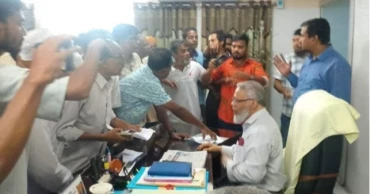
RMU VC, section officer allegedly forced to resign
Rajshahi Medical University (RMU) Vice-Chancellor Prof Dr Md Jawadul Haque and Section Officer Nazmul Hossain were allegedly forced to sign resignation letters on Tuesday.
Witnesses and the alleged victims said a group of people entered the university campus around 11am under the banner of “Apamor Chhatra-Janata” and forcibly entered the VC's office. They allegedly identified themselves as activists of Jubo Dal, although their identities could not be independently confirmed.
According to witnesses, the group accused the VC of being an “ally of the Awami League” and alleged that university work was being awarded to contractors from Dhaka. They allegedly assaulted the VC and section officer before forcing them to sign pre-written resignation letters.
After obtaining the signatures, the group allegedly forced them out of their rooms and locked the university's main gate.
Nazmul, who is also the VC's personal assistant, alleged that the group took away the computer CPU and equipment used to store CCTV footage from the VC's office. They also allegedly disconnected electricity and internet services across the campus.
Nazmul alleged that the VC was forced to sign a pre-written resignation letter and that he was also compelled to sign one. When he refused, he was beaten, Nazmul alleged.
Rajshahi Metropolitan Jubo Dal President Shariful Islam Jony, however, denied the involvement of any Jubo Dal leaders or activists in the incident.
He said he went to the spot after learning about the incident and collected video footage. None of those seen in the footage were associated with Jubo Dal, he claimed, adding that he did not know who they were.
Rajshahi Metropolitan Police Deputy Commissioner and spokesperson Md Gaziur Rahman said police were sent to the university after receiving information about the incident but found no one there.
He said that legal action would be taken if a complaint was submitted.
8 days ago
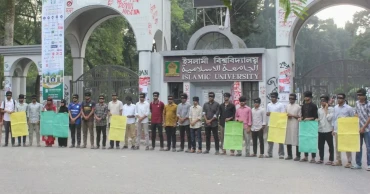
IU journos protest wearing black eye patches over attack on RU journalists
Journalists working at Islamic University in Kushtia on Monday formed a human chain protesting the attack on Rajshahi University Journalists allegedly by the Jatiyatabadi Chhatra Dal activists, student wing of the ruling BNP, demanding a safe environment for independent journalism.
The demonstration was held at the university's main gate, where 3 journalists’ organizations of IU including Islamic University Journalists’ Association, Press Club and Reporters’ Unity attended.
Protesting journalists displayed placards with various written slogans including 'Attacks on journalists are attacks on democracy,' 'Journalists will speak out against injustice, pens will move even if blood flows,' and 'Journalists are assets, have you forgotten?'
Among others, IU Journalists' Association President Niamatullah Munim, General Secretary Juel Rana, Press Club President Abir Hossain, General Secretary Nazmul Hussain, Reporters' Unity President Saqib Aslam, and General Secretary Rabiul Alam participated in the program alongside other campus journalists.
Earlier, the journalists’ organizations issued statements strongly condemning the incident. There they said that physical attacks, threats, and intimidation on campus journalists are threats to press freedom and journalists' safety.
They also demanded an impartial investigation to identify those involved in the RU incident and bring them to justice.
9 days ago

Attack on RU journos: DUJA warns against allowing JCD to get away with it again
Dhaka University Journalists’ Association (DUJA) has condemned the attack on the journalists at the Rajshahi University by Chhatra Dal and demand exemplary punishment against the involved, as well as an environment that ensures journalists can work safely on campuses.
DUJA’s president Manjur Hossain Mahi and secretary Liton Islam expressed the condemnation in a joint statement today.
The statement notes that on Sunday night, leaders and activists of Chhatra Dal attacked journalists with locally made weapons while they were performing their professional duties in front of the Shaheed Ziaur Rahman Hall at Rajshahi University. At least ten individuals participated in the attack, including M Ahsan Habib (Vice-President of the university unit), Hasibul Islam (Joint General Secretary), Shariful Islam (Vice-President), Shahriar Alam (Assistant Office Secretary), and activist Bishal Chakraborty.
“The journalists were brutally beaten with machetes, cleavers, hockey sticks, iron rods, and baseball bats, and attempts were made to snatch their mobile phones. At least ten people were injured in this reckless attack, including Arif-uz-Zaman Korban of bdnews24.com, Jahidul Islam of Daily Agamir Somoy, Noor Ahsan Mridul of The Daily Star, and Mainul Islam Raju of Daily Samakal,” the statement added.
DUJA leaders said, "We demand a speedy trial for this incident. If justice and accountability are not ensured following this attack, questions naturally arise regarding the performance of the relevant state institutions.”
Mentioning a past incident the statement said, “On April 23 of this year, at least ten members of DUJA were attacked by Chhatra Dal while performing their professional duties inside the Shahbagh Police Station. Although the Dhaka University administration formed an inquiry committee following the incident, more than five months have passed without the report being submitted or any visible action being taken. The Shahbagh police also did not register a case regarding the incident.”
Such impunity and procrastination not only delay justice but also increase the risk of similar incidents recurring in the future. The government, law enforcement agencies, and the university administration cannot in any way evade responsibility for this state of impunity, the statement mentioned.
The leaders said the failure to ensure justice and accountability for attacks on journalists undermines public expectations for a free, democratic Bangladesh after the July uprising. They called for prompt legal action and exemplary punishment against those involved in the Rajshahi University attack and urged authorities to ensure a safe, uninterrupted environment for journalists to perform their professional duties on all campuses.
10 days ago
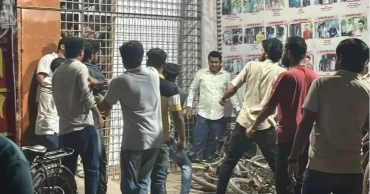
At least 4 journalists injured in attack by RU Chhatra Dal
At least four journalists were seriously injured in an alleged attack by leaders and activists of the ruling party BNP's student front, the Jatiyatabadi Chhatra Dal (JCD), on journalists and students at Rajshahi University on Sunday night.
The incident took place around 8:30pm in front of Shaheed Ziaur Rahman Hall.
The injured journalists were identified as Arifuzzaman Korban, university correspondent of bdnews24.com; Zahidul Islam of Agamir Shomoy; Noor Ahsan Mridul of The Daily Star; and Mainul Islam Raju of Samakal.
Around 10 other journalists and several students were also injured in the attack. The injured were receiving treatment at the university's medical centre.
Witnesses said JCD leaders and activists came to the hall gate from the university's Transport Market in a procession, allegedly intending to attack the hall parliament's General Secretary (GS) Ariful Islam.
They were reportedly carrying locally made weapons, including machetes, cleavers, hockey sticks, pipes and baseball bats.
When the university proctor arrived at the spot, the JCD activists allegedly hid the weapons. Journalists who approached the area to record video of the situation were then attacked.
Witnesses said a Samakal correspondent was beaten with sticks in the presence of the proctor, while an attempt was also made to seize the mobile phone of an Ajker Patrika correspondent. The bdnews24.com correspondent was later allegedly assaulted.
The proctor subsequently took the journalists inside the hall and locked the door for their safety.
When other journalists arrived after hearing about the attack, The Daily Star and Agamir Shomoy correspondents were allegedly beaten. Zahidul Islam suffered a head injury.
Journalists who tried to intervene were also allegedly threatened by the attackers.
The incident reportedly stemmed from a dispute over comments made by JCD leader Ahsan Habib on a Facebook post concerning Rajshahi University Central Students' Union (RUCSU) GS Salahuddin Ammar.
Habib alleged that Rakibul had made abusive comments about his mother and sister, while Rakibul claimed that Habib had threatened to beat him and asked about his whereabouts. Both later made posts on social media presenting their respective positions.
University Proctor Mahbubur Rahman said, “We failed. It was not possible for us to control the situation. We called the police, but the police also fled in fear.”
Rajshahi University unit JCD President Sultan Ahmed Rahi said he had informed the central committee of the incident and that action would be taken against those responsible.
10 days ago