Dhaka University

DU marks Messi’s birthday with flash mob, cake cutting
A flash mob and cake-cutting ceremony were held at Dhaka University (DU) on Wednesday marking the 39th birthday of Argentine soccer star Lionel Messi.
2 months ago
PM walks through DU campus to students’ cheers
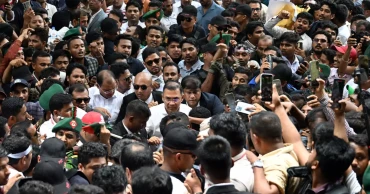
Prime Minister Tarique Rahman on Tuesday walked on foot from Dhaka University’s Nabab Nawab Ali Chowdhury Senate Bhaban to the Prof Muzaffar Ahmed Chowdhury Auditorium in the Faculty of Social Sciences, in an unprecedented moment in campus history.
The Prime Minister began walking shortly before 12:00pm after attending the inaugural session of a national workshop titled “Transforming Higher Education in Bangladesh: Roadmap to Sustainable Excellence,” organised by the University Grants Commission of Bangladesh at the Senate Bhaban.
Despite an official motorcade being prepared outside the Senate Bhaban, Tarique Rahman chose to walk to the Social Sciences Faculty building near the Arts building (Kala Bhaban) to join an interactive session with students.
As students saw the Prime Minister walking through the campus, many clapped their hands while others chanted slogans.
Prime Minister’s Press Secretary Saleh Shibly, who accompanied him during the walk, described the moment as historic. “This is not only a first in Bangladesh’s history, but also in the history of Dhaka University – a head of government walking through the campus so freely to attend an event. It is a rare incident,” he said.
He noted that previous visits by heads of government to the campus were often marked by protests, counter-slogans, or clashes. “However, there was no such scene today.”
Saleh Shibly said students in the hundreds gathered along the path, many applauding, chanting slogans, and waving at the Prime Minister as he made his way through the campus.
At the Prof Muzaffar Ahmed Chowdhury Auditorium, the Prime Minister took part in an open question-and-answer session with around 150 students, where he responded candidly to a range of academic and campus-related issues.
The event drew such an overwhelming response that many students, unable to find seats inside the auditorium, watched the Prime Minister’s live interaction on their mobile phones from different spots across the campus.
PM seeks students’ cooperation to maintain stability for nation-building
Prof Morshed Hasan Khan, convener of the event organising committee, described the Prime Minister’s walk as “remarkable history.”
“There has never been an example of any head of government walking through the university campus like this without a heavy security cordon. There were students of diverse views and ideological backgrounds. But their reaction was truly memorable.”
4 months ago
Facebook post triggers tension in Shahbagh as DUCSU leaders come under attack
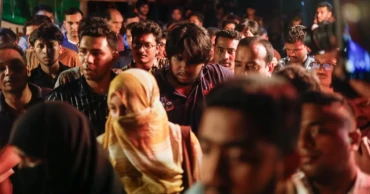
Tension gripped Shahbagh police station on Thursday evening following a clash between activists of Jatiyatabadi Chhatra Dal (JCD) and Dhaka University Central Students’ Union (DUCSU) leaders over a Facebook post.
Two DUCSU leaders elected from the panel backed by Islami Chhatra Shibir, were briefly left in a vulnerable situation before being escorted to safety by senior JCD leaders.
The incident involved DUCSU Literature and Cultural Affairs Secretary Musaddiq Ali Ibne Mohammad and Social Welfare Secretary Zubayer bin Nesari (A B Zubair).
4 months ago
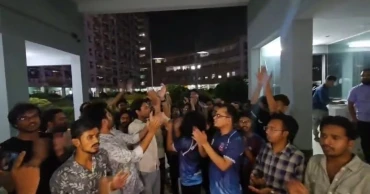
Six journalists harassed allegedly by JCD at DU
Jatiyatabadi Chhatra Dal (JCD) activists have allegedly harassed six journalists at Dhaka University (DU) in two separate incidents.
Three members of the DU Journalists’ Association (DUJA) were harassed while covering a tense situation at Bijoy Ekattor Hall on Wednesday evening over wall writing.
At that time, JCD activist Navid Anjum Nivan obstructed Prime Bangladesh’s DU correspondent Iftekhar Sohan Sifat from filming the episode.
Sifat said despite identifying himself as a journalist, Nivan said, “Just because you are a journalist does not mean you can record videos here.”
When two other DUJA members – Asaduzzaman Khan, correspondent of Daily Manab Zamin, and Harun Islam, correspondent of Naya Diganta – protested the incident, they were also harassed. The situation escalated at one point, but senior JCD leaders present intervened and brought it under control.
The incident reportedly began following an argument between JCD activists over wall writing in front of the hall parliament room.
In a separate incident at Dr Muhammad Shahidullah Hall around 1:00am on Thursday, three more journalists were harassed allegedly by the JCD men.
They encountered the situation while gathering information amid tensions between JCD and Islami Chhatra Shibir over wall writing at the hall.
Eyewitnesses said when three journalists entered a room in the hall just before the meeting began in the presence of the house tutor, they were asked to leave. At that time, several JCD activists approached them aggressively and issued threats.
DU correspondent of the Daily Observer, one of the victims, said, “Even after we identified ourselves, we were told to leave terming us outsiders. Then several JCD people rushed towards us.”
He further alleged that though the house tutor was present during the incident, no effective steps were taken to ensure the journalists’ safety.
Following the first incident, JCD’s DU unit President Ganesh Chandra Roy Sahas, Office Secretary Mollik Wasi Uddin Tami, and other leaders visited the DUJA office to settle the matter. They expressed regret to the journalists and assured that such incidents would not occur in the future.
However, the back-to-back harassment of six journalists has raised concerns about the safety of journalists on campus. Members of the journalists’ association have demanded a proper investigation and action against those responsible.
4 months ago
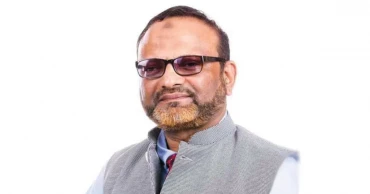
DU VC Niaz Ahmed Khan resigns
Dhaka University Vice-Chancellor (VC) Prof Niaz Ahmed Khan resigned on Sunday.
He submitted his resignation letter to Education Minister Dr A N M Ehsanul Haque Milon at the Ministry of Education in the morning.
Dr Niaz Ahmed also submitted an application to the President seeking to return to his original post as a Grade-1 Professor of Department of Development Studies.
During the meeting, the Education Minister sought his views on the university’s current and future challenges and ways to strengthen education and research.
Dr Khan briefed him on academic and research activities, campus security, and future plans, reaffirming his commitment to contribute to Dhaka University and the broader education sector.
The Education Minister thanked Dr Niaz Ahmed for his notable contributions to the university’s development during a critical period and extended best wishes.
Dr Khan announced his intention to resign during a special press conference on February 10, two days before the national election.
6 months ago
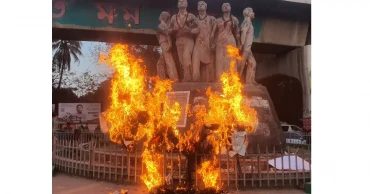
Effigies of adviser Sakhawat, BIDA’s Ashik, amongothers burnt at DU
Effigies of several individuals were burned at Dhaka University on Thursday in protest against the government’s move to lease the New Mooring Container Terminal (NCT) of Chittagong Port to foreign entities, branding them as “economic hitmen.”
The demonstration was held in the afternoon at the Raju Sculpture under the banner of “Aggrieved Student Community (Sangkhubdo Shikkarti Samaj).”
Effigies of Shipping Ministry Adviser M Sakhawat Hossain, the Chief Adviser’s Special Envoy for International Affairs Lutfey Siddiqi, Bangladesh Investment Development Authority (BIDA) Executive Chairman Ashik Chowdhury, and Chattogram Port Authority Chairman S M Moniruzzaman were set ablaze during the programme.
The protesters said the government must withdraw from any initiative to hand over control of Chattogram Port, described as a key pillar of Bangladesh’s national security, to foreign hands.
Mohiuddin Rahat, a 2019–20 session student of the Department of Criminology at Dhaka University, said the government is making excessive efforts just ahead of the election to lease the New Mooring Container Terminal to DP World.
“It appears as if the government believes its entire mission and vision will fail if it cannot hand over this port,” he said.
NCP officially launches election campaign from Dhaka University
He further alleged that four individuals within the Bangladesh government are attempting to lease the New Mooring Terminal to DP World in exchange for commissions from foreign companies, and that they have been lobbying extensively to hand over Chattogram Port to DP World.
7 months ago
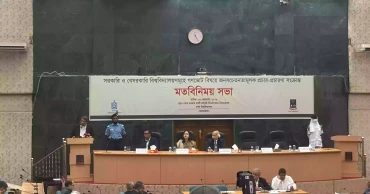
Every ‘July Charter’ word written in blood: Ali Riaz
Prof Ali Riaz, special assistant to the chief adviser, on Tuesday said the book of the July Charter presented to the public may be printed in black and white, but every single word of it has been written with the blood of the country’s people.
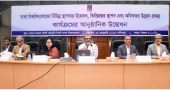
He made the remarks at an interactive meeting titled ‘Public Awareness Campaign on Referendum in Public and Private Universities’ held at the Nabab Nawab Ali Chowdhury Senate Building auditorium of Dhaka University.
Referring to the sacrifices of the July martyrs and injured, Ali Riaz said they did not seek to become prime minister or president; they wanted a dignified state. The July Charter, he said, is the recognition of that debt.
“Do we have no responsibility? Will we deny the debt that allows us to speak here today?” he asked, adding that acknowledging this debt is precisely what the July Charter represents.
He said the charter was prepared through discussions with political parties, civil society, various organisations, groups, and individuals. “When I open the book of the July Charter, I hear the cries of mothers who lost their children.”
Ali Riaz also discussed the context behind the abolition of the caretaker government system.
He said the July Charter includes safeguards to ensure that ‘one-person rule’ never returns to Bangladesh. “Everyone knows that the farce carried out in the name of three so-called elections in Bangladesh happened at the will of one individual. That became possible through the abolition of the caretaker government system.”
Referring to the 2014 Election Commission, he said, “The President staged another drama.”
He claimed that the name Kazi Rakibuddin Ahmad was not on the search committee’s list, yet he was appointed Chief Election Commissioner at the Prime Minister’s behest, leading to a rigged election in 2014. “No conscientious person with democratic aspirations can say that such a situation should continue.”
He said that through extensive dialogue, political parties have agreed in the July National Charter that future Election Commissions will be formed based on consultations among representatives of the ruling party, the main opposition party and the third party-the second-largest opposition party- in parliament.
Ali Riaz highlighted the role of the Public Service Commission during the previous regime and said that if the July Charter is implemented, the President will no longer hold unilateral authority to grant pardons.
He said the Constitution allows the ‘right to life’ to be violated during a state of emergency, but political parties have agreed that future emergencies will drop the term ‘internal disturbance’ and require cabinet approval with opposition representation.
Mentioning past instances of constitutional amendments made for the benefit of a single individual, he said that any future constitutional amendment would require a two-thirds majority in the parliament, followed by the support of at least 51 members of a 100-member upper house.
He also spoke about reforms related to the presidential election and changes to Article 70. “The situation created by forcing public representatives into party servitude has meant that our parliament has not even become a debating club,” he said.
Awami League must face trial, seek apology before returning to politics: Ali Riaz
Ali Riaz said all political parties have agreed that out of the standing committees of the parliament, four key committees will be chaired by members from the opposition.
He urged all to work in support of the July Charter.
Those present included the Chief Adviser’s Special Assistant Monir Haidar, University Grants Commission Chairman Dr SMA Fayez, DU Pro-Vice-Chancellor Prof Dr Sayma Haque Bidisha, individuals injured in July, and vice-chancellors, teachers, students and officials from various universities.
7 months ago
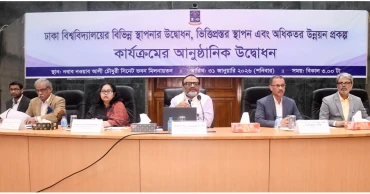
DU launches major development projects worth Tk 28.41 billion
Dhaka University (DU) has formally inaugurated activities under its large-scale development project with an estimated cost of Tk 28.41 billion, alongside several other development initiatives.
The inauguration ceremony was held on Saturday at the auditorium of the Nawab Nawab Ali Chowdhury Senate Building on the university campus. Vice-Chancellor Professor Dr. Niaz Ahmed Khan attended the event as the chief guest and officially launched the project activities.
The development projects include the construction of a 21-storey academic building for the Faculty of Earth and Environmental Sciences and the Faculty of Engineering and Technology, residential buildings for third-class employees, a 15-storey IT hub, nine halls (four for male students and five for female students), six academic buildings, a central mosque, DUCSU building, medical centre, administrative building, gymnasium and playground development, renovation and beautification of water bodies, road network development, and the construction of public toilets.
Read More: NCP officially launches election campaign from Dhaka University
During the event, the Vice-Chancellor also briefed journalists on 41 major activities and achievements of the university administration carried out between August 2024 and January 2026.
The programme was presided over by DU Treasurer Professor Dr. M. Jahangir Alam Chowdhury. Among others present at the event were Pro-Vice-Chancellor (Admin) Professor Dr. Sayema Haque Bidisha, Proctor Professor Saifuddin Ahmed, deans of all faculties, provosts of all residential halls, and leaders of DUCSU and hall unions.
Mohammad Jabed Alam Mridha, Acting Director of the Planning and Development Office, presented an overview of the ongoing and proposed development project activities.
Read More: Dhaka University to begin online classes from tomorrow
7 months ago

NCP officially launches election campaign from Dhaka University
The National Citizen Party (NCP) officially kicked off its election campaign on Thursday afternoon by paying respect at the graves of the Three National Leaders, Huseyn Shaheed Suhrawardy, Khawaja Nazimuddin, and Sher-e-Bangla A.K. Fazlul Huq, located near Doel Chattar of Dhaka University.
Following this, party leaders visited the graves of National Poet Kazi Nazrul Islam and Osman Hadi, situated adjacent to the Dhaka University Central Mosque.
The event was attended by the NCP Convener Nahid Islam, as well as Nasir Uddin Patwari, a candidate for the Dhaka-8 constituency.
Speaking at the venue, Nahid Islam noted that Dhaka University was the starting point for the Language Movement, the Liberation War, and the mass uprising of 2024. Consequently, the NCP chose this historic site to begin its electoral journey.
Ameer-e-Jamaat launches campaign for Dhaka-15 in Mirpur
"We want the election to be held on February 12 at any cost," Nahid Islam stated. "Our sole agenda now is to win that election and represent the people in Parliament."
He further alleged that the Election Commission (EC) is failing to maintain neutrality under the current government’s influence. "We have repeatedly pointed out that the Commission is not acting impartially. They are granting special privileges to a particular party. While that party has been campaigning for several days despite it being against the rules, the EC served us a show-cause notice for campaigning in favor of a referendum. We demand true neutrality, yet we are determined to move forward regardless of these obstacles."
Nahid Islam emphasized that the NCP remains as steadfast regarding elections and referendums as it has been regarding reforms and justice. "We will do whatever is necessary to ensure a fair election on February 12. We expect the 10-party electoral alliance to win by a landslide and form the government," he added.
He asserted that the general public is with them and that there is no alternative to a victory for the 10-party alliance to carry forward the spirit of the July uprising and the momentum of national reform.
Urging the nation to support the alliance, he said, "We have 30 candidates across the country. I call upon the people to elect them under the 'Shaplakoli' symbol. In Parliament, the NCP and the 10-party alliance will be the voice of the common people, the mass uprising, national reform, and our country's sovereignty."
7 months ago

Paws and play take over TSC as DU holds first pet carnival
Wagging tails, curious whiskers and smiling faces filled the Dhaka University Teacher-Student Centre (TSC) on Tuesday afternoon (January 20, 2026) as the campus hosted its first-ever Pet Carnival, turning the iconic spot into a lively celebration of companion animals.
Organised by Dhaka University Central Students’ Union (DUCSU) with support from the Ministry of Fisheries and Livestock, the colourful event brought together pet lovers and their furry friends for an afternoon of fun, learning and awareness.
Read more: US colleges welcome pets in dorms to ease students’ stress
7 months ago