Cuba
Cuba declares "international emergency" over U.S. tariff threat
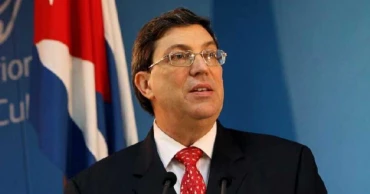
Cuba on Friday declared an "international emergency" in response to a U.S. executive order threatening tariffs on goods linked to Cuba.
Cuban Foreign Minister Bruno Rodriguez Parrilla said the situation represents an "unusual and extraordinary threat" originating largely from the "U.S. anti-Cuban neo-fascist right wing."
He added that the threat endangers not only national security and foreign policy but also international peace and human survival amid nuclear risks and climate change.
The executive order, signed by U.S. President Donald Trump on Thursday, warns of tariffs on countries that sell or supply oil to Cuba.
7 months ago
Trump threatens tariffs on countries supplying oil to Cuba, increasing pressure on Mexico
President Donald Trump on Thursday signed an executive order authorizing tariffs on goods from any nation that sells or provides oil to Cuba, a step that could further strain the island amid a worsening energy crisis.
The measure mainly targets Mexico, which has been a critical oil supplier to Cuba and has maintained ties with the island despite efforts by President Claudia Sheinbaum to foster a strong relationship with Trump.
When asked if he intended to “choke off” Cuba, which he called a “failing nation,” Trump replied, “I’m not trying to, but it looks like it’s something that’s just not going to be able to survive.”
Trump and Sheinbaum spoke by phone Thursday morning, though Sheinbaum said Cuba was not discussed. She noted that Mexico’s foreign affairs secretary had told U.S. Secretary of State Marco Rubio that continuing humanitarian aid to Cuba was important, and Mexico was ready to act as an intermediary between the U.S. and Havana.
Trump threatens 50% tariff on Canadian aircraft, escalating trade war
Speculation has grown this week that Mexico might reduce oil shipments under U.S. pressure. Cuba, facing an economic and energy crisis partly fueled by U.S. sanctions, has relied heavily on oil from allies such as Mexico, Russia, and Venezuela. Following a U.S. operation that ousted Venezuelan President Nicolás Maduro, Trump announced no Venezuelan oil would be sent to Cuba.
Mexico’s state oil company, Pemex, reported shipping nearly 20,000 barrels of oil per day to Cuba from January to September 2025, though experts tracking shipments via satellite say the amount has fallen to around 7,000 barrels.
Sheinbaum has provided ambiguous answers regarding the shipments. She said some deliveries had temporarily paused due to normal supply fluctuations, calling the decision “sovereign” and not influenced by the U.S., while maintaining that Mexico would continue supporting Cuba. She emphasized that contracts with Pemex largely determine shipment schedules.
Trump orders reopening of Venezuela commercial airspace, signals travel resumption
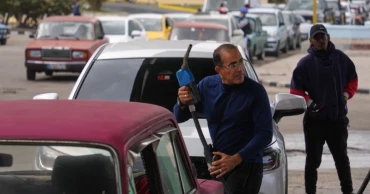
The uncertainty highlights the intense pressure on Mexico and other Latin American nations as Trump escalates his confrontational stance following the Venezuela operation. It remains unclear how the executive order will affect Cuba, where long gasoline lines and growing anxiety underscore the island’s ongoing crisis. Cuban authorities did not immediately respond to requests for comment.
7 months ago

Trump moves to end protections for over 530,000 migrants from Cuba, Haiti, and others
The Trump administration has announced plans to end the temporary legal status for more than half a million migrants from Cuba, Haiti, Nicaragua, and Venezuela.
According to a federal government notice, these migrants are being warned to leave the U.S. by April 24, when their permits and deportation protections will be revoked. The 530,000 individuals had entered the U.S. under a Biden-era sponsorship program, known as CHNV, designed to create legal migration pathways. However, Trump suspended the program when he took office.
It remains unclear how many of these migrants have secured alternative legal status allowing them to stay in the U.S. in the meantime. The CHNV program was launched by Democratic President Joe Biden in 2022, initially covering Venezuelans before expanding to other countries.
Trump plans to sign executive order for shutdown of US Education Department
The program permitted migrants and their immediate families to enter the U.S. if they had American sponsors, where they could stay for two years under temporary immigration status, called parole. The Biden administration argued that CHNV would help reduce illegal crossings at the U.S.-Mexico border while providing better vetting for migrants entering the country.
On Friday, the Department of Homeland Security (DHS) criticized the previous administration, stating that the program had failed in its objectives. The DHS said that Biden's officials "granted them [migrants] opportunities to compete for American jobs and undercut American workers; forced career civil servants to promote the programs even when fraud was identified; and then blamed Republicans in Congress for the chaos that ensued and the crime that followed."
Nevertheless, the 35-page notice in the Federal Register mentioned that some individuals in the U.S. under CHNV might be allowed to stay on a "case-by-case basis."
Trump is also contemplating whether to revoke the temporary legal status for approximately 240,000 Ukrainians who fled to the U.S. due to the ongoing conflict with Russia.
The CHNV program facilitated the entry of around 213,000 Haitians into the U.S. amid worsening conditions in Haiti, along with more than 120,700 Venezuelans, 110,900 Cubans, and over 93,000 Nicaraguans before Trump terminated the program.
In addition, last month, DHS announced plans to end another immigration program, temporary protected status (TPS), for 500,000 Haitians living in the U.S. starting in August. TPS was originally granted to nationals of countries facing unsafe conditions, such as armed conflict or environmental disasters.
DHS also suspended TPS for Venezuelans in the U.S., though this move is currently facing a legal challenge.
Since Trump took office, his immigration policies have faced numerous legal obstacles.
Source: BBC
1 year ago

Cuba’s faces massive blackout after major power plant failure
Cuba’s electrical grid went down Friday after one of the island’s major power plants failed, a day after a massive blackout swept across the Caribbean island and with no official estimate for when service will be restored.
The Cuban energy ministry announced that the grid had gone down hours after the Antonio Guiteras thermoelectric plant had ceased operations, at about 11 a.m. local time Friday. It said state-owned power company UNE was using distributed generation to provide power to some areas and that a gas-fired thermoelectric plant was starting operations.
Mexico's president slams US aid for Ukraine and sanctions on Venezuela and Cuba
But as darkness started to fall, millions of Cubans remained without power.
Even in a country accustomed to frequent outages amid a deepening economic crisis, Friday’s supply collapse was unprecedented in modern times, aside from incidents involving intense hurricanes, like one in 2022. Various calls by The Associated Press seeking to clarify the extent of the blackout on Friday weren’t answered. In addition to the Antonio Guiteras plant, Cuba has several others and it wasn’t immediately clear whether or not they remained functional.
“The power went out at 8 in the morning and it is now 5 in the afternoon and there is no electricity anywhere,” said Luis González, a 73-year-old retiree in Havana.
Early Friday, Prime Minister Manuel Marrero had sought to assuage concerned citizens about the blackout Thursday evening, which was already the nation's worst in at least two years.
Officials said that 1.64 gigawatts went offline during peak hours, about half the total demand at the time. Millions were left without power, and on Friday the government implemented emergency measures to slash demand, including suspending classes, shutting down some state-owned workplaces and canceling non-essential services.
“The situation has worsened in recent days,” Marrero said in a special address on national television in the early hours of Friday. “We must be fully transparent ... we have been halting economic activities to ensure energy for the population.”
During Marrero's address, he was accompanied by Alfredo López, the chief of UNE, who said the outage Thursday stemmed from increased demand from small- and medium-sized companies and residences’ air conditioners, as well as breakdowns in old thermoelectric plants that haven’t been properly maintained and the lack of fuel to operate some facilities.
Changes to electricity rates for small- and medium-sized companies, which have proliferated since they were first authorized by the communist government in 2021, are also being considered, Marrero said.
Marrero sought to provide reassurance about the outage, citing an expected influx of fuel supply from Cuba's state-owned oil company.
“We are devoting absolute priority to addressing and solving this highly sensitive energy contingency,” Cuba’s President Miguel Díaz-Canel wrote on X. “There will be no rest until its restoration.”
The blackout has left millions of Cubans on edge. Thursday night, residents shut their doors and windows they typically leave open at night, and candles or lanterns were visible inside their homes. By Friday night, there was no indication that a solution was imminent.
Prolonged electricity outages in the past have affected services like water supply and Yasunay Pérez, a Havana resident, said, with sarcasm, that she’s willing and able to bathe in the sea.
“We can use all our survival (skills),” she said.
1 year ago

Bangladesh for strong statement against interference in countries’ internal affairs at upcoming G-77 Summit
Bangladesh has stressed the need for strengthening the G-77 forum under the current presidency of Cuba and for coming up with a strong statement against interference in the internal affairs of other countries at the upcoming G-77 Summit.
The Summit will be held in Havana in September 2023 to promote and safeguard the interests of developing countries.
Bangladesh High Commissioner to Canada, Dr. Khalilur Rahman, presented his credentials — as concurrent Ambassador to the Republic of Cuba — to Cuban President Miguel Díaz-Canel Bermúdez at the Presidential Palace in Havana on Saturday (April 15, 2023).
The Ambassador received a guard of honour from the presidential guard at the palace.
Read more: Want security in the region but no defence pact: Momen on Indo-Pacific Strategy
After the presentation of the letters of credence, a discussion was held with the Cuban president in presence of Bruno Eduardo Rodríguez Parrilla, foreign minister of Cuba.
The president of Cuba highlighted the long-standing and friendly bilateral relations laid down by the Father of the Nation Bangabandhu Sheikh Mujibur Rahman and Cuban Revolutionary leader and its former president Fidel Castro.
He also highlighted the bond of existing friendship ever since diplomatic relations were established between the two countries. He deeply appreciated Bangladesh’s support to Cuba in different international organizations and looked forward to continuing collaboration between the two countries.
On his part, the ambassador also recalled the support of the Cuban people and its government led by the revolutionary leader Fidel Castro during Bangladesh’s war of liberation in 1971, and personal friendship between Bangabandhu and Castro.
Read more: US wants Bangladesh to set a strong example of free, fair election
The ambassador specifically mentioned that in recognition to the support to Liberation War by revolutionary leader Fidel Castro, the Government of Prime Minister Sheikh Hasina awarded him ‘Bangladesh Liberation War Honour’ on March 24, 2013.
3 years ago

Chess Olympiad: Bangladesh concede defeat by 2 points against Cuba
Bangladesh conceded a 1-3 game points defeat against Cuba in the 2nd round of the FIDE World Youth Under-16 Chess Olympiad held in the Nakhichevan Autonomous Republic of Azerbaijan on Monday.
In Monday's 2nd round, CM Manon Reja Neer of Bangladesh won against Gonzalez Soler Leduard Manuel of Cuba while three other Bangladeshi players --Jannatul Ferdousi, CM Sakline Mostafa Sajid and Md. Sajidul Haque lost to FM Hidalgo Diaz Daniel, Hernandez Izquierdo Jose A and Caballero Ramos Cuba respectively.
Read: World Youth Chess Olympiad: Bangladesh beat South Africa 3-1 points
Bangladesh is playing with Malaysia in the 3rd round on Tuesday.
Bangladesh team earned two points from two matches.
3 years ago

17 missing, 121 hurt as fire rages in Cuban oil tank farm
A fire set off by a lightning strike at an oil storage facility raged uncontrolled Saturday in the city of Matanzas, where four explosions and flames injured 121 people and left 17 firefighters missing, Cuban authorities said.
Firefighters and other specialists were still trying to quell the blaze at the Matanzas Supertanker Base, where the fire began during a thunderstorm Friday night, the Ministry of Energy and Mines tweeted. Authorities said about 800 people were evacuated from the Dubrocq neighborhood closest to the fire,
The government said it had asked for help from international experts in “friendly countries” with experience in the oil sector.
Deputy Foreign Minister Carlos Fernández de Cossío said the U.S. government had offered technical help to quell the blaze. On his Twitter account, he said the “proposal is in the hands of specialists for the due coordination.”
Minutes later, President Miguel Díaz-Canel thanked Mexico , Venezuela, Russia, Nicaragua, Argentina and Chile for their offers of help. The first support flights from Mexico and Venezuela were expected to arrive at Matanzas' airport Saturday night.
The official Cuban News Agency said lightning hit one tank, starting a fire, and the blaze later spread to a second tank. As military helicopters flew overhead dropping water on the blaze, dense column of black smoke billowed from the facility and spread westward more than 100 kilometers (62 miles) toward Havana.
Read:Supreme Leader acknowledges Iran took Greek oil tankers
Roberto de la Torre, head of fire operations in Matanzas, said firefighters were spraying water on intact tanks trying to keep them cool in hopes of preventing the fire from spreading.
Cuba's health minister reported late Saturday that 121 people were injured with five of them in critical condition. There were no deaths. The Presidency of the Republic said the 17 people missing were “firefighters who were in the nearest area trying to prevent the spread.”
The accident comes as Cuba struggles with fuel shortages. There was no immediate word on how much oil had burned or was in danger at the storage facility, which has eight giant tanks that hold oil used to fuel electricity generating plants.
“I was in the gym when I felt the first explosion. A column of smoke and terrible fire rose through the skies,” resident Adiel Gonzalez told The Associated Press by phone. “The city has a strong smell of sulfur.”
He said some people also decided to leave the Versailles district, which is a little farther from the tank farm than Dubrocq.
Many ambulances, police and fire engines were seen in the streets of Matanzas, a city with about 140,000 inhabitants that is on Matnzas Bay.
Local meteorologist Elier Pila showed satellite images of the area with a dense plume of black smoke moving from the point of the fire westward and reaching east to Havana.
“That plume can be close to 150 kilometers long,” Pila wrote on his Twitter account.
4 years ago

Desperate search for survivors in Cuba hotel blast; 27 dead
Relatives of the missing in Cuba’s capital desperately searched Saturday for victims of an explosion at one of Havana's most luxurious hotels that killed at least 27 people. They checked the morgue, hospitals and if unsuccessful, they returned to the partially collapsed Hotel Saratoga, where rescuers used dogs to hunt for survivors.
A natural gas leak was the apparent cause of Friday’s blast at the 96-room hotel. The 19th-century structure in the Old Havana neighborhood did not have any guests at the time because it was undergoing renovations ahead of a planned Tuesday reopening after being closed for two years during the pandemic.
On Saturday evening, Dr. Julio Guerra Izquierdo, chief of hospital services at the Ministry of Health, raised the death toll to 27 with 81 people injured. The dead included four children and a pregnant woman. Spain's President Pedro Sánchez said via Twitter that a Spanish tourist was among the dead and that another Spaniard was seriously injured.
Cuban authorities confirmed the tourist’s death and said her partner was injured. They were not staying at the hotel. Tourism Minister Dalila González said a Cuban-American tourist was also injured.
Representatives of Grupo de Turismo Gaviota SA, which owns the hotel, said during a news conference Saturday that 51 workers had been inside the hotel at the time, as well as two people working on renovations. Of those, 11 were killed, 13 remained missing and six were hospitalized.
González said the cause of the blast was still under investigation, but a large crane hoisted a charred gas tanker from the hotel's rubble early Saturday.
Search and rescue teams worked through the night and into Saturday, using ladders to descend through the rubble and twisted metal into the hotel’s basement as heavy machinery gingerly moved away piles of the building’s façade to allow access. Above, chunks of drywall dangled from wires, desks sat seemingly undisturbed inches from the void where the front of the building cleaved away.
READ: Rescuers look for victims at Cuba hotel after blast kills 25
At least one survivor was found early Saturday in the shattered ruins, and rescuers using search dogs clambered over huge chunks of concrete looking for more. Relatives of missing people remained at the site while others gathered at hospitals where the injured were being treated.
A desperate Yatmara Cobas stood outside the perimeter waiting for word of her daughter, 27-year-old housekeeper Shaidis Cobas.
“My daughter is in the Saratoga; she’s been there since 8 a.m. (Friday), and at this time I don’t know anything about her,” Cobas said. “She’s not at the morgue, she’s not in the hospital.” The mother said she had gone everywhere seeking answers from authorities, but coming up empty.
“I’m tired of the lies,” she said.
Gov. Reinaldo García Zapata said Saturday evening that 19 families have reported loved ones missing and that rescue efforts would continue.
Lt. Col. Enrique Peña briefed Comandante Ramiro Valdés, who fought alongside Fidel Castro, on the search efforts at the site. Peña said the presence of people had been detected on the first floor and in the basement and four teams of search dogs and handlers were working. He did not know if the victims were alive or dead.
“I don’t want to move from here,” Cristina Avellar told The Associated Press near the hotel.
Avellar was waiting for news of Odalys Barrera, a 57-year-old cashier who has worked at the hotel for five years. She is the godmother of Barrera’s daughters and considers her like a sister.
Neighbors were still in shock a day after the explosion.
“I thought it was a bomb,” said Guillermo Madan, a 73-year-old retiree, who lives just meters from the building, but was not injured. The three-decade resident of the neighborhood was cooking and watching television when he heard the blast. “My room moved from here to there. My neighbor’s window broke, the plates, everything.”
Katerine Marrero, 31, was shopping at the time. “I left the store, I felt the explosion,” she said. “Everyone started to run.”
Although no tourists were reported injured, the explosion is another blow to the country’s crucial tourism industry.
Even before the coronavirus pandemic kept tourists away from Cuba, the country was struggling with tightened sanctions imposed by former U.S. President Donald Trump and kept in place the Biden administration. Those limited visits by U.S. tourists to the islands and restricted remittances from Cubans in the U.S. to their families in Cuba.
Tourism had started to revive somewhat early this year, but the war in Ukraine deflated a boom of Russian visitors, who accounted for almost a third of the tourists arriving in Cuba last year.
A 300-student school next to the hotel was evacuated.
The emblematic hotel had a stunning view of Cuba's center, including the domed Capitol building about 110 yards (100 meters) away. The Capitol suffered broken glass and damaged masonry from the explosion.
The hotel was renovated in 2005 as part of the Cuban government’s revival of Old Havana and is owned by the Cuban military’s tourism business arm, Grupo de Turismo Gaviota SA. The company said it was investigating the cause of the blast and did not respond to an email from the AP seeking more details about the hotel and the renovation it was undergoing.
In the past, the Hotel Saratoga has been used by visiting VIPs and political figures, including high-ranking U.S. government delegations. Beyoncé and Jay-Z stayed there in 2013.
García Zapata said structures adjacent to the hotel were being evaluated, including two badly damaged apartment buildings. Díaz-Canel said families in affected buildings had been transferred to safer locations.
Mexican President Andrés Manuel López Obrador arrived in Havana for a visit late Saturday. He was scheduled to meet with Diaz Canel Sunday morning and return to Mexico Sunday night.
4 years ago
.jpg)
Cuba begins vaccinating children as young as 2
Sitting on her mother’s lap, 2-year-old Lucía looked at the illustrations in her book while around her several children watched the doctors in white coats and nurses with thermometers in amazement. In an adjoining room, Danielito, also 2, sniffled while getting a shot as a clown tried to distract him.
Cuba on Thursday began a massive vaccination campaign for children between the ages of 2 and 10, becoming one of the first nations to do so. Health officials here say Cuba’s homegrown vaccines have been found safe to give to young children.
“Our country would not put (infants) even at a minimal risk if the vaccines were not proven save and highly effective when put into children,” Aurolis Otaño, director of the Vedado Polyclinic University, told The Associated Press in a vaccination room.
Also read: UK OKs vaccines for 12 year olds, aims to avoid lockdowns
Otaño said the circulation of the Delta variant produced an increase in infections among the youngest, so Cuba’s scientific community decided to “take the vaccine to clinical trial” and it was approved for children.
The Polyclinic expects to vaccinate about 300 children between 2 and 5. Those between 5 and 10 are receiving their first shot at their schools.
Lucía’s mother, Denisse González, watched the children in the vaccination room while waiting the hour that her daughter had to be under observation after being vaccinated.
“I was very doubtful and worried at first, really, but I informed myself,” she said.
“Our children’s health is first and foremost, which is the main thing and (contagion) is a risk because young children are always playing on the floor,” added González, a 36-year-old engineer.
In previous weeks, the vaccination of Cubans between 11 and 18 began. The plan includes two doses of Soberana 02 vaccine and one of Soberana Plus, as was done with adults.
Cuba faces a persistent COVID-19 outbreak that almost collapsed its health-care system. Provinces such as Matanzas, Ciego de Ávila and Cienfuegos received support from doctors from other parts of the country and even from international donors.
Also read: Global vaccine disparity gets sharper amid talk of boosters
In addition to the Soberanas, Cuba has developed another national vaccine, Abdala. According to Cuba’s Ministry of Health, 776,125 positive cases of COVID-19 have been registered with 6,601 deaths.
In June, Chinese regulators approved the use of the Sinovac and Sinopharm vaccines for children ages 3 to 17. The United States and many European countries currently allow COVID-19 vaccinations for children 12 and older.
Children have largely escaped the worst of the pandemic and show less severe symptoms when they contract the virus. But experts say children can pass the virus on to others and suffer negative consequences.
“As more adults receive their COVID-19 vaccines, children, who are not yet eligible for vaccines in most countries, account for a higher percentage of hospitalizations and even deaths,” said Carissa F. Etienne, director of the Pan American Health Organization. “We must be clear: children and young people also face significant risks.”
5 years ago
Cubans wonder what's next after antigovernment protests
Less than a week after a rare series of antigovernment protests were broken up by police and government sympathizers, and elicited self-criticism from President Miguel Díaz-Canel, things appear calm in Cuba. But many wonder for how much longer.
Squares and parks were occupied by government sympathizers with flags on Friday, and the circulation of traffic and people was normalizing. But mobile internet data service – which authorities cut on Sunday – remained limited.
Read: Police patrol Havana in large numbers after rare protests
“There is political and social erosion ... There is a lot of disgust, we must talk more, do more things and things that were done wrong should be rectified,” said Abel Alba, a 50-year-old civil engineer. “The president has tried to smooth things over a bit” but he waited “too long” to listen to the demands of the people in the streets.
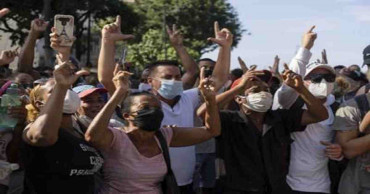
The protests began Sunday when thousands of Cubans marched on Havana’s Malecon promenade and elsewhere to protest food and medicine shortages, power outages and some even calling for political change. The protests continued in smaller numbers into Monday and Tuesday.
Díaz-Canel initially responded by looking for culprits, pointing to U.S. economic sanctions, the economic impact of the coronavirus pandemic and a social media campaign by Cuban American groups. But he later acknowledged some responsibility by Cuba’s leaders.
With this in mind, Cuban Cabinet ministers announced a mix of measures including permits for travelers to import food and medicine without limits and allowing the emergency registration of Cubans’ supply books by people outside their place of origin.
“The Cuban government has just shown that it could have allowed the entry of food and medicine without quantity limits or tariffs all along but chose not to do so for more than a year of the pandemic,” wrote José Jasan Nieves, director of the independent digital newspaper, El Toque. “People twisted their arms.”
Authorities reiterated their intentions to finish authorizing the operation of small and medium-sized companies as a source of employment as well as a program for state companies to pay more than the current salary scale.
What officials also made clear is that they are not willing to make changes to the island’s political model.
Street vendor Marlén Rodríguez, 66, was not optimistic following the government’s announcements. “There are no medicines, there is nothing, there is no food.”
According to Díaz-Canel, there were four sectors involved in the protests: radical supporters of the United States who waved that country’s flag during the protests and demanded a humanitarian intervention from Washington, criminal groups who took advantage of the situation to loot, people genuinely desperate due to the impact of the crisis on their daily lives and young who have no projects in society.
Read: Tropical Storm Elsa moving across west Cuba, then to Florida
The marches turned violent with police clashing with protesters, patrol cars being destroyed, shops looted, windows broken, stones thrown and violent arrests and injuries.
Some Cubans were upset by the vandalism and groups of government supporters took to the streets and clashed with protesters.
“They were coming down the Calzada de San Miguel (del Padrón) while we were going up. We tried to persuade them, but these comrades were violent and threw stones at us,” said Julio César Pérez, a Communist Party member and employee of the Ministry of Construction. He said several members of his group were injured in the brawl.
One government opponent died in the protests and the exact number of people arrested is not known. Government opponents have said on social media that the number is more than 100.
On Friday, the United Nations High Commissioner for Human Rights, Michelle Bachelet, called for release of the protesters.
The measures announced by the government “are positive measures, but they are insufficient,” said Cuban economist Omar Everleny Pérez.
“Without affecting the ideology, there is a lot of space in which the state can take action,” he said, mentioning permits for private entrepreneurs to import goods without going through the state monopoly, allowing foreign companies to install retail markets or raising the ceiling for agricultural prices in order to increase supply.
But political analysts said the economic challenges are great.
“I think the government is just trying to signal to people that it understands their desperation and that it’s going to try to alleviate some of the misery that they’re experiencing. The problem is that the government just doesn’t have much in the way of resources that it can devote to doing that,” said William LeoGrande, an expert on Cuba at the American University in the United States.
LeoGrande said the unrest in Cuba and the assassination of Haitian President Jovenel Moïse have put the Caribbean back on the agenda of U.S. President Joe Biden.
“There is no question that the demonstrations in Cuba and the assassination of Haiti’s president and the resulting unrest there have pushed the Caribbean to the top of President Biden’s foreign policy agenda, even though they would have preferred that it stayed on the back burner for a much longer time,” he said. “What the administration will do on Cuba is still very much up in the air.”
5 years ago