Argentina
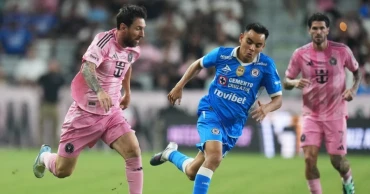
Argentina to give Messi a farewell match, his last in the shirt
One more time. That's it, that's all. Lionel Messi will wear the Argentina shirt once more, and then that's the end of it.
The plan had been rumored ever since Messi announced his international retirement last month: the Argentine Football Association (AFA) wanted him back for one home friendly during a FIFA window, so the fans who'd watched him for twenty years could actually be there to say goodbye. Now it's confirmed.
Argentina play Benin on October 6 at the Monumental in Buenos Aires — 85,000 seats, and Messi's name is on the squad list Lionel Scaloni released. It's his last game in the shirt.
AFA president Claudio Tapia put it plainly in a video message: the federation invited Messi so he'd get, in his words, "the proper farewell he deserves."
It's going to be a lot, that night. The AFA invited every player from the 2022 World Cup-winning squad, plus their families, and Tapia says the whole match is being dedicated to Messi.
There was a real chance this wasn't how his story with the national team would end. Argentina lost the World Cup final to Spain 1-0 back in July, and Messi — 39 now — posted his retirement on social media on August 31. For a while, it looked like that final loss would just be the last thing anyone remembered. The AFA clearly didn't want that to stick.
Two friendlies come first: Bolivia in Córdoba on September 30, then Burkina Faso in Buenos Aires on October 3. Benin will be cap number 208 for Messi.
Only Cristiano Ronaldo has played more internationals and scored more international goals than him. Within Argentina alone, Messi already owns both records — 207 caps, 125 goals.
There's a wrinkle hanging over the home games. FIFA hit Argentina with a disciplinary sanction last month for using a match to make a political statement, and ordered the next home game capped at half capacity. So the Bolivia match at Estadio Mario Kempes will be played with the stands half-empty.
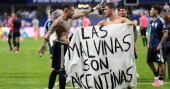
That goes back to the World Cup semi-final win over England, when a group of Argentina players unfurled a banner reading "The Falklands are Argentina's."
Separately, suspensions from the brawl between Argentine and Spanish players after the World Cup final are due to kick in around these same friendlies — Leandro Paredes gets 10 matches, Nahuel Molina seven, Thiago Almada one.
3 days ago
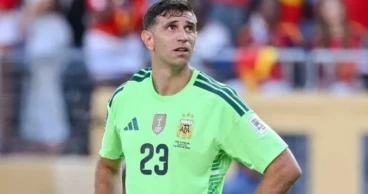
Martinez raises doubts over Argentina future after World Cup
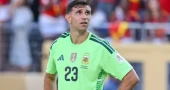
Argentina goalkeeper Emiliano Martinez has cast doubt over his international future after the team's defeat to Spain in the 2026 FIFA World Cup final.
He said he would use the aftermath of the loss to consider what comes next.
Writing on Instagram after Argentina returned to Buenos Aires on Monday, Martinez spoke of the disappointment of missing out on a second straight World Cup title and questioned whether it was time to step away from the national team.
"We dreamed of winning the World Cup again, of bringing the trophy back to Argentina and making history once more," he wrote.
"It's hard to put this pain into words. Now it's time to think about many things, about how to move forward. And maybe it's also time to ask whether my moment to step aside has come."
Martinez made no attempt to point fingers after the defeat. Instead, he apologized to Argentina supporters, saying he had given everything he could for the team.
"I'm truly sorry," he wrote. "I tried to give everything I had to help my country and my teammates."
The 33-year-old was one of Argentina's best players during the tournament. In the final, he produced 11 saves but could not keep out Ferran Torres, whose extra-time goal gave Spain a 1-0 victory.
Thousands of supporters welcomed the squad home in Buenos Aires despite cold and rainy weather, applauding the players after their run to a second consecutive World Cup final.
Martinez made his Argentina debut in a World Cup qualifier against Chile in June 2021 and quickly established himself as the team's first-choice goalkeeper. He played a central role in Argentina's Copa América and World Cup triumphs and has become one of the senior figures in Lionel Messi's squad.
Martinez stopped short of announcing his retirement, but his comments left open the possibility that the World Cup final could prove to be his last appearance for Argentina.
1 month ago

Messi says Argentina ready to give everything in World Cup final against Spain
Lionel Messi says Argentina will give everything they have when they take on Spain in Sunday's FIFA World Cup final, as the defending champions aim to retain the title.
"We will give it our all," Messi said on Friday during what is expected to be his final public appearance before the title clash in East Rutherford, New Jersey.
Messi spoke at Fanatics Fest in New York, where he shared the stage with some of the world's biggest sports stars, including NFL legend Tom Brady, tennis great Novak Djokovic and NBA star Kevin Durant. The event highlighted Messi's global appeal, with the sports icons also taking a group selfie with the Argentine captain.
FIFA held its pre-final media event at the four-day sports festival instead of a traditional news conference, allowing hundreds of fans to see the players and coaches up close.
Spain captain Rodri praised Messi, calling him the greatest footballer of all time.
"It goes beyond words what Messi means as a player and what he means for Argentina," Rodri said. "For me, he's the greatest of all time."
Instead of journalists asking questions, the discussion was led by sports stars. Brady asked Messi about a viral photo showing him bathing a baby who later grew up to become Spain winger Lamine Yamal.
"What a crazy picture," Messi said.
Djokovic asked Argentina coach Lionel Scaloni and Messi how they deal with pressure in major tournaments, while Durant asked goalkeeper Emiliano Martinez what winning back-to-back World Cups would mean for Argentina.
Scaloni kept the focus on the match itself.
"It's one more game," he said. "We cannot really think about the fact that it's a World Cup final."
Argentina have reached the final with a perfect 7-0-0 record and remain the tournament's only unbeaten team. Spain are 6-0-1 after drawing their opening match against Cape Verde.
Argentina's road to the final has not been easy. They came from behind to beat England in the semifinals after trailing 1-0 in the second half. They also recovered from a 2-0 second-half deficit against Egypt in the Round of 16, while both their Round of 32 match against Cape Verde and quarterfinal against Switzerland went to extra time.
"I've said many times: We never stop fighting," Messi said.
Messi received a warm welcome from fans at the event, many of whom recorded his entrance on their phones before cheering loudly as he waved.
At the end of the programme, players, coaches and celebrities, including actor Kevin Hart, rapper Travis Scott, former England defender Rio Ferdinand and Fanatics CEO Michael Rubin, gathered for a group selfie.
"Sunday is going to be a great show," Scaloni said.
Argentina are aiming to become the first team since Brazil in 1958 and 1962 to win consecutive World Cup titles.
Goalkeeper Emiliano Martinez said the team is determined to make the country proud.
"We've got a group of players and coaches working incredibly hard every day to bring happiness to our country," Martinez said. "We're going to give absolutely our best, with Leo and this team, to bring the World Cup back to our country and celebrate with our people."
2 months ago
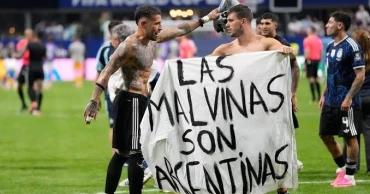
UK calls on FIFA to investigate Argentina over Falklands banner at World Cup
The British government has called on FIFA to investigate Argentina's national football team after its players celebrated a World Cup semifinal victory while holding a banner asserting Argentina's claim over the disputed Falkland Islands.
Argentina defeated England 2-1 in the World Cup semifinal in Atlanta on Wednesday. During the post-match celebrations, players displayed a banner handed to them by supporters that read, "Las Malvinas son Argentinas" ("The Malvinas are Argentine").
Argentina refers to the Falkland Islands as Islas Malvinas. The islands became the focus of a 10-week war in 1982 after Argentina's military government invaded the British-controlled territory. Britain regained control following the conflict.
UK Business Secretary Peter Kyle described the players' actions as "entirely inappropriate" and said he expected FIFA to conduct a thorough investigation.
Under FIFA's disciplinary code, political, ideological, religious or offensive messages displayed at stadiums are prohibited. Violations can result in fines ranging from $5,000 to $20,000. FIFA had not commented on the matter as of Thursday.
Argentina defender Lisandro Martínez said the banner carried strong emotional significance.
"I can imagine a Malvinas war veteran seeing that banner and crying," said Martínez, who has played for Manchester United in England for the past four years. "I don't know whether there will be sanctions, but the message simply expressed our belief that the islands belong to us."
Long-running political dispute
The Falkland Islands are a British Overseas Territory with a population of around 3,500 people. They are located about 480 kilometres off Argentina's coast and nearly 13,000 kilometres from Britain.
Argentina maintains that Britain illegally took control of the islands in 1833. Britain says its claim dates back to 1765 and that it expelled Argentine forces attempting to establish sovereignty over the territory in 1833.
The 1982 Falklands War claimed the lives of 649 Argentine troops, 255 British military personnel and three islanders.
The conflict coincided with the 1982 FIFA World Cup in Spain, where Argentina, England, Scotland and Northern Ireland all competed. British broadcasters declined to televise Argentina's opening match of the tournament, in which the defending champions lost to Belgium.
Argentina midfielder Leandro Paredes said the banner reflected a painful chapter in his country's history.
"It is a sad part of our history for everyone involved, and it still hurts," he said. "We knew we were playing for them as well."
FIFA's political neutrality under scrutiny
Kyle told the BBC that politics should remain separate from football, adding that the issue was now FIFA's responsibility.
FIFA's commitment to political neutrality has faced renewed scrutiny during this World Cup. Critics have questioned decisions by FIFA President Gianni Infantino and the governing body's disciplinary panel, particularly after United States forward Folarin Balogun was allowed to play against Belgium in the round of 16 despite receiving a red card in the previous match.
Under FIFA rules, Balogun should have been suspended for the next game, but the ban was postponed for one year on probation. Belgium went on to beat the United States 4-1 and advance to the quarterfinals.
Infantino is expected to attend Sunday's World Cup final between Argentina and Spain in East Rutherford, New Jersey, alongside US President Donald Trump and Argentine President Javier Milei.
Similar incidents in the past
Argentina's players displayed the same "Las Malvinas son Argentinas" slogan during a World Cup warm-up match in Buenos Aires in 2014. FIFA later fined the Argentine Football Association 30,000 Swiss francs (about $37,000) after that tournament.
In another case, South Korean footballer Park Jong-woo received a two-match FIFA suspension after displaying a banner reading "Dokdo is our territory" following South Korea's victory over Japan in the bronze medal match at the 2012 London Olympics.
More recently, during the 2022 World Cup, FIFA fined Serbia's football federation 20,000 Swiss francs (about $24,800) after a political banner showing Kosovo as part of Serbia and carrying the slogan "No Surrender" was displayed in the team's dressing room before a match against Brazil.
2 months ago
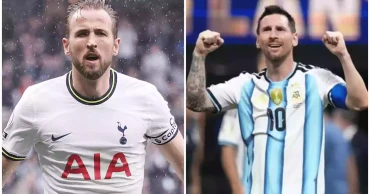
Argentina, England set for blockbuster World Cup semifinal
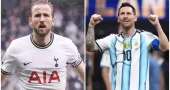
Argentina and England will reignite one of international football’s most storied rivalries when they face off in the FIFA World Cup semifinals on Thursday at 1:00 am, with a place in Monday’s final against Spain at stake.
The semifinal in Atlanta brings together two of the sport’s traditional powerhouses, whose World Cup clashes over the decades have produced some of football’s most memorable and controversial moments.
England coach Thomas Tuchel acknowledged the significance of the fixture, describing both national teams as iconic and their previous encounters as deeply embedded in football history.
The rivalry stretches back to the 1960s, but gained greater intensity during the 1966 World Cup quarterfinal when England defeated Argentina 1-0 in a heated contest that saw Argentine captain Antonio Rattin sent off. England went on to lift its only World Cup title that year.
Twenty years later, Argentina gained revenge in the 1986 World Cup quarterfinal, where Diego Maradona inspired a 2-1 victory with his infamous "Hand of God" goal and a remarkable solo effort widely regarded as one of the greatest goals in World Cup history. Argentina eventually won the tournament.
Argentina coach Lionel Scaloni said Maradona’s famous second goal remains one of football’s most unforgettable moments and continues to inspire generations of fans.
The rivalry continued in 1998 when England midfielder David Beckham was sent off during a round-of-16 defeat on penalties after an incident involving Argentina’s Diego Simeone. Beckham later found redemption by scoring the decisive penalty in England’s 1-0 group-stage victory over Argentina at the 2002 World Cup, contributing to Argentina’s early elimination.
Despite the history between the teams, Tuchel said his focus has been on preparing his players for the match itself rather than dwelling on past encounters.
Both teams have faced difficult paths to the last four.
Defending champions Argentina survived tough knockout matches against Cape Verde and Egypt before overcoming a 10-man Switzerland side 3-1 after extra time in the quarterfinals.
England also had to battle through adversity, coming from behind to defeat DR Congo and Norway before edging co-host Mexico 3-2 in an exhausting round-of-16 contest despite playing part of the match with 10 men.
Argentina captain Lionel Messi has once again been central to his team's campaign, scoring eight goals and contributing key assists.
England, meanwhile, has relied heavily on captain Harry Kane and midfielder Jude Bellingham. Both players have scored six goals during the tournament, with Bellingham netting twice in each of England’s previous two matches.
The winner of Thursday’s semifinal will face Spain in the World Cup final in East Rutherford, New Jersey, on Monday.
2 months ago
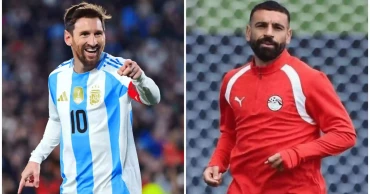
Messi, Salah set for high-stakes World Cup last-16 showdown
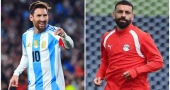
The race for the FIFA World Cup quarterfinals continues on Tuesday with two final round-of-16 matches, headlined by a much-anticipated showdown between Argentina captain Lionel Messi and Egypt star Mohamed Salah in Atlanta.
The winner of the clash will move a step closer to the title, while the losing side will see its World Cup campaign come to an end.
The knockout stage has already featured several standout performances from football's biggest stars. France, inspired by Kylian Mbappé, secured a place in the last eight, while Norway advanced behind Erling Haaland. England also booked a quarterfinal berth after edging Mexico 3-2, whereas Portugal exited the tournament following a 1-0 defeat to Spain in what was Cristiano Ronaldo's final World Cup appearance.
Defending champions Argentina enter Tuesday's match led by Messi, who continues to impress at the age of 39. The eight-time Ballon d'Or winner has scored seven goals in four matches, matching Mbappé and Haaland in the race for the tournament's Golden Boot. Messi has also extended his record by scoring in eight consecutive World Cup matches dating back to Argentina's title-winning campaign in 2022, taking his overall World Cup tally to 20 goals.
Egypt, meanwhile, will rely heavily on Mohamed Salah, who has long been the face of the country's football. The Liverpool forward has scored three World Cup goals, one shy of the Egyptian national team's all-time international scoring record held by current coach Hossam Hassan.
Salah has already helped Egypt reach new milestones by guiding the Pharaohs to their first-ever World Cup group-stage victory and their maiden knockout-stage win after eliminating Australia in a penalty shootout.
Neither Messi nor Salah has confirmed whether they will continue playing international football after the tournament, adding further significance to Tuesday's encounter.
In the day's other last-16 fixture, Switzerland will take on Colombia in Vancouver. Colombia will become the only team to have played matches in all three host nations — Mexico, the United States and Canada — during this expanded World Cup.
Colombia reached the knockout stage after victories over Uzbekistan, Congo and Ghana, while Switzerland advanced by defeating Algeria 2-0 for its first World Cup knockout win since 1938.
However, the Swiss could be without several key players, with Johan Manzambi, Ruben Vargas and Djibril Sow all facing fitness concerns after cutting short Monday's training session.
Argentina coach Lionel Scaloni warned against underestimating Egypt, noting that several traditional football powers have already been eliminated in an unpredictable tournament.
"This World Cup has shown there are no clear favorites," Scaloni said, recalling Argentina's hard-fought extra-time victory over Cape Verde in the previous round.
Egypt coach Hossam Hassan also expressed confidence ahead of the match, insisting his side is capable of producing another upset.
The winner of Argentina-Egypt will face the victor of the Switzerland-Colombia match in the quarterfinals on Saturday in Kansas City. France, Belgium, Spain, Norway and England have already secured their places in the last eight.
Round of 16 schedule (BD time):
Tuesday, July 7:
— Argentina vs. Egypt, 10:00pm in Atlanta
Wednesday, July 8:
— Switzerland vs. Colombia, 2:00am in Vancouver, British Columbia
Quarterfinals schedule
Friday, July 10:
— Morocco vs. France, 2:00am in Foxborough, Massachusetts
Saturday, July 11:
— Spain vs. Belgium, 1:00am in Inglewood, California
Sunday, July 12:
— Norway vs. England, 3:00am in Miami Gardens, Florida
— Argentina-Egypt winner vs. Switzerland-Colombia winner, 7:00am in Kansas City, Missouri
2 months ago
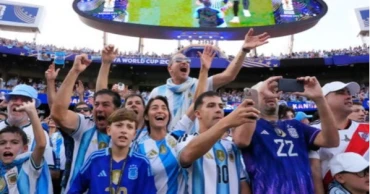
Argentina fans show unmatched passion as World Cup title defence begins
As reigning champions Argentina national football team began their World Cup title defence on Tuesday, supporters turned out in extraordinary numbers, spending heavily and travelling thousands of miles to follow their team.
For many fans, distance, cost and exhaustion were no barrier. Three supporters cycled nearly 17,700 kilometres from South America to Kansas City without even having match tickets. Others drove for about 20 hours, surviving on simple meals to cut expenses.
One long-time supporter, 73-year-old Daniel Otero, said he is attending his seventh World Cup and is spending nearly $100,000 to watch Argentina across the tournament with his two sons.
“We are crazy for Argentina,” he said. “That’s why we spend so much money to see our national team.”
Their dedication was rewarded as Argentina opened its campaign with a dominant 3-0 win over Algeria. Star forward Lionel Messi scored all three goals, further fuelling excitement that this may be his final World Cup appearance as he turns 39 next week.
Fans compared Argentina’s global following to iconic sports dynasties. One supporter said the team’s popularity with Messi is similar to the Chicago Bulls era led by Michael Jordan, noting the striker’s worldwide influence.
Many travelling fans said they are following the team across multiple matches, with some estimating costs of tens of thousands of dollars for the journey.
Supporters also expressed admiration for Messi’s long-standing impact on the national team, with many saying they cannot imagine Argentina without him.
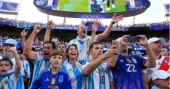
In and around the stadium, the atmosphere reflected deep emotional connection to the team. Fans waved flags, wore Messi jerseys and gathered around a travelling supporters’ band known as ‘Los Sin Entradas’, which performed outside the venue with drums and banners declaring “I love you, Lio.”
An 11-year-old fan from Miami, whose family has Argentine roots, said he feels closely connected to the country because of Messi and regularly travels there to visit relatives.
The group of travelling musicians said they plan to follow Argentina to upcoming matches in Dallas and beyond, depending on where the team advances.
Local organisers in Kansas City said they have been impressed by the extreme lengths fans have gone to attend matches, including cyclists who arrived without tickets but were later helped by locals to secure entry.
Many other supporters arrived days in advance, some driving long distances and staying in budget accommodation to afford tickets, which can cost hundreds of dollars.
One fan, who was born in Argentina but now lives in the United States, said attending the World Cup felt like a once-in-a-lifetime opportunity, especially with Argentina holding the title.
“We’re the last champions,” she said, describing the emotional pull of watching her national team on football’s biggest stage.
3 months ago
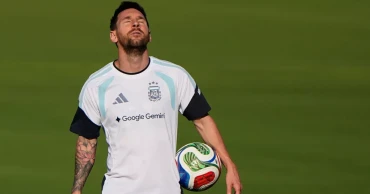
Messi set for 200th Argentina appearance as world champions begin title defence against Algeria
Argentina coach Lionel Scaloni says football fans across the world are eager to watch Lionel Messi play as the superstar prepares to make his 200th appearance for Argentina when the defending champions open their World Cup campaign against Algeria national football team on Tuesday.
Scaloni, who shares roots in Argentina’s Santa Fe province with Messi, said the eight-time Ballon d’Or winner remains a global attraction whose influence extends far beyond Argentine supporters.
“Not only Argentinians but people all over the world want to see him play,” Scaloni said. “Everyone wants to see him on the pitch because he has an impact on football fans everywhere.”
Argentina will begin its title defence at Arrowhead Stadium in Kansas City, with Messi expected to feature despite recently dealing with a minor hamstring problem.
The 39-year-old forward appeared fully fit in Argentina’s final warm-up match against Iceland last week. Coming on as a second-half substitute, he scored from the penalty spot and completed his brief appearance without any issues.
If selected as expected, Messi will reach the milestone of 200 international appearances against Algeria.
“There’s nothing negative to say about him,” Scaloni said. “He’s always there for us and remains a key part of this team.”
Messi's presence has generated huge excitement among fans in Kansas City ahead of the match.
Tapash Chakraborty, owner of an engineering design company, was among supporters hoping to catch a glimpse of the Argentine squad before the game.
“Messi is Messi,” he said. “He is the god of football.”
Messi jerseys have become a common sight throughout the city, with fans wearing shirts from Argentina, his former club FC Barcelona and current club Inter Miami CF.
Michelle Lemmon, who travelled from Missouri with her children to attend World Cup activities, described Messi as the world’s best player and said she was thrilled to have Argentina based in Kansas City during the tournament.
She added that a dream final would see the United States face Argentina.
Many football fans believe the debate over the greatest player of all time often comes down to Messi and Brazilian legend Pelé. A successful World Cup title defence would add another remarkable achievement to Messi’s career.
Only two countries have previously won consecutive World Cups: Italy in the 1930s and Brazil in 1958 and 1962. Argentina came close to repeating the feat four years ago after defeating France in a dramatic final in Qatar.
Veteran defender Nicolás Otamendi said memories of Argentina’s triumph in Qatar continue to inspire the squad.
“The whole country came together during that tournament,” Otamendi said. “Those memories stay with us and motivate us to keep pushing forward. We cannot relax. We have to keep working with humility.”
Otamendi also praised Messi’s attitude, describing him as a humble person who remains fiercely competitive despite his achievements.
“He focuses on training and always wants to win,” Otamendi said. “We want to support him and enjoy playing alongside him. When the match starts, the team must stay united and work together on the field.”
3 months ago
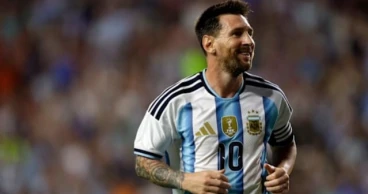
Messi scores from the spot as Argentina beat Iceland 3-0 in final World Cup warm-up
Lionel Messi marked his return from injury with a goal as Argentina defeated Iceland 3-0 on Tuesday in their final warm-up match ahead of the World Cup.
The Argentina captain, who is preparing for a record sixth World Cup appearance, came off the bench in the 70th minute and converted a penalty two minutes later after Lautaro Martínez was fouled inside the box.
Messi, 38, had been recovering from muscle fatigue and a minor hamstring strain picked up during his last appearance for Inter Miami on May 24. After missing the start of the match, he made an immediate impact once introduced.
The Argentina star, the national team’s all-time top scorer with 117 goals, struck a high left-footed penalty in the 72nd minute to seal the win.
Argentina, the reigning world champions and three-time winners in 1978, 1986 and 2022, will begin their World Cup campaign against Algeria on June 16 in Kansas City. Group J also includes Austria and Jordan.
The match was only the second meeting between Argentina and Iceland. Their previous encounter came at the 2018 World Cup, which ended 1-1, where Messi had missed a penalty.
3 months ago
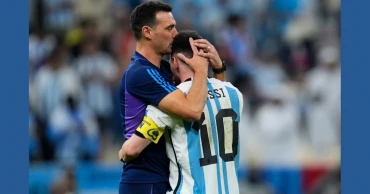
Lionel Scaloni stays composed as Argentina prepare to defend World Cup crown
Lionel Scaloni, calm and expressionless on the touchline, watched as Gonzalo Montiel scored the winning penalty in the 2022 World Cup final, sealing Argentina’s third world title with a dramatic victory over France.
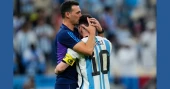
While players celebrated wildly, Scaloni initially remained still and silent, almost as if processing the moment in private. Only minutes later did he break down emotionally when a player hugged him and whispered: “We are world champions.”
That calmness has long defined Scaloni. He did not react publicly to early criticism over his lack of experience. He stayed composed when Argentina’s World Cup hopes were under pressure from Kylian Mbappé’s goals in the final. And he remains steady now as he leads Argentina into another title defence.
Those close to him say Scaloni’s calm mindset is shaped by cycling, a daily routine he adopted after retiring as a player. He spends two to three hours a day riding, often through the mountains of Mallorca in Spain, where he lives, or in his hometown Pujato in Argentina.
He says the activity helps him clear his mind and think about football without pressure.
“On the bike, you can think about your team, your opponent, how to prepare for the match. It really clears my head,” Scaloni has said in interviews. “It helps me lower my expectations and stay calmer.”
In the coming weeks, Scaloni will become only the third coach to lead Argentina in back-to-back World Cups, following César Luis Menotti and Carlos Bilardo, both former champions. But he often rejects comparisons with them, saying they belong to a different level of achievement.
Scaloni’s journey to the top job was unexpected. With no senior coaching experience, he took charge temporarily in 2018 after Argentina’s poor World Cup campaign in Russia. At the time, he was not seen as a serious long-term candidate, with names like Mauricio Pochettino and Diego Simeone being discussed instead.
Diego Maradona, Argentina’s 1986 World Cup-winning captain, once sharply questioned his ability to lead the national team.
Despite doubts, Scaloni stayed on. He guided Argentina to Copa América glory in 2021 and successfully led the team through qualification for the 2022 World Cup.
In Qatar, after a shock opening loss to Saudi Arabia, he reshaped the squad by introducing young players such as Enzo Fernández, Alexis Mac Allister and Julián Álvarez. The move helped transform Argentina’s performance, culminating in Lionel Messi delivering a career-defining World Cup triumph.
Scaloni later admitted the criticism was expected, given his inexperience, but said he held no resentment.
The challenge now is even greater. Argentina must defend their title with Messi approaching the end of his career and amid ongoing tensions within the country’s football administration.
Brazil was the last team to win back-to-back World Cups in 1962, a reminder of how difficult the task is.
Scaloni has repeatedly stressed that past success guarantees nothing.
“I don’t dwell on what we achieved. You always have to look forward,” he said in late 2025. “With this shirt, you can’t relax.”
Argentina have remained strong under his leadership, winning Copa América titles in 2021 and 2024 and finishing top of South American qualifying for the 2026 World Cup, even when Messi missed matches due to fitness issues.
Football figures in Argentina say the team’s biggest strength is unity
“It’s a team with very clear leadership,” said former World Cup winner Jorge Valdano. “Players haven’t lost their hunger.”
However, Scaloni’s tenure has not been without uncertainty. In 2023, he briefly hinted at stepping down after a World Cup qualifier win over Brazil, citing personal and emotional strain.
There have also been reports of internal disagreements and broader instability within Argentine football administration, including criticism over match scheduling and governance issues.
Despite this, Scaloni has remained focused and largely avoids public controversy.
Argentina will begin their World Cup campaign in Kansas City on June 16 against Algeria, followed by matches against Austria and Jordan.
Scaloni, true to his style, remains calm and cautious.
“We know expectations are high because we are champions,” he said. “But football is unpredictable. Anything can happen.”
3 months ago