
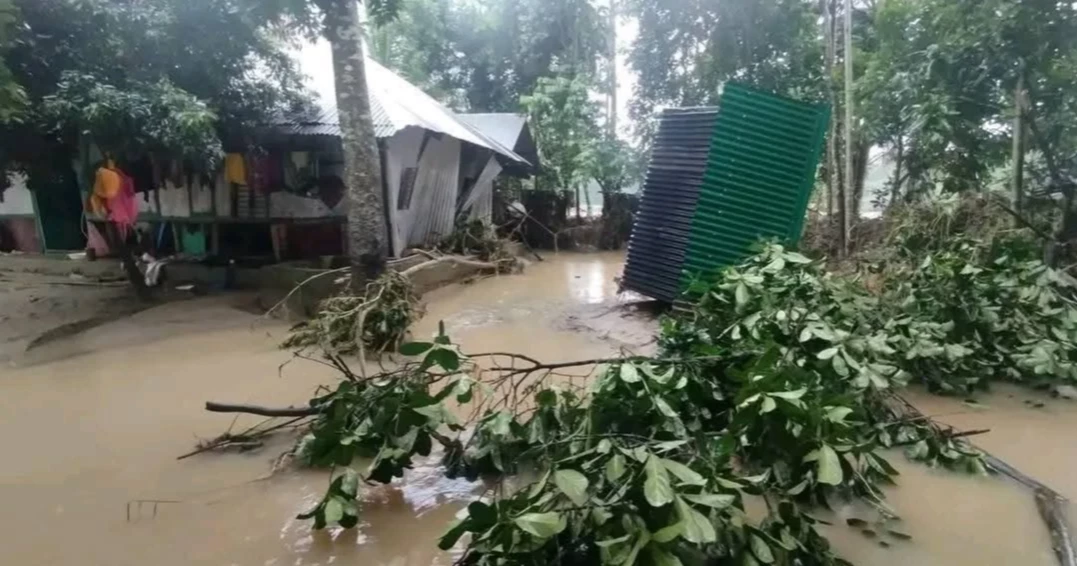
Vast swathes of countryside along Bangladesh’s all three major river systems – Ganges, Brahmaputra and Meghna – face the threat of being flooded over the next three days as extremely heavy rain begins in the upstream covering parts of Nepal, Bhutan and India.
Thousands of people in low-lying remote areas along the Padma got stranded in flood water on Tuesday with authorities shutting down over a dozen schools amid the Padma rapidly swelling and India issuing red alert for its states upstream adjacent to Bangladesh.
The upstream Indian states and parts of Nepal and Bhutan where extremely heavy rainfall is occurring comprises the world's wettest place and one of the largest mountain ranges.
An event of extremely heavy rainfall could unleash devastating flash flood in Bangladesh’s north, northeast and southeast in a matter of worse, which occur almost every year, often multiple times.
“Char dwellers are leaving their homes,” said Shahidul Islam, a member of Horiyan Union of Paba upazila in Rajshahi.
Water reached Shahidul’s doorstep on Tuesday. People are particularly troubled by the need to relocate their children, elderly family members and livestock.
A vast tract of low-lying areas in Daulatpur upazila of Kushtia district have been flooded due to the rise in water level of the Padma River, rendering 40,000 people in Ramkrishnapur and Chilmari unions stranded.
Thirteen government primary schools under the two unions have been shut due to the flood.
According to the Pabna Water Hydrology Division, the Padma River is flowing just one centimetre below the danger level at Daulatpur in Kushtia.
Some 243 hectares of croplands, including paddy, banana, vegetables, chili and maize, have already been damaged, according to the local agriculture office.
Abdul Mannan, Chairman of Chilmari Union Parishad, said, “Water levels are still rising. If this continues, it will start entering people’s homes.”
The Padma River is likely to continue swelling over the next four days, said the Flood Forecasting and Warning Center in its weather bulletin issued on Tuesday afternoon.
The Ganges River is likely to reach its warning level over the next 24 hours, the FFWC bulletin said.
40,000 people marooned in Kushtia flashflood; 13 schools shut
The Teesta, Dharla and Dudhkumar rivers may cross their danger mark over the next two days, flooding low-lying areas of Lalmonirhat, Nilphamari, Rangpur and Kurigram districts.
The three rivers constitute the Brahmaputra river system, which is likely to keep swelling over the next three days, reaching warning levels at many points.
Warning level implies a river flowing just 50cm below its danger level at a certain point.
The Teesta and Dudhkumar reached their warning levels by 3:00pm on Tuesday.
The Mahananda, Upper Atrai, Jamuneswari, Tangon, Punorbhoba, Ghaghat and Karatoa might keep swelling over the next three days, the FFWC said, eventually touching their warning point.
The Someswari, Bhugai and Kangsha, rivers in the Meghna basin, on the other hand, might flow at their warning levels over the next three days, the FFWC warning said.
Bangladesh’s three major river systems drain runoff generated over 1.6 million-square-km, only 7.5 per cent of the massive landscape lying inside Bangladesh.
The average water amount passing through the three river systems is 1,009,000 million cubic meters during the monsoon season, which officially extends between June and September.
Bangladesh Meteorological Department forecast a low pressure area to form over the Bay of Bengal by tomorrow, implying an increase in rainfall inside Bangladesh soon.
Large areas in Bangladesh covering Rangpur, Mymensingh, Dhaka, Barishal, Chattogram and Sylhet divisions are likely to experience rain at many places through tomorrow, the BMD said, predicting a fall of 2C in temperature over the period.