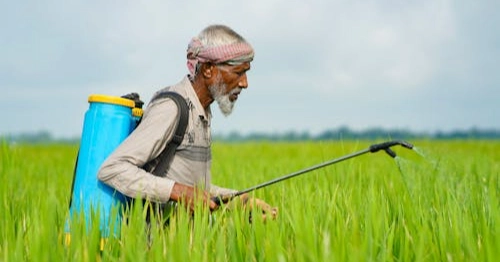
The development of Bangladesh's domestic pesticide industry has been stalled for a number of years now, due to significant tariff disparities and regulatory hurdles, leaving the country heavily dependent on imports essential to the agriculture sector that still dominates the economy.
Industry insiders and agricultural economists warn that, while Bangladesh has successfully become a global exporter of pharmaceuticals, the relatively simple technology of pesticide manufacturing remains underdeveloped due to a "discriminatory" tax structure.
They suggested a reasonable and competitive tax rate on raw material imports for pesticide production in the upcoming budget for the fiscal year of 2026-27.
The primary obstacle to the growth of local industries is the stark contrast in import duties between finished products and raw materials. If the tax barrier is removed, Bangladesh could become self-sufficient in pesticides within the next three years, said Tawfiqul Islam Khan, additional research director of the Centre for Policy Dialogue (CPD).
This is seen as a critical step before the country's LDC graduation, after which the agricultural sector may face even greater challenges if a self-sustaining local industry is not established, Khan pointed out.
He said that crop production at an affordable cost will be affected due to import dependency and higher duties on pesticide raw materials. In the volatile global situation, the import dependency of any food production-related product may affect food security.
How the "discriminatory" tax structure manifests:
Finished Pesticides: Low-quality finished pesticides can be imported from countries like India and China with a mere 5 percent customs duty and no additional VAT.
Raw Materials: Local manufacturers face duties of up to 58 percent on the 32 essential raw materials required for production.
Unjustified VAT: An additional 15 percent VAT is imposed on raw material imports, a cost not applied to imported finished goods.
KSM Mostafizur Rahman, President of the Bangladesh Agrochemical Manufacturers Association (BAMA), noted that this imbalance has turned Bangladesh into a market for foreign products rather than a manufacturing hub.
"While our pharmaceutical industry has grown from import-dependence to near self-sufficiency with 200 local firms, the pesticide industry is being held back by these tax barriers," he stated.
The current tax policy has resulted in domestic producers holding only a tiny fraction of the market, that is estimated between Tk 5,000 crore and Tk 7,500 crore.
Seven multinational companies control 55 percent (Tk 4,125 crore) of the market. Approximately 41% percent of the demand is met by local importers.
Domestic producers account for only 4 percent (Tk 300 crore) of the market share.
Agricultural economist Jahangir Alam emphasized that these high costs are ultimately passed down to farmers, increasing their production expenses while forcing them to use potentially inferior imported products.
Budget 2026-27: Opportunity to shift
BAMA and other stakeholders have placed two major demands before the National Board of Revenue (NBR) for the upcoming FY 2026-27 budget.
Zero Tariff on Raw Materials: Following an inter-ministerial recommendation that labeled the current high duties as "irrational," entrepreneurs are seeking a total waiver on the 58 percent duty for raw materials.
Ease of Port Procedures: Manufacturers report severe delays at Chittagong Port, where raw materials are often held for 40 to 45 days pending physical factory visits by customs officials, leading to massive compensation costs.
Industry leaders believe that if these barriers are removed, Bangladesh could become self-sufficient in pesticides within the next three years. This is seen as a critical step before the country's LDC graduation, after which the agricultural sector may face even greater challenges if a self-sustaining local industry is not established.