agriculture
Japanese Okinawa sweet potato brings new hope to farmers in Brahmanbaria
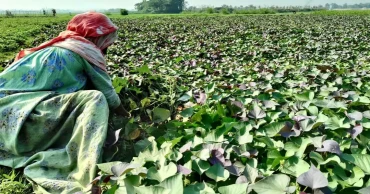
A Japanese variety of sweet potato known as Okinawa is steadily transforming the fortunes of farmers in Nabinagar upazila of Brahmanbaria, as growing consumer demand and high yields turn the crop into a promising superfood.
Although cultivation began on an experimental basis about three years ago, this season recorded nearly 30 bighas cultivation of Okinawa sweet potato in char areas and fallow lands. Farmers, agricultural entrepreneurs and health-conscious consumers are increasingly showing interest in the crop because of its profitability and nutritional value.
Farmers in Sunamganj haor region worried over cattle feed shortage after crop loss
Sweet potatoes are currently cultivated on about 255 hectares of land in Nabinagar upazila.
Around 20 farmers in Natghar, Nabinagar West, Satmora, Barikandi and Birgaon unions are now producing the Okinawa variety, signalling the beginning of what could become a lucrative new crop for the area.
Local farmers said the Okinawa variety produces significantly higher yields than traditional local sweet potatoes. Production can exceed 100 maunds per bigha, while the crop also offers better storage capacity and greater resistance to pests and diseases.
According to farmers, more than three maunds of sweet potatoes can be harvested from each decimal of land, around one and a half times higher than many local varieties. The tubers are larger in size and more visually appealing, making them attractive in the market.
The sweet potato, when boiled or roasted, reveals a distinctive yellow interior with a naturally sweet taste and soft texture. Consumers say slow cooking enhances its flavour, while chilling after boiling further intensifies its sweetness.
Nutrition experts say the crop is widely misunderstood in terms of its impact on blood sugar. With a relatively low glycaemic index, Okinawa sweet potatoes can be consumed in moderation even by diabetic patients. They are also rich in antioxidants, dietary fibre and vitamin A, supporting digestion, eye health and long-term energy release.
The variety is closely associated with Japan’s Okinawa region, known globally for longevity and healthy diets, which has contributed to its branding as a superfood in international markets.
Farmers in Nabinagar say the crop has already begun improving their incomes.
Nur Mohammad of Barikandi village said he started cultivation after receiving training from the Department of Agriculture Extension and collecting vines through local officials.
“Last year, I cultivated it on 20 decimals of land and harvested around 65 maunds,” he said.
Another farmer, Kamal Mia of Darilapang village under Nabinagar West union, said he has been cultivating the crop for two consecutive years on three bighas of land.
“The yield is high, demand is strong, and the price is good. We get around 120 maunds per bigha. It is profitable due to low production costs, so I plan to expand cultivation further,” he said.
Officials say interest in the crop is growing steadily.
Nabinagar Upazila Agriculture Officer Md Jahangir Alam Liton said farmers are increasingly adopting the variety due to its profitability and market demand.
He said initiatives are underway to expand cultivation further through training programmes and vine production, with a target of bringing 100 bighas under Okinawa sweet potato cultivation next season.
However, challenges remain in post-harvest management.
Deputy Director of Brahmanbaria DAE Dr Mostafa Imran Hossain said Bangladesh still lacks adequate storage facilities for sweet potatoes.
He stressed that the development of proper storage systems and agro-processing industries could ensure fair prices for farmers and year-round availability for consumers.
4 months ago
Revisiting tax barriers can revive growth of stunted pesticide industry
The development of Bangladesh's domestic pesticide industry has been stalled for a number of years now, due to significant tariff disparities and regulatory hurdles, leaving the country heavily dependent on imports essential to the agriculture sector that still dominates the economy.
Industry insiders and agricultural economists warn that, while Bangladesh has successfully become a global exporter of pharmaceuticals, the relatively simple technology of pesticide manufacturing remains underdeveloped due to a "discriminatory" tax structure.
They suggested a reasonable and competitive tax rate on raw material imports for pesticide production in the upcoming budget for the fiscal year of 2026-27.
The primary obstacle to the growth of local industries is the stark contrast in import duties between finished products and raw materials. If the tax barrier is removed, Bangladesh could become self-sufficient in pesticides within the next three years, said Tawfiqul Islam Khan, additional research director of the Centre for Policy Dialogue (CPD).
This is seen as a critical step before the country's LDC graduation, after which the agricultural sector may face even greater challenges if a self-sustaining local industry is not established, Khan pointed out.
He said that crop production at an affordable cost will be affected due to import dependency and higher duties on pesticide raw materials. In the volatile global situation, the import dependency of any food production-related product may affect food security.
How the "discriminatory" tax structure manifests:
Finished Pesticides: Low-quality finished pesticides can be imported from countries like India and China with a mere 5 percent customs duty and no additional VAT.
Raw Materials: Local manufacturers face duties of up to 58 percent on the 32 essential raw materials required for production.
Unjustified VAT: An additional 15 percent VAT is imposed on raw material imports, a cost not applied to imported finished goods.
KSM Mostafizur Rahman, President of the Bangladesh Agrochemical Manufacturers Association (BAMA), noted that this imbalance has turned Bangladesh into a market for foreign products rather than a manufacturing hub.
"While our pharmaceutical industry has grown from import-dependence to near self-sufficiency with 200 local firms, the pesticide industry is being held back by these tax barriers," he stated.
The current tax policy has resulted in domestic producers holding only a tiny fraction of the market, that is estimated between Tk 5,000 crore and Tk 7,500 crore.
Seven multinational companies control 55 percent (Tk 4,125 crore) of the market. Approximately 41% percent of the demand is met by local importers.
Domestic producers account for only 4 percent (Tk 300 crore) of the market share.
Agricultural economist Jahangir Alam emphasized that these high costs are ultimately passed down to farmers, increasing their production expenses while forcing them to use potentially inferior imported products.
Budget 2026-27: Opportunity to shift
BAMA and other stakeholders have placed two major demands before the National Board of Revenue (NBR) for the upcoming FY 2026-27 budget.
Zero Tariff on Raw Materials: Following an inter-ministerial recommendation that labeled the current high duties as "irrational," entrepreneurs are seeking a total waiver on the 58 percent duty for raw materials.
Ease of Port Procedures: Manufacturers report severe delays at Chittagong Port, where raw materials are often held for 40 to 45 days pending physical factory visits by customs officials, leading to massive compensation costs.
Industry leaders believe that if these barriers are removed, Bangladesh could become self-sufficient in pesticides within the next three years. This is seen as a critical step before the country's LDC graduation, after which the agricultural sector may face even greater challenges if a self-sustaining local industry is not established.
4 months ago

China’s farms go high-tech, boosting yields and cutting waste
Zhang Tong, 36, oversees his family farm along the Yellow River in Shandong Province, blending tradition with cutting-edge technology. Unlike past generations of farmers, Zhang relies on drones, smart machines, and precision irrigation to manage his 300-hectare wheat fields.
A sleek silver drone maps the plots, plans spraying routes, and checks for water stress, while snake-like pipes deliver water and fertilizer directly to plant roots, reducing water use by nearly 30 percent. “The pipes work like the fine blood vessels of the human body,” Zhang explained.
Since starting his farming career in 2019, Zhang has embraced automation. Intelligent seeders planted his entire farm in a month, while a fertilizer blender adjusts nutrients based on soil tests. Driverless harvesters and unmanned scout vehicles monitor crops and control pests. These innovations have pushed his annual wheat yield to 3,000 tonnes.
Across China, agriculture is undergoing a similar transformation. In the south, rice seedlings grow in climate-controlled facilities, while winter wheat in the north thrives under drone-guided care. The
centuries-old image of farmers with oxen and hoes is giving way to high-tech operations powered by AI, robotics, and data-driven planning.
Zhang is also experimenting with soybean-corn intercropping and custom seeders to optimize harvest timing. Researchers like Feng Lingyang of Peking University support farmers by using computer vision, machine learning, and gene editing to improve crop yields and create new revenue streams.
China produced a record 715 million tonnes of grain last year. Under the 15th Five-Year Plan (2026–2030), the country aims to increase production to 725 million tonnes, focusing on stabilizing rice and wheat while expanding corn and soybean output. Experts say technology will be key to achieving these goals.
On a neighboring farm, over 500 sensors track soil moisture, temperature, and wind across 660 hectares. Yu Long, general manager of Jinan Chengfa Agricultural Technology Co., said the goal is to cut grain loss by 5 percent, raise yields by 15 percent, and reduce fertilizer and pesticide use. “We are installing water-saving sprinklers and larger harvesters to further minimize losses,” he added.
The fields along the Yellow River reflect a new era of Chinese farming, where science and machinery are transforming how the nation feeds its 1.4 billion people.
5 months ago
Illegal topsoil extraction threatens ‘Gaillar Haor’, croplands in Sunamganj
Fertile farmlands of ‘Gaillar Haor’ in Shantiganj upazila of Sunamganj district has been facing severe degradation as an influential syndicate continues large-scale illegal extraction of topsoil, posing a serious threat to local agriculture and rural infrastructure.
The upper fertile layer of cropland, commonly known as topsoil, in Alampur village under Purba Pagla Union, is being indiscriminately removed using excavators, according to local people.
The soil is reportedly being used to fill private homesteads and roads, while the ongoing operation has disrupted both agricultural productivity and daily life.
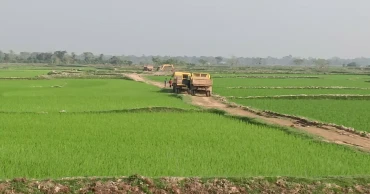
During a recent visit to the area, this UNB correspondent observed multiple excavators digging deep pits across vast stretches of cropland.
Read more: Unchecked soil lifting threatens Gomti River, infrastructures in Cumilla
The extraction continued day and night, with rows of heavy dump trucks transporting the soil to different locations.
The constant movement of trucks has damaged newly built rural roads, intensifying public suffering.
Local people alleged that the illegal activity is being carried out under the direct leadership of influential former local representatives Saidul Islam and Kalam Mia.
Farmers affected by the soil removal expressed deep concern and said they feared retaliation if they protested openly.
Several farmers, speaking on condition of anonymity, said the removal of topsoil, the most fertile portion of farmland, has permanently destroyed soil productivity. They warned that deep excavation has also increased the risk of adjacent farmlands collapsing.
If the haor is carved up like this, there will be no land left for cultivation in the future, said Jamaluddin, a farmer.
They demanded immediate and strict intervention from the administration.
Under the Soil and Sand Management Act, 2010, extracting soil from agricultural land for commercial or personal use is a punishable offence.
Locals, however, alleged that the syndicate continues its activities by evading administrative oversight or using political influence.
Beyond agricultural damage, the operation has also caused severe deterioration of rural roads.
Read more: Overuse of chemical fertilisers threatens soil health in northern Bangladesh
Heavy trucks carrying soil have led to road collapses, making daily movement increasingly difficult for villagers.
When contacted, Fatema Tuz-Zohra, Assistant Commissioner (Land) of Shantiganj upazila, said the administration is aware of the issue.
“Cutting topsoil from cropland is completely illegal. We have received information about soil extraction in Alampur village. A mobile court will be conducted there soon,” she assured.
Those who were involved in the act would not be spared and legal action will be taken, including the seizure of machinery used in the illegal activity, she said.
Meanwhile, experts from civil society urged for exemplary punishment, including imprisonment and confiscation of excavators, to protect the haor’s fragile ecosystem.
Read more: BIWTA dredging restores navigability of Sunamganj rivers; boosts trade, employment
They also feared that if the government did not take immediate action, Shantiganj’s agricultural economy and ecological balance could suffer irreversible damage.
7 months ago

Safe Agriculture movement urges parties to adopt 20-point charter
Safe Agriculture and Food Movement on Sunday urged political parties and candidates contesting the upcoming national parliamentary elections to incorporate their 20-point proposals into their election manifestos and public commitments which highlight ensuring the state recognition of farmers’ identity with dignity.
The demands aiming at establishing a safe, fair, climate-resilient, profitable, healthy, pollution-free, sustainable and sovereign agriculture and food system in the country were announced at a press conference held in the morning.
The 20-point charter was presented by joint spokesperson of the movement, writer and researcher on environment and nature Pavel Partha. The demands include state recognition of farmers’ identity with dignity; ensuring the rights of all farmers, fishers and shifting cultivators; protection of agricultural land through strict enforcement of land-use laws; banning cultivation practices and inputs harmful to soil structure and microorganisms; and prioritising conservation and expansion of indigenous seed diversity.
Healthy-sounding food labels may mask high levels of added sugar
Other key demands include ensuring safe irrigation by reducing groundwater dependency and protecting natural water flows; gradually phasing out chemical fertilisers by promoting organic alternatives; banning highly hazardous pesticides and ultimately stopping the production, marketing and use of all toxic chemicals in agriculture and food production.
The charter also calls for stopping ultra-processed and artificial food items, ensuring fair prices for all crops, establishing area-based farmers’ markets, fixing minimum wages for agricultural workers, introducing farmer pensions, implementing safe waste management in agriculture and food production, and promoting indigenous fisheries and livestock breeds through rural household farming.
Additional demands focus on promoting urban agriculture and rooftop gardening using local seeds, preserving regional agricultural traditions through state-sponsored fairs and exhibitions, integrating safe agriculture and food systems into all levels of education, and prioritising local adaptation strategies to address the climate crisis with easy access to climate funds for affected farmers.
The proposals further include ensuring legal protection for farmers facing losses, establishing a transparent and accountable agriculture sector, introducing crop insurance and farmer risk allowances, issuing farmer cards based on farmers’ input, and expanding skill development, awareness and promotion related to safe agricultural production, processing and marketing.
Expressing solidarity with the demands, farmers including Asma Akhter from Manikganj, Sayed Ahmed Khan Bacchu from Netrokona, and Kalachan, a farmer-organiser from Manikganj Farmers’ School Cooperative Society, called for immediate implementation of the proposals.
Representative of the Natural Agriculture Society Delwar Jahan highlighted severe nutrient depletion in agricultural soils and said the 20-point demands are essential to restore soil and food nutrition. Advocate Shafiqul Rahman of the National Farmers’ Movement warned against laws that undermine farmers’ ownership and rights over seeds.
Rice prices keep food inflation high despite slight easing in Nov: GED
Economist Prof Anu Muhammad said a shift in the current development paradigm is needed by ensuring people’s participation in policymaking, adding that the 20-point charter could play an effective role in that transition. He urged collective efforts to implement the demands.
Agricultural scientist Dr Abdus Sobhan, CAB representative SM Nazer Hossain, Bangladesh Organic Agricultural Network agronomist Dr Md Najim Uddin and representatives of several civil society organisations also spoke at the press conference.
8 months ago
After flood, Boro season unfolds in Sunamganj
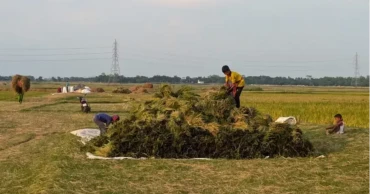
As the vast haor waters slowly recede, life in Sunamganj’s low-lying wetlands is once again defined by urgency, mud and relentless labour by farmers.
Across the district, farmers have plunged into the Boro cultivation season, racing against a narrow planting window that will determine their livelihoods for the year ahead.
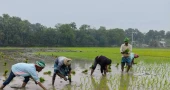
From one upazila to another, the haor landscape has turned vibrant with activity. Knee-deep in muddy water, farmers and agricultural labourers work from dawn to dusk, transplanting paddy seedlings on freshly exposed land. Shantiganj, Tahirpur, Madhyanagar, Dharmapasha, Shalla and Jamalganj are among the upazilas where the seasonal rush is most visible.
According to the District Agriculture Department, seedlings have already been planted on 1.53 lakh hectares of land in Sunamganj.
Read more: Jujube cultivation brings new prosperity to Cumilla’s Shikarpur village
With haor waters withdrawing gradually, farmers are making full use of every available day to ensure timely transplantation and a successful harvest.
Boro cultivation in the haor region typically begins after floodwaters recede, following the preparation of seedbeds in November and December.
This year, soil testing has been completed in advance, and required fertilisers, including urea, TSP, DAP, MOP and gypsum, have been applied as per recommendations.
Farmers are cultivating a mix of high-yielding and hybrid rice varieties, including BRRI dhan-28, BRRI dhan-29, BRRI dhan-89 and BRRI dhan-92. If weather conditions remain favourable, rice ears are expected to emerge in April-May, marking the crucial phase when grains mature ahead of harvest.
Yet the physical toll of the season is unmistakable. Despite the biting winter cold, labourers stand for hours in icy water, trampling mud to plant seedlings by hand. For many, agriculture is the only means of survival, leaving little room for rest.
“I work from 8am till evening for a daily wage of Tk 600 and one meal,” said Ibrahim Mia, a farmer from Khushdar Haor in Lalpur village. “Even in severe winters, we have to trample mud in water. We are poor people and survive through hard labour.”
Like many others, Ibrahim hopes that good yields and fair market prices will reward their effort. “If we get proper prices, farmers will be more motivated,” he said.
Read more: Haor regions to see controlled pesticide use in upcoming Boro season
Officials say the Boro season is not only vital for food production but also creates seasonal employment in the haor belt.
Deputy Director of the Sunamganj District Agricultural Extension Department Mohammad Omar Faruk said Boro remains the district’s main cropping season.
“Workers from different districts have come to Sunamganj to take part in the planting activities,” he said, adding, “They are earning between Tk 600 and Tk 800 per day, which has created temporary employment opportunities in the haor areas.”
He said the Boro cultivation target for the current season has been set at 2,23,505 hectares, with planting already completed on about 1,53,000 hectares.
As farmers push forward against time, cold and uncertainty, the receding haor waters signal both hope and hardship, a familiar rhythm in Sunamganj, where the success of the Boro season shapes food security and livelihoods for thousands.
Read more: Kushtia farmers upset over canal blockage, fear permanent waterlogging
8 months ago
Jujube cultivation brings new prosperity to Cumilla’s Shikarpur village
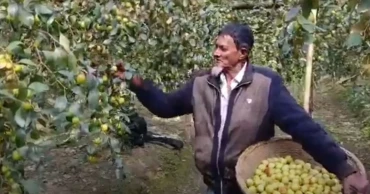
Shikarpur village in Barura upazila of Cumilla district is witnessing a quiet agricultural revolution as jujube orchards transform the rural landscape and uplift farmers’ incomes.
Once a traditional farming community, the village has now become a hub for cultivating Ball Sundari, Bari Sundari and Kashmiri varieties of jujube.
The success of jujube cultivation in Shikarpur is gradually spreading to neighbouring villages, attracting farmers eager to tap into the lucrative market.
Many of these farmers had spent years abroad before returning home, drawn to jujube farming as a promising alternative to conventional crops.
Read more: Sirajganj’s mustard fields bloom into golden seas, promise bumper harvest
A winter morning visit to the village offers a picturesque scene: sunlight filters softly through the crisp air, illuminating clusters of ripe jujubes that hang from branches bending under their weight.
Farmers are busy plucking fruits, weighing them for buyers and savouring the freshly harvested sweetness during short breaks.
Ramiz Uddin, a farmer who returned after nearly 20 years abroad, credits his success to the guidance of his brother, Suruj Mia, an established jujube grower.
“In the first year, I cultivated jujubes on 18 decimals of land. Seeing good profits, I expanded cultivation to another 32 decimals,” he said, adding that today many farmers consult him for advice. Alongside jujubes, Ramiz also grows a variety of vegetables.
Abdur Razzak, another local farmer, highlighted the profitability of the crop.
“Shikarpur has become widely known for jujube production. Compared to other crops, jujube farming is far more profitable. Three of us brothers cultivated jujubes on 60 decimals of land. Our cost was about Tk 1,50,000, while sales are expected to reach Tk 5,00,000,” he said.
He also credited the Department of Agriculture Extension (DAE) for guidance, which helped them achieve good yields.
The popularity of jujube cultivation is crossing village borders. Junab Ali, a farmer from Joykamata, said he started cultivating jujubes after bringing saplings from Shikarpur three years ago.
“I began with 22 decimals in the first year, expanded by another 22 decimals in the second year, and this year I cultivated an additional 16 decimals,” he said.
Deputy Assistant Agriculture Officer Golam Sarwar Bhuiyan of the DAE confirmed that jujube cultivation began in Shikarpur four years ago, with Suruj Mia being the pioneer.
Read more: Chapainawabganj farmer sparks local excitement with amazing Chinese orange harvest
“Seeing his success, other farmers, including Ramiz Uddin and Abdur Razzak, also became interested. From the beginning, we have been providing advice and assistance. Today, jujube is being cultivated on 20 acres in this village. Its popularity is now spreading to neighbouring areas, offering new hope for sustainable rural livelihoods,” he said.
Shikarpur’s jujube orchards are not just changing the scenery—they are reshaping the local economy, turning a once-sleepy village into a centre of agricultural innovation and prosperity, he added.
8 months ago
Kushtia farmers upset over canal blockage, fear permanent waterlogging
Allegations that a government canal is being blocked to construct a pipe culvert have raised serious concerns among farmers in Kumarkhali upazila of Kushtia, with at least 70 hectares of agricultural land at risk of permanent waterlogging.
Local residents of Nandlalpur Union recently submitted a written complaint to the Upazila Nirbahi Officer (UNO), accusing influential individuals of obstructing a key canal at Buzruk Bakhai Bottola intersection to install a narrow pipe culvert.
They fear the move will severely disrupt natural water flow.
According to the complaint and local sources, the nearly one-kilometre-long canal runs from Buzruk Bottola in Nandlalpur Union to Mirzapur Bazar in Shilaidaha Union.
Read more: Fertiliser crunch threatens Kushtia’s onion boom despite high prices
It plays a crucial role in draining water from the Buzruk Bakhai, Chandpur, and Bahalbariya beels into the nearby Gorai and Padma rivers. However, the canal has not been properly excavated or maintained for several years.
Local farmers alleged that portions of the canal have gradually been encroached upon, with multiple pipe culverts constructed to create makeshift roads.
This has led to prolonged waterlogging in the surrounding lowlands for at least six months each year. As a result, farmers in the area are able to cultivate only one crop—Boro rice—during the irrigation (IRRI) season.
The situation has worsened following a recent initiative to block a 22-foot-wide section of the canal at Buzruk Bakhai Bottola, replacing it with a three-foot-wide pipe culvert under a Union Parishad project reportedly costing around Tk 6 lakh.
Farmers fear the narrow culvert will further obstruct water flow, rendering vast tracts of farmland uncultivable throughout the year.
A visit to the site revealed a concrete bridge over the canal at Bottola intersection. The western side of the canal has been partially filled with sand, while the remaining portion has been narrowed to about three feet with concrete casting.
At least 27 pipes were observed stacked in the courtyard of a nearby house, suggesting preparations for the culvert installation.
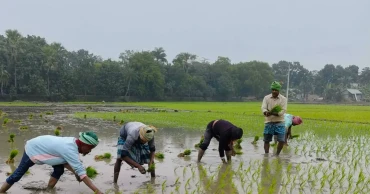
Meanwhile, farmers and labourers were busy transplanting Boro seedlings in adjacent fields.
Read more: As haor waters recede, Sunnamganj farmers sow hope in every field
Suman Hossain, a local resident, said, “People associated with the chairman started blocking the canal to install pipes in the morning. Locals protested and forced the workers to leave. We later filed a written complaint with the UNO demanding that the work be stopped.”
Rashidul Sheikh, son of farmer Azizul Sheikh from Buzruk Bakhai village, stressed the canal’s importance. “The canal is the only route through which water from the beels flows to the Padma River. We get only one harvest a year. If the canal is blocked, there will be no crop at all,” he said, demanding the immediate cancellation of the project.
8 months ago
Fertiliser crunch threatens Kushtia’s onion boom despite high prices
Onion farmers in Kumarkhali Upazila are struggling with a fertiliser shortfall just as high market prices are driving record planting this season.
Last year, onions fetched prices ranging from Tk 35–40 per kilogram at the start of the season, climbing to Tk 120–135 per kilogram later in the year, locals said.
This fiscal year, they said, prices currently hover around Tk 85-90 per kilogram, while production costs stand at Tk 22–25 per kilogram, creating a lucrative margin that has prompted many farmers to expand cultivation.
Read more: Govt to procure 50,000 mt of non-basmati parboiled rice, 80,000 mt fertiliser
But farmers say a lack of essential fertilisers, including urea, TSP, MOP, and DAP, threatens the budding crop. Allegations of dealer collusion are rife, with sub-dealers and intermediaries reportedly charging Tk 5–10 more per kilogram than government-fixed rates.
Kumarkhali Upazila has a total cultivable area of 18,240 hectares. For the 2025–26 fiscal year, authorities set a target of 4,920 hectares for onion cultivation, with saplings already planted on 3,690 hectares.
Agriculture officials expect the area under cultivation to surpass the target, buoyed by the crop’s profitability.
Production costs, including land lease, seeds, fertilisers, and crop care, average around Tk 150,000 per hectare. Yet farmers on the ground say limited access to fertilisers could erode potential profits.
“Last year, onions sold for Tk 40 to Tk 135 per kilogram, which motivated many to switch to onion cultivation,” said Laltu Ali Sheikh of Panti Union. “But we cannot get sufficient fertilisers.”
Farmers claim dealers provide only 10–20 kilograms per bigha at official prices, forcing them to buy extra at higher rates. Sub-dealers are reportedly selling TSP at Tk 1,850–2,000 per sack, DAP at Tk 1,450–1,600, and MOP at Tk 1,150–1,200, significantly above official prices of Tk 1,350, Tk 1,050, and Tk 1,000, respectively.
Khondakar Abdul Gaffar, president of the Kushtia BCIC Fertiliser Dealers Association, acknowledged government supply shortfalls but denied deliberate overpricing by dealers. “Some sub-dealers and unscrupulous traders buy from various sources and sell at higher rates. Legal action is needed against them,” he said.
Local authorities maintain that fertiliser availability is stable.
Upazila Agriculture Officer Md Raisul Islam said, “Fertilisers are being sold at fair prices. Some unscrupulous traders sold at higher rates but were fined.”
Upazila Nirbahi Officer Farzana Akhter added that authorities are monitoring dealer syndicates and taking action to ensure fertilisers are sold at government-fixed rates.
Read more: Overuse of chemical fertilisers threatens soil health in northern Bangladesh
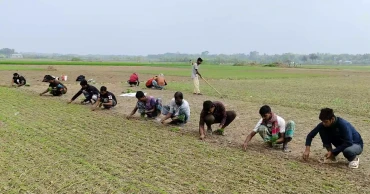
Meanwhile, fields in Yaduboyra, Panti, Bagulat, Nandalalpur, and Chapra unions are alive with activity. Groups of 20–30 people, including farmers, labourers, and students, are planting onion seedlings. Some students are earning Tk 500 per day to help cover labour shortages.
For Kushtia’s onion growers, the challenge is clear: lucrative returns are on offer, but without timely access to fertilisers, the season’s promise could be undercut, according to local market observers.
8 months ago
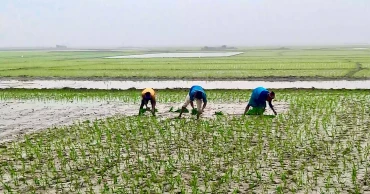
As haor waters recede, Sunnamganj farmers sow hope in every field
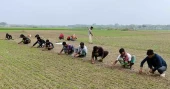
As the floodwaters of Madhyanagar’s haors slowly recede, farmers have embarked on the crucial boro rice planting season, working relentlessly to ensure timely transplantation.
The effort has drawn participation from all sections of haor-side communities. With examinations concluded, students have joined the fields with some delivering midday meals to labourers, while others assist with collecting seedlings to support the planting process.
A field visit to Tanguar Haor, Ghoradoba Haor, Shaldigha Haor and other wetlands in the upazila revealed farmers actively engaged across expansive tracts of land.
Read more: Rice prices keep food inflation high despite slight easing in Nov: GED
According to the Upazila Agriculture Office, the target for this season is the cultivation of boro rice on 13,640 hectares. To date, approximately 2,815 hectares have been successfully planted.
Nazar Hossain, a farmer from Nishchintpur village in Tanguar Haor’s Banshikunda South Union, pointed out that delayed water recession has hindered transplantation across all fields. “Once the water fully recedes, we will be able to complete planting swiftly,” he said.
Similarly, Ghoradoba Haor farmer Abdul Majid said, “We are planting rice in the fields every day. This is the final period for boro transplantation, but the slow receding of water has caused some delay.”
Meanwhile, Noor Alam, Assistant Engineer at the Upazila Water Development Board, reported that work has begun on strengthening the haor-protection embankments. “As water levels drop, we will fully resume construction. We hope the project will be completed efficiently in the near future,” he added.
Upazila Agriculture Officer Ashayad Bin Khalil Rahat emphasised that, under government incentives, high-quality seeds and fertiliser have been distributed to marginal and smallholder farmers to boost production.
Read more: Haor farmers reap early gains as mustard cultivation flourishes in Sunamganj
With the normalisation of water levels, he assured, boro rice transplantation will be completed within the scheduled timeframe.
The ongoing activity, Rahat said, underscores the resilience of haor communities, blending tradition and collective effort to meet seasonal agricultural demands despite climatic uncertainties.
8 months ago