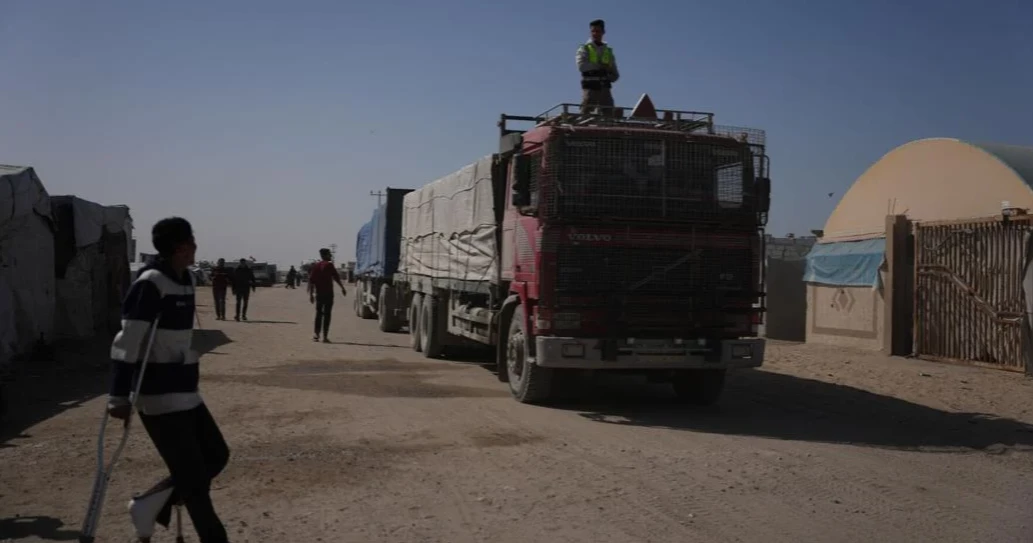
Palestinians in Gaza on Sunday watched with cautious hope as preparations got underway to reopen the Rafah border crossing with Egypt, the territory’s main gateway to the outside world, with Israel saying limited travel would resume from Monday under the ongoing ceasefire with Hamas.
Workers were seen readying the crossing, which has been largely shut since Israel seized control of it in May 2024. Many Gazans welcomed the move but voiced frustration over strict limits on the number of people allowed to cross.
“Opening the crossing is a good step, but setting a cap on how many people can pass through is a real problem,” said Ghalia Abu Mustafa from Khan Younis. Others stressed the urgent need for medical travel. Suhaila Al-Astal, displaced from Rafah, said her sick daughter required treatment abroad and called for the crossing to be opened permanently and in both directions.
Israel said the crossing had been opened on a trial basis and that Gaza residents would be allowed to begin crossing from Monday, though only in small numbers initially. Prime Minister Benjamin Netanyahu has said Israel will allow 50 medical patients to leave Gaza each day. According to an official familiar with the talks, each patient will be permitted to travel with two relatives, while up to 50 Palestinians who left Gaza during the war will be allowed to return daily.
Zaher al-Wahidi, head of documentation at Gaza’s Health Ministry, said the ministry had not yet been officially informed about the start of medical evacuations. Around 20,000 Palestinians in need of medical care are hoping to leave Gaza via Rafah, while thousands more outside the enclave are seeking to return.
Under the new arrangement, Israel and Egypt will vet those entering and leaving through the crossing, which will be overseen by European Union border monitors. Israeli officials say the number of travelers could increase gradually if the system functions smoothly.
The announcement came a day after Israeli airstrikes killed at least 30 Palestinians, including several children, according to hospital officials, marking one of the deadliest days since the ceasefire began on Oct. 10. Israel accused Hamas of violating the truce.
Nicolay Mladenov, head of US President Donald Trump’s newly established Gaza peace board, urged all sides to exercise restraint and said efforts were under way with a newly selected Palestinian committee to prevent further incidents.
Meanwhile, Israel’s Diaspora Ministry said it was moving to end the operations of Doctors Without Borders in Gaza by Feb. 28. Israel had suspended the medical charity’s activities in December after it declined to comply with new registration rules requiring aid groups to submit lists of local staff, arguing the measures could put Palestinian employees at risk.
Doctors Without Borders warned that the decision would have a devastating impact on health services in Gaza, where it supports six hospitals, runs two field hospitals, eight primary health centers and clinics, and operates two of the enclave’s five stabilization centers for severely malnourished children. Israel has suspended more than two dozen humanitarian organizations under the new rules, saying they are needed to prevent militant infiltration, while aid groups say the restrictions harm civilians in desperate need.
Palestinian security officers crossed through the Egyptian side of Rafah on Sunday to join the EU mission supervising the crossing, according to an Egyptian official. Ambulances were also seen passing through the Egyptian gate.
Before the war, Rafah was Gaza’s primary crossing for people traveling in and out of the territory. Israel says its takeover of the crossing last year was aimed at stopping weapons smuggling by Hamas. The crossing was briefly opened for medical evacuations during a temporary ceasefire in early 2025 but remained closed afterward until recent developments, including the recovery of the remains of the last hostage in Gaza.
Under the ceasefire terms, Israeli forces continue to control the area between the Rafah crossing and densely populated parts of Gaza. Egypt has repeatedly said the crossing must operate in both directions, amid concerns it could otherwise be used to force Palestinians out of the enclave.
The ceasefire paused more than two years of fighting that began with the Hamas-led attack on southern Israel on Oct. 7, 2023, which killed about 1,200 people and led to the capture of 251 hostages. Israel’s subsequent offensive has killed 71,795 Palestinians, according to Gaza’s Health Ministry, including 523 since the ceasefire began.
The first phase of the truce includes hostage and prisoner exchanges, increased humanitarian aid and a partial Israeli troop withdrawal. A more complex second phase envisions new governance arrangements for Gaza, the deployment of an international security force, the disarmament of Hamas and steps toward reconstruction.