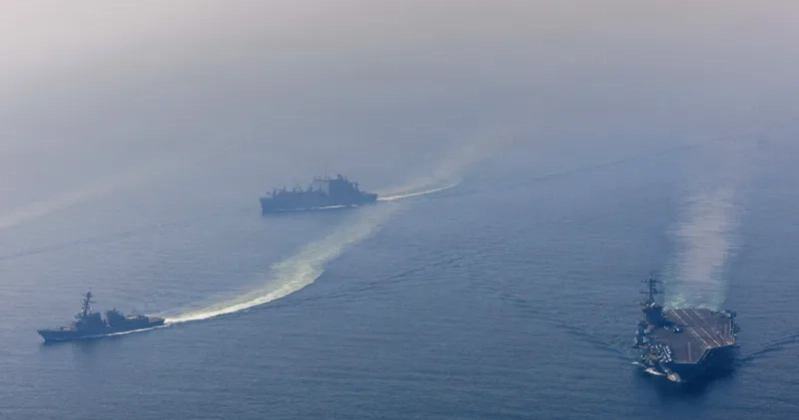
The United States has significantly increased its naval and air deployments in the Middle East, with satellite images confirming the presence of the aircraft carrier USS Abraham Lincoln near Iran, as Washington continues to apply pressure over Tehran’s military programme and its recent crackdown on protests.
BBC Verify said satellite imagery placed the carrier in the Arabian Sea, about 700 kilometres off the coast of Oman. The Lincoln, which leads a strike group of three guided-missile destroyers, carries about 90 aircraft including F-35 fighter jets and has a crew of nearly 5,700. It was reportedly deployed to the region in late January but had not been clearly visible until now.
US and Iranian officials are scheduled to meet in Switzerland on Tuesday for a second round of discussions. Iran has said the talks will focus on its nuclear programme and the possible lifting of US economic sanctions, while Washington has signalled it wants broader issues on the agenda.
The US has also reportedly sent the world’s largest warship, the USS Gerald R Ford, towards the Middle East, with reports suggesting it could reach the region within weeks.
According to BBC Verify, the arrival of the Abraham Lincoln adds to a wider US military build-up in recent weeks. Satellite imagery has tracked at least 12 US naval vessels across the region, including destroyers and combat ships positioned in the Gulf, the eastern Mediterranean and the Red Sea. Several vessels are stationed at a naval base in Bahrain, while others have been seen near a US base at Souda Bay.
US air activity has also increased. Analysts have observed more F-15 and EA-18 fighter jets at a military base in Jordan, along with a rise in US cargo, refuelling and communications aircraft moving from the US and Europe into the Middle East.
Iran has responded with its own show of force. The Islamic Revolutionary Guard Corps recently launched naval drills in the Strait of Hormuz, a vital global oil shipping route through which around a fifth of the world’s oil and gas passes. Iranian media showed missiles being launched from naval vessels during the exercises.
Military experts say the current US deployments appear broader and more sustainable than previous operations in the region, suggesting a posture designed not only for potential strikes but also for long-term deterrence. They note that the scale of naval assets, aircraft and existing US bases would allow Washington to sustain intensive operations while countering possible Iranian responses across the Middle East.
With inputs from BBC