Antonio Guterres
UN chief visits Haiti as new international force prepares to tackle gang violence
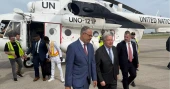
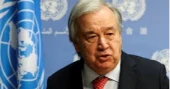
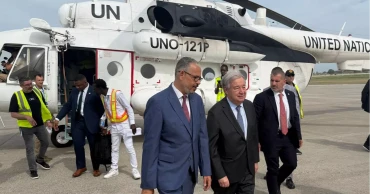
UN Secretary-General António Guterres visited Haiti on Tuesday as the country faces worsening gang violence that has displaced millions and left thousands dead or homeless.
According to new UN figures, around 2,300 people have been killed in Haiti so far this year, while another 100 have been kidnapped. The violence has forced about 1.5 million people from their homes. Among the latest kidnapping victims is James Boyard, chief of staff at the Defense Ministry, who was abducted last week in what was considered one of the safer areas of the capital.
Guterres arrived in Port-au-Prince for a one-day visit days after a violent weekend in the seaside slum of Cité Soleil, where more than 30 people were killed, injured or reported missing, according to a local human rights group.
His convoy passed through areas heavily damaged by years of gang violence, including abandoned homes, destroyed businesses and buildings scarred by gunfire. Graffiti on walls reflected public frustration, with messages supporting police and condemning the powerful gang coalition known as Viv Ansanm, which is believed to control about 70% of Port-au-Prince.
The UN chief also saw large numbers of displaced people living in makeshift shelters under tarpaulins and temporary structures.
More than 300,000 people have been displaced by gang violence in Port-au-Prince alone, the highest number ever recorded. The UN's migration agency said over 18,000 people fled Cité Soleil in May.
"Haiti's displacement crisis is entering an even more alarming phase," said Gregoire Goodstein, the International Organization for Migration's chief in Haiti.
During his visit, Guterres toured the headquarters of a newly formed international force that is expected to begin operations in the coming weeks. The force was approved by the UN Security Council and will replace the previous UN-backed mission led by Kenyan police, which struggled with limited funding and manpower.
Troops from Jamaica, Chad, El Salvador and Guatemala have joined the force, although total deployment remains below 1,000 personnel.
The international force is expected to work alongside Haiti's National Police and armed forces to combat gangs and restore security.
Guterres later held talks with Prime Minister Alix Didier-Fils-Aimé, who is under growing pressure to organize elections in the Caribbean nation of nearly 12 million people.
Haiti has been without a president since Jovenel Moïse was assassinated at his private residence in July 2021.
Following the meeting, Fils-Aimé said security remained the government's top priority to allow elections to take place and restore constitutional governance. He also called on countries supporting the international force to fulfill their commitments.
Guterres also visited a temporary shelter set up in a former school, where more than 1,200 displaced people are living in overcrowded conditions.
Many residents said they had fled gang attacks years ago and still could not safely return home. Women living at the shelter complained about the lack of privacy, poor sanitation and concerns for their children.
One resident described the cramped conditions, while others said only one meal a day was guaranteed.
"We're going to do our best," Guterres told a group of women during a private discussion.
Outside the shelter, some residents voiced frustration and demanded a safe return to their communities.
Wendy Cejour, who has lived at the shelter with his family for about 18 months, said conditions remained extremely difficult.
"As long as we're alive we have hope, but things are difficult," he said, calling for the chance to return home.
Ahead of the visit, Human Rights Watch urged the UN chief to focus on protecting civilians and addressing the root causes of violence and human rights abuses.
After meeting displaced families, Guterres said he was deeply moved by what he witnessed.
"What I saw will not leave me," he said. "Each day is a fight to survive. The women and the children pay the highest price."
3 months ago
UN faces risk of ‘imminent financial collapse’, secretary general warns
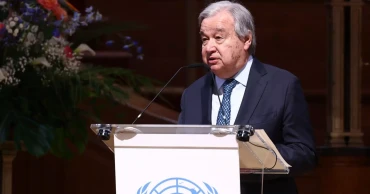
The United Nations is facing the danger of an “imminent financial collapse” as several member states fail to pay their mandatory contributions, UN Secretary General António Guterres has warned.
In a letter sent to all 193 member states, Guterres said the organisation’s financial crisis was worsening and now “deepening, threatening programme delivery”, with funds potentially running out by July. He urged countries either to pay their assessed contributions in full or to reform the UN’s financial rules to avert collapse.
The warning comes as the United States, the UN’s largest contributor, has declined to pay into the organisation’s regular and peacekeeping budgets and has withdrawn from multiple UN agencies, describing them as a “waste of taxpayer dollars”. Several other countries are also in arrears or have refused to pay their dues.
Although the UN General Assembly approved limited changes to the financial system in late 2025, the organisation remains under severe cash strain. The situation is compounded by a rule requiring the UN to refund unspent funds even when the money was never received in the first place.
At the UN’s Geneva headquarters, notices highlighting the financial crisis have been widely displayed. Cost-cutting measures are visible, with escalators frequently shut down and heating reduced in an effort to conserve funds.
Guterres wrote that while the UN had experienced financial difficulties before, the current crisis was “categorically different”. He noted that “decisions not to honour assessed contributions that finance a significant share of the approved regular budget have now been formally announced,” without naming specific countries.
Read More: 12th DU National Model United Nations set to begin on May 29
He stressed that the “integrity of the entire system” relies on members fulfilling their obligations under the UN Charter to pay their “assessed contributions”. According to the secretary general, only 77 percent of total dues were paid in 2025, leaving an unprecedented amount outstanding.
Guterres also criticised a financial rule that forces the UN to return unused programme funds, describing it as a “double blow” in which the organisation is “expected to give back cash that does not exist”.
“I cannot overstate the urgency of the situation we now face. We cannot execute budgets with uncollected funds, nor return funds we never received,” he wrote.
As a result, the UN is now refunding millions of dollars it never had. The letter stated: “Just this month, as part of the 2026 assessment, we were compelled to return $227m [£165m] – funds we have not collected.”
“The bottom line is clear,” Guterres added. “Either all member states honour their obligations to pay in full and on time – or member states must fundamentally overhaul our financial rules to prevent an imminent financial collapse.”
UN agencies often struggle to secure full funding for humanitarian responses, but the past year has been especially challenging. The US did not pay its contribution to the UN’s regular budget in 2025 and provided only 30 percent of its expected funding for peacekeeping missions, reports BBC.
Read More: Kofi Annan was the United Nations
In January, President Donald Trump withdrew the US from dozens of international bodies, including 31 UN agencies, aiming to “end American taxpayer funding and involvement in entities that advance globalist agendas over US priorities”. Although Washington pledged $2 billion (£1.5 billion) for UN humanitarian work in late December, it warned the organisation must “adapt or die”, a sharp drop from the $17 billion it provided in 2022.
Other major donors, including the UK and Germany, have also announced significant cuts to foreign aid, further affecting UN operations.
Guterres had earlier cautioned that the organisation was in its most fragile financial position in years, blaming unpaid contributions and warning in October of a “race to bankruptcy”.
Meanwhile, Trump has faced criticism over proposals to replace some UN functions with his proposed Board of Peace to oversee reconstruction in Gaza. Although he said the initiative would work “in conjunction with the United Nations”, he previously suggested otherwise, saying: “Well, it might.”
7 months ago
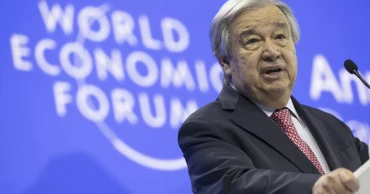
Nobody wins in a trade war: UN Chief
UN Secretary-General Antonio Guterres has warned that “nobody wins in a trade war,” according to his spokesperson on Friday.
The statement comes after U.S. President Donald Trump signed an executive order on Wednesday introducing “reciprocal tariffs.” The move includes a 10-percent “minimum baseline tariff” and potentially higher duties on selected trade partners, drawing widespread criticism.
Responding to questions about the secretary-general’s stance on the White House’s new tariff policy, UN spokesperson Stephane Dujarric said, “In a trade war, nobody wins.”
He expressed concern for the world's most vulnerable nations, stating they are “the least equipped to deal with the current situation.” Dujarric also noted that a global trade conflict would “negatively” affect progress toward the UN’s Sustainable Development Goals.
UK watchdog to probe charity co-founded by Prince Harry
In a separate statement released Friday, the UN Conference on Trade and Development (UNCTAD) echoed these concerns. It warned that the U.S.-imposed tariffs would hurt vulnerable economies, emphasizing that “the global trade system is entering a critical phase -- threatening growth, investment, and development progress, particularly for the most vulnerable economies,” as major powers move forward with sweeping new trade measures.
1 year ago
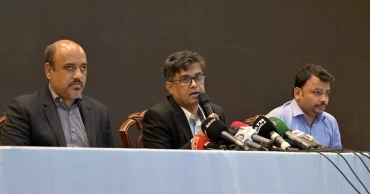
Reform initiative completely a homegrown process: CA’s Press Secretary
Chief Adviser’s Press Secretary Shafiqul Alam on Sunday said the entire reform initiative is completely a “homegrown” process and it will remain the same, noting that Bangladesh’s friendly partners and well-wishers back the reform agenda.
“The reform process is fully a homegrown one. We are maintaining the highest transparency,” he told reporters at the Foreign Service Academy while responding to a question.
Earlier, the electoral reform commission, police reform commission, judiciary reform commission, anti-corruption commission reform commission, public administration reform commission and constitutional reform commission submitted their reports and a national consensus building commission was formed.
EU to support Bangladesh in holding elections meeting international standards
Press Secretary Alam said the consensus building commission held its first meeting and there will be more in the coming days.
He said there will be intensive consultations between the political parties and consensus building commission.
“You see the whole process is homegrown,” Alam said, adding that in some areas technical support may be required. “We have not said yet whether we will accept technical support or not. But it is fully homegrown reforms involving our people and experts.”
The Press Secretary said the interim government remains transparent with adequate openness and this whole process will remain homegrown.
As the country undergoes important reforms and transitions, UN Secretary-General Antonio Guterres assured that the UN stands ready to assist in fostering peace, national dialogue, trust and healing.
Reforms to make Bangladesh one of the perfect democracies in world, says Guterres before departing Dhaka
"You can count on the UN to be your steadfast partner, working alongside the people of Bangladesh to help build a sustainable and equitable future for all," he said during his just-concluded visit.
CA’s Deputy Press Secretary Abul Kalam Azad Majumder and Senior Assistant Press Secretary Ahammad Foyez were also present.
1 year ago
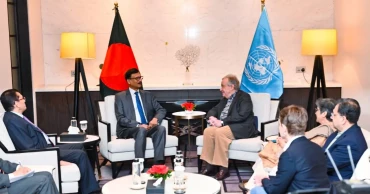
UN chief to call upon int'l community to step up humanitarian assistance for Rohingyas
UN Secretary-General Antonio Guterres, who will visit the Rohingya camp together with Chief Adviser Prof Muhammad Yunus on Friday afternoon, will "issue a call" to the international community to step up their humanitarian assistance for these men, women and children who have already suffered so much.
He will share an Iftar with the refugees, to be hosted by Dr Yunus.
A million Rohingyas will break fast in their camps in Cox's Bazar with Guterres and Chief Adviser Dr Yunus.
"Every Ramadan, I spend time with Muslim communities living in difficult circumstances, to observe the fast with them and help shine a spotlight on their plight. This year I’m in Bangladesh to express my solidarity with Rohingya refugees and the Bangladeshi people hosting them," Guterres said on his Ramadan solidarity visit.
Foreign Affairs Adviser Touhid Hossain and High Representative of Chief Advisor on Rohingya Issue and Priority Matters Dr Khalilur Rahman met with the UN chief at Hotel InterContinental on Friday morning and discussed the issues related to the Rohingya crisis.
The UN chief had a bilateral meeting with the chief adviser and they are scheduled to leave Hazrat Shahjalal International Airport for Cox’s Bazar by a chartered Biman Bangladesh flight at 11:15am today (Friday), a senior official told UNB.
Guterres arrived in Dhaka on Thursday afternoon with a packed schedule for Friday and Saturday, featuring a series of meetings and greater engagements in Cox’s Bazar Rohingya camp, before his departure on Sunday morning.
Guterres and Dr Yunus will meet there with Rohingya refugees who have been forcibly displaced from their homes in Myanmar.
UN chief to inspire Rohingyas with hope for safe return: Shafiqul Alam
They will meet with the host Bangladeshi communities who have been so generous in hosting them.
On Saturday in Dhaka, the secretary-general will meet with youth and representatives from civil society, said an official at the UN office in Dhaka.
He will also have a joint press conference with the Foreign Adviser Hossain on Saturday afternoon.
And we will update you on all of the secretary-general’s activities.
Chief Adviser’s Press Secretary Shafiqul Alam on Thursday said Guterres, who is now in city on a four-day Ramadan solidarity visit, will give the Rohingya community a message of hope that they will be able to return to their homeland soon in dignity and with safety, and that all of their rights will be fully established and respected.
"We would also urge that the Secretary General will invest his exceptional leadership to make progress toward the objective of their early repatriation and ensure that international aid to Rohingyas are not adversely affected," Alam said while responding to some queries that he received from the media.
Regarding contact with Arakan Army, the Press Secretary said considering the newly emerged situation in the Rakhine state, they ought to act and safeguard their border security, stability and peace.
"Therefore, we are keeping operational contact with the actors on the other side of the border," Alam said.
He said the solution of the Rohingya issue lies in sustainable repatriation of the Rohingyas back to Myanmar.
Dr Yunus, UN chief Guterres to visit Rohingya camps Friday
This should be the highest priority of the international community, Alam said, adding that Bangladesh is relentlessly working toward this objective.
Bangladesh has been hosting over 1.2 million Rohingya refugees for long eight years.
In recent months. around 80,000 more Rohingyas have entered Bangladesh.
"It is beyond the capacity of Bangladesh to continue to host the forcibly displaced Rohingyas," Alam said.
He said the international support for Rohingyas has taken a turn for the worse, leading to the decision to cut the daily food ration for the Rohingyas.
"This will severely affect their nutritional status, particularly women and children. It will also have serious social and security implications, including safety and security within the camps and in the host community," Alam said.
He said they reiterate Bangladesh's appeal to all donors and the UN system to ensure that the assistance to Rohingyas is given high priority and aid to them does not diminish.
Global focus on Rohingya crisis to return through UN chief’s visit: Govt
In light of the dire humanitarian situation in Rakhine State, the press secretary said, Bangladesh will positively consider supporting UN-led humanitarian assistance to the state.
1 year ago
UN Secretary-General to visit Bangladesh on March 13-16
The Office of the United Nations Secretary-General has said that UN Secretary-General António Guterres will undertake an official visit to Bangladesh from March 13-16.
Not for UN Secretary-General to designate an event as genocide: Spokesman
The visit follows an invitation from Chief Adviser of Bangladesh, Dr Muhammad Yunus, which was handed over by Dr Khalilur Rahman, High Representative of the Chief Adviser on the Rohingya Issue and Priority Matters, during his meeting with the Secretary-General on February 7 in New York.
1 year ago
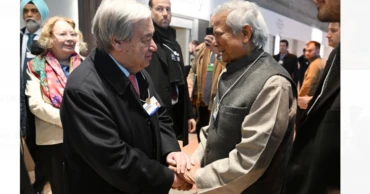
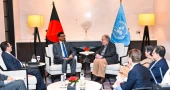
UN chief Guterres meets Dr Yunus in Davos
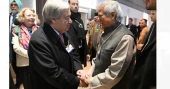
United Nations (UN) Secretary General Antonio Guterres on Wednesday met Chief Adviser Prof Muhammad Yunus in the Swiss city of Davos.
During the meeting on the sidelines of the World Economic Forum (WEF) annual meeting, Antonio Guterres and Dr Yunus exchanged pleasantries.
CA Dr Yunus begins hectic 2nd day in Davos with 14 meetings lined up
The Chief Adviser also had a brief conversation with European Central Bank chief Christine Lagarde on the sidelines of the WEF meeting.
UAE invites Dr Yunus to attend World Governments Summit in Dubai
1 year ago

Zero hunger is achievable: Antonio Guterres
Some 780 million people around the world are going hungry and almost fifty million children are at risk of death from severe wasting, said United Nations Secretary-General António Guterres.
“Yet funding for this year’s global humanitarian appeal stands at just 32 percent,” he said in a message marking the World Food Day that falls on October 16.
World Food Day 2023 comes during a global food crisis, with the world moving backwards on ending hunger and malnutrition.
Brian Urquhart, early leader of United Nations, dies at 101
“This World Food Day, I call on governments, the private sector, civil society and academia to work together; to prioritize feeding the hungry; to bring ending this crisis to the top of the global agenda; and to invest in long-term solutions that provide everyone with enough to eat,” said the UN chief, noting that zero hunger is achievable.
Guterres said in their world of plenty, it is outrageous that a person dies of hunger every few seconds, while the World Food Programme has been forced to cut its essential aid programmes.
Kofi Annan was the United Nations
In 2015, after years of progress, governments set the goal of zero hunger by 2030. But eight years later, the number of people suffering from hunger has increased significantly.
“This crisis demands action – first and foremost from national governments, which have a responsibility to make sure their people have enough to eat. But many governments lack the resources to do so, and so effective international solidarity is also essential,” said the UN chief.
The long-term causes of the global food crisis include conflicts, climate extremes, inequality, and economic instability, he said.
Dr Debapriya reappointed to United Nations CDP
The UN system is addressing these root causes through our support for sustainable, equitable food systems that put people over profits.
“That means massively scaling up investments in resilient agriculture, and aligning them with climate action. It means leveraging science and technology to improve the efficiency and reach of food systems,” Guterres said.
This year’s theme for World Food Day focuses on water – a necessity for nutritious and healthy food.
The sustainable management of water for agriculture and food production is essential to end hunger, achieve the SDGs, and preserve water for future generations, said the UN chief.
2 years ago

UN steps up criticism of IMF and World Bank, the other pillars of the post-World War II global order
From the ashes of World War II, three institutions were created as linchpins of a new global order. Now, in an unusual move, the top official in one — the secretary-general of the United Nations — is pressing for major changes in the other two.
Antonio Guterres says the International Monetary Fund has benefited rich countries instead of poor ones. And he describes the IMF and World Bank 's response to the COVID-19 pandemic as a "glaring failure" that left dozens of countries deeply indebted.
Also Read: Budget not based on IMF conditions: Finance Minister
Guterres' criticism, in a recent paper, isn't the first time he's called for overhauling global financial institutions. But it is his most in-depth analysis of their problems, cast in light of their response to the pandemic, which he called a "stress test" for the organizations.
His comments were issued ahead of meetings called by French President Emmanuel Macron in Paris on Thursday and Friday to address reforms of the multilateral development banks and other issues.
Neither the IMF nor the World Bank would comment directly on the secretary-general's criticisms and proposals. But Guterres' comments echo those of outside critics, who see the IMF and World Bank's leadership limited by the powerful nations that control them — a situation similar to that of the United Nations, which has faced its own calls for reform.
Also Read: Bangladesh faces external pressures, requires careful macroeconomic management: World Bank
Maurice Kugler, a professor of public policy at George Mason University, told The Associated Press that the institutions' failure to help the neediest countries "reflects the persistence of a top-down approach in which the World Bank president is a U.S. national appointed by the U.S. president and the IMF managing director is a European Union national appointed by the European Commission."
Richard Gowan, the International Crisis Group's U.N. director, said there is a lot of frustration with the U.S. and its European allies dominating decision-making, leaving African countries with only "a sliver of voting rights." Developing countries also complain that the bank's lending rules are weighted against them, he said.
"In fairness, the bank has been trying to update its funding procedures to address these concerns, but it has not gone far enough to satisfy countries in the Global South," Gowan said.
Guterres said it's time for the boards of the IMF and the World Bank to right what he called the historic wrongs and "bias and injustice built into the current international financial architecture."
Also Read: Bangladesh receives $858 mln World Bank fund for agriculture growth, road safety
That "architecture" was established when many developing countries were still under colonial rule.
The IMF and what is now known as the World Bank Group were created at a conference in Bretton Woods, New Hampshire, in July 1944 to be key institutions of a postwar international monetary system. The IMF was to monitor exchange rates and lend reserve currencies to countries with balance of payment deficits. The World Bank would provide financial assistance for postwar reconstruction and for building the economies of less developed countries.
Guterres said the institutions haven't kept pace with global growth. He said the World Bank has $22 billion in paid capital, the money used for low-interest loans and grants for government development programs. As a percentage of global GDP, that's less than one-fifth of the 1960 funding level.
At the same time, many developing countries are in a deep financial crisis, exacerbated by inflation, rising interest rates and a standstill in debt relief.
"Some governments are being forced to choose between making debt repayments or defaulting in order to pay public sector workers — possibly ruining their credit rating for years to come," Guterres said, adding that "Africa now spends more on debt service costs than on health care."
The IMF's rules unfairly favor wealthy nations, he said. During the pandemic, the wealthy Group of Seven nations, with a population of 772 million, received the equivalent of $280 billion from the IMF while the least developed countries, with a population of 1.1 billion, were allocated just over $8 billion.
"This was done according to the rules," Guterres said. This is "morally wrong."
He called for major reforms that would strengthen the representation of developing countries on the boards of the IMF and World Bank, help countries restructure debts, change IMF quotas, and revamp the use of IMF funds. He also called for scaling up financing for economic development and tackling the impact of climate change.
IMF spokesperson Julie Kozack, asked about Guterres' proposals at a June 8 news conference, said "I'm not in a position to comment on any of the specifics."
She added that a review of IMF quotas is a priority and is expected to be completed by Dec. 15.
In a written response to a query from the AP, the IMF said it has mounted "an unprecedented" response to the largest-ever request from countries for help dealing with recent shocks.
After the pandemic hit, the IMF approved $306 billion in financing for 96 countries, including below-market rate loans to 57 low-income countries. It also increased interest-free lending fourfold to $24 billion and provided around $964 million in grants to 31 of its most vulnerable nations between April 2020 and 2022 so they could service their debts.
The World Bank Group said in January that its shareholders have initiated a process "to better address the scale of development."
The bank's development committee said in a March report that the bank "must evolve in response to the unprecedented confluence of global crises that has upended development progress and threatens people and the planet."
Guterres' push for reforming the IMF and World Bank comes as the United Nations also faces demands for an overhaul of its structure, which still reflects the post-World War II global order.
Gowan said many U.N. ambassadors think it might be "marginally easier" and more helpful to developing countries to overhaul the IMF and World Bank than to reform the U.N. Security Council, which has been debated for more than 40 years.
While Guterres and U.N. ambassadors talk about reforming the financial institutions, any changes are up to their boards. Gowan noted that when the Obama administration engineered a reform of IMF voting rights in 2010, "Congress took five years to ratify the deal — and Congress is even more divided and dysfunctional now."
"But Western governments are aware that China is an increasingly dominant lender in many developing countries," Gowan said, "so they have an interest in reforming the IMF and World Bank in ways that keep poorer states from relying on Beijing for loans."
Beyond the Paris meeting, the debate over IMF and World Bank reforms will continue in September at a summit of leaders of the Group of 20 in New Delhi, and at the annual gathering of world leaders at the United Nations.
U.S. climate chief John Kerry said in an Associated Press interview Wednesday that he will be attending the Paris summit along with IMF and World Bank officials.
"Hopefully, new avenues of finance will be more defined than they have been," he said. "I think it's really important."
3 years ago

Stop targeting truth, truth-tellers: UN Chief on World Press Freedom Day
UN Secretary-General Antonio Guterres has said world must speak with one voice — stop lies and disinformation, and stop targeting truth and truth-tellers.
"As journalists stand up for truth, the world stands with them," he said in a message marking World Press Freedom Day that falls on May 3.
For three decades, on World Press Freedom Day, the international community has celebrated the work of journalists and media workers.
"Freedom of the press is the foundation of democracy and justice. It gives all of us the facts we need to shape opinions and speak truth to power. And as this year’s theme reminds us, press freedom represents the very lifeblood of human rights," Guterres said.
But in every corner of the world, freedom of the press is under attack, he said.
Truth is threatened by disinformation and hate speech seeking to blur the lines between fact and fiction, between science and conspiracy, the UN chief said.
Also read: Repeal DSA, demands TIB marking World Press Freedom Day
The increased concentration of the media industry into the hands of a few, the financial collapse of scores of independent news organizations, and an increase of national laws and regulations that stifle journalists are further expanding censorship and threatening freedom of expression, he said.
Meanwhile, Guterres said, journalists and media workers are directly targeted on and offline as they carry out their vital work. They are routinely harassed, intimidated, detained and imprisoned.
At least 67 media workers were killed in 2022 — an unbelievable 50 percent increase over the previous year.
Nearly three quarters of women journalists have experienced violence online, and one in four have been threatened physically.
Ten years ago, the United Nations established a plan of action on the safety of journalists to protect media workers and end impunity for crimes committed against them.
The world must stop the threats and attacks, the UN chief said. "Stop detaining and imprisoning journalists for doing their jobs."
3 years ago