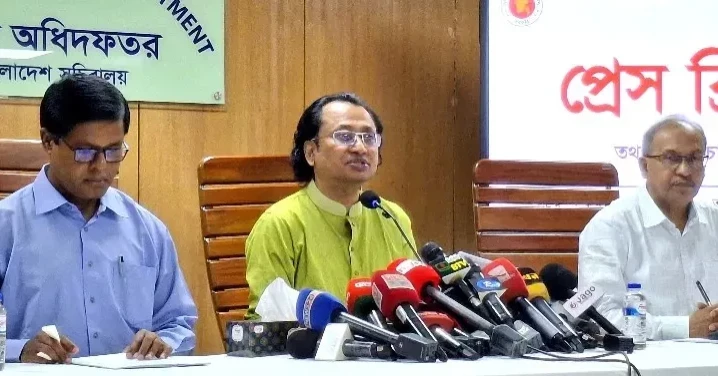
Prime Minister’s Information and Broadcasting Adviser Zahed Ur Rahman on Tuesday defended the government’s decision to raise fuel prices and acknowledged that the hike is causing and will continue to cause hardship for people.
“The move is causing and will cause hardship for people but the government has to maintain a balance between spending on fuel subsidies and other sectors including social safety-net programmes, healthcare and education,” he said while responding to questions from journalists at a press briefing held at the Secretariat on the progress of various government activities.
Global oil prices has declined slightly over the past few days but the international market remains unstable, with the possibility of further increases ahead, said the adviser.
“Crude oil prices have fallen by two or three percent over the last two or three days. It is still above $100 per barrel. It has come down somewhat, but there is actually little possibility that this will be sustained,” he added.
Pointing to the Middle East crisis, the adviser said the risk of disruptions to key shipping routes, possible disruptions to Saudi Arabia’s oil exports and attacks on oil facilities linked to the Russia-Ukraine war as factors that could further destabilise the global fuel market.
The government could not spend heavily on fuel subsidies while simultaneously allocating large amounts to social protection, healthcare and education, he said.
“One of the very important tasks of a government is spending on the welfare sector. We want to spend on social safety, healthcare and education at the same time. But if we try to do everything together, it becomes difficult,” he said.
The adviser also highlighted the pressure of subsidies in the gas and electricity sectors.
He said around Tk 48,000 crore were allocated for subsidies in the current fiscal year, but nearly half of that amount has already been spent within two and a half months.
“If you continue providing subsidies for gas and electricity at this rate, by the end of the year it will stand at Tk 1.25 lakh crore to Tk 1.5 lakh crore,” he said.
Zahed acknowledged that higher diesel prices would increase transportation costs, saying the government would try to ensure that transport fares are adjusted by a reasonable amount.
He also said initiatives are being taken to expand food assistance, Open Market Sale (OMS) programmes and Family Card programmes for low-income and vulnerable people.
Regarding the price increases for petrol and octane, he said domestic production from condensate was insufficient to meet the country’s total demand and so petrol and octane also have to be produced from imported crude oil.
He said there was also a policy rationale for keeping petrol and octane prices relatively higher, as these fuels are used more by comparatively affluent consumers.
Fuel price hike not due to IMF condition
Asked whether the fuel price increase was linked to any specific condition imposed by the International Monetary Fund (IMF), Zahed said there was no such condition.
“No, there is actually no such condition. The basic rule of the IMF is that it does not want a government to provide excessive subsidies,” he said.
He said the government is considering reducing large subsidies for fuel, gas and electricity based on economic realities rather than any specific IMF condition.
Adviser explains public servants' pay hike
Responding to questions about the decision to increase government employees’ salaries amid pressure from fuel subsidies, Zahed said the last pay scale was implemented in 2015 and has not been revised for around a decade.
“The last pay scale was in 2015, if I am not mistaken. Ten or 11 years have passed since then, and inflation has been around 10 percent, more or less, grossly. So think about the fact that it has not been revised during this period,” he said.
He said the decision was to implement the recommendations of the pay commission gradually rather than all at once, describing it as part of the government’s effort to balance resource allocation among various priorities.
PM's trip shortened for cost-cutting, domestic situation
The adviser said Prime Minister Tarique Rahman’s current foreign trip was shortened to reduce expenses and in view of the country’s domestic situation.
“A shorter trip is more cost-effective than a long trip. You will notice that he has gone with a very small delegation. At the same time, the country is going through various kinds of crises. So staying in the country is certainly a better priority for him at this moment,” he said.
He also said they are not yet aware of any plan for a bilateral meeting between the prime minister and US President Donald Trump during the trip.