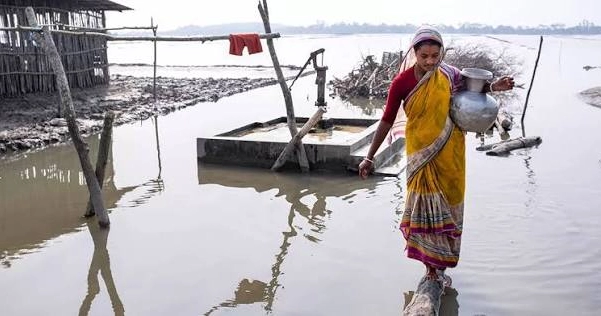
Preliminary findings from a study conducted in coastal Bangladesh from 2023 to 2025 indicate substantial exposure to saline drinking water alongside elevated cardiovascular health risks, reinforcing the need to address water security, climate adaptation and non-communicable diseases together.
The findings were presented at a high-level policy and dissemination seminar titled “Drinking Water Salinity and Impact on Health: Bangladesh Evidence and Policy Recommendations,” organised by icddr,b in collaboration with Imperial College London at the Sasakawa Auditorium at icddr,b in Mohakhali, Dhaka.
Dr Aliya Naheed, Senior Scientist at icddr,b, presented preliminary findings from the Bangladesh programme of the NIHR Global Health Research Centre for Non-Communicable Diseases and Environmental Change.
The programme first assessed drinking-water sources in 172 villages in 71 Community Clinic catchment areas in Koyra Upazila of Khulna, the intervention area, and Assasuni Upazila of Satkhira, the usual-care comparison area.
Researchers surveyed 27,697 water sources, of which 6,703, or 24.2 percent, were being used for drinking. Among the drinking-water sources, 55.3 percent in Koyra and 23.3 percent in Assasuni were found to be saline.
“For millions of people living in coastal Bangladesh, the water they depend on every day is becoming a growing health concern. Drinking-water salinity is no longer only an environmental challenge; increasing sodium exposure can contribute to high blood pressure and related cardiovascular and kidney diseases, while women may face additional risks during pregnancy,” Dr Aliya said.
The research also assessed cardiovascular disease risk among 15,471 adults aged 40 years or older in Koyra and Assasuni, said a press release.
Of them, about one in five, or 21.6 percent, were estimated to have a moderate-to-high 10-year risk of cardiovascular disease (CVD), defined as a risk of at least 10 percent.
The prevalence was 19.7 percent in Koyra and 23.6 percent in Assasuni, with both areas showing substantially higher levels than the national estimate of approximately 9.02 percent.
Based on this evidence, the research team has designed a package of water and primary healthcare interventions integrating digital innovation.
The water intervention will seek to improve access to low-salinity drinking water through community awareness and engagement, better operation and maintenance of water sources, and the establishment of a strong local governance and monitoring framework.
It covers communal rainwater harvesting systems, household rainwater harvesting systems, pond sand filters and tube wells, together with a proposed digital registry and monitoring system for drinking-water sources.
Research conducted in coastal Bangladesh over nearly two decades has found associations between saline drinking water, particularly sodium exposure, and elevated blood pressure.
Professor Paolo Vineis of Imperial College London presented evidence that the available research does not identify a clear health-based threshold for drinking-water salinity.
He stressed the need for national and international institutions to consider developing an appropriate health-based threshold guideline for drinking water while research continues to clarify how sodium and other minerals affect health.
Professor Adrian Butler of Imperial College London presented evidence on how tropical-cyclone storm surges can cause long-term salinisation of drinking-water ponds and shallow groundwater.
He highlighted the need to maintain and, where appropriate, raise polder embankments, together with rapid clean-up and restoration of water sources after storm surges.
Dr Tahmeed Ahmed, Executive Director of icddr,b, said evidence linking climate change with health outcomes in Bangladesh remains limited, while even less research has focused on practical adaptation strategies and innovations.
“icddr,b is working to address these critical gaps by generating evidence and testing solutions that connect safe drinking water, primary healthcare and community participation. Through our collaboration with Imperial College London, we are moving from understanding the problem to evaluating approaches that can protect climate-vulnerable communities,” he said.
Fahmida Khanom, Secretary In-Charge, Ministry of Environment, Forest and Climate Change, attended the seminar as the chief guest.
“Salinity is already a major health problem for coastal communities, and climate change will intensify salinity intrusion. Evidence like this is important not only for national action; it gives Bangladesh stronger evidence to take into international climate negotiations and emphasized adaptation and mitigation strategy,” she said.
Representatives from government, academia, development agencies, media and research institutions participated in a panel and open discussion.
The seminar called for stronger water-quality monitoring and data sharing, health-based guidance on sodium in drinking water, improved inter-ministerial coordination, sustainable management of water sources, protection against climate-related hazards, and integration of safe-water action with NCD prevention and primary healthcare.