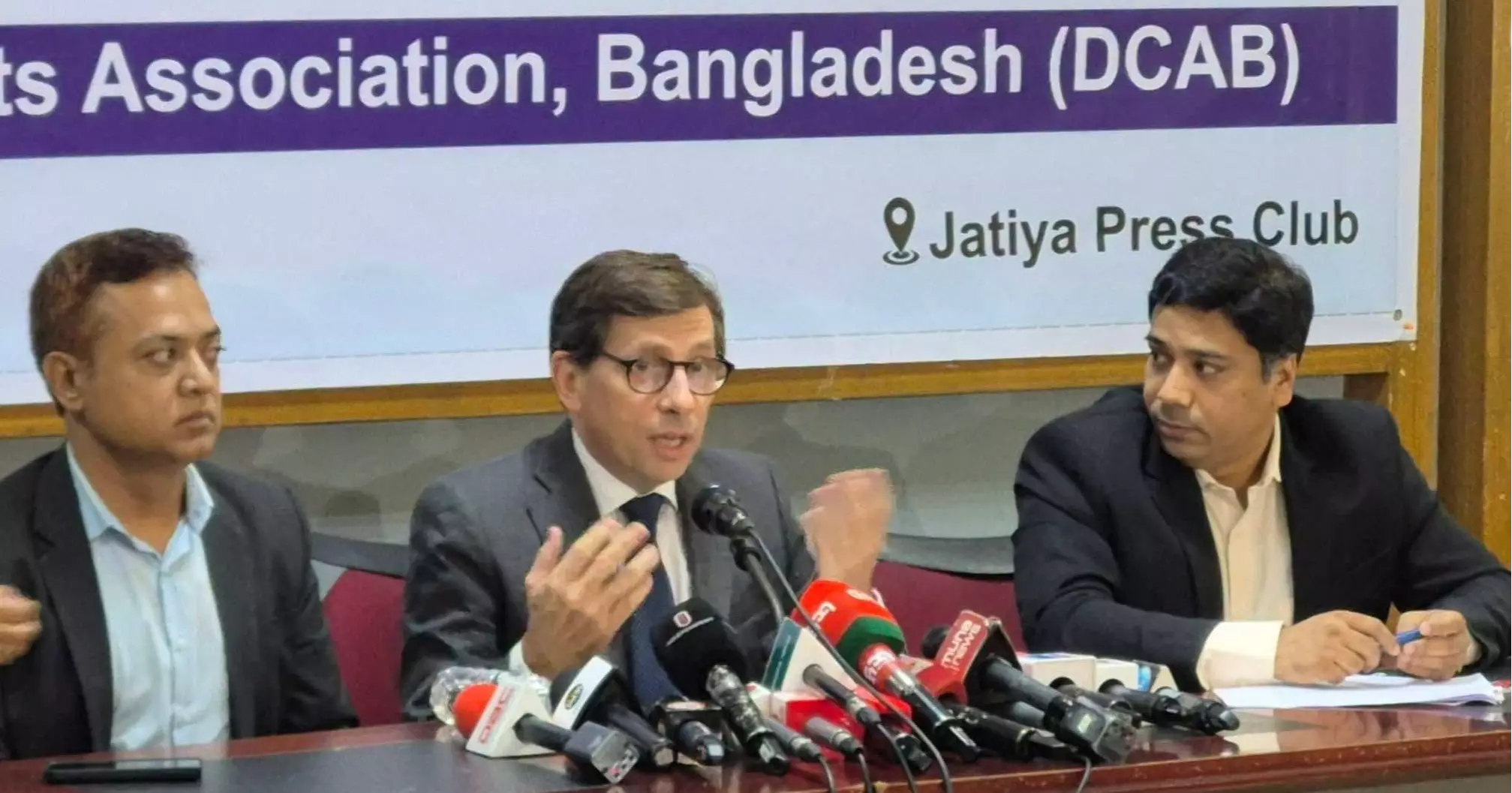
France Ambassador to Bangladesh Jean-Marc Séré-Charlet on Tuesday said France aims to help its partners in South Asia, such as Bangladesh, achieve their own strategic autonomy, so that they are not forced to choose between Washington and Beijing.
“Faced with the growing rivalry between the United States and China, France is positioning itself as a balancing power, leveraging its status as an Indian Ocean nation,” he said.
Ambassador Séré-Charlet said France's diplomatic and strategic interests in the Indo-Pacific region, particularly in its relationship with Bangladesh, are centered around promoting a multilateral "third way."
Speaking at the “DCAB Talk”, he said promoting a "third way" in the face of hegemonic powers means strategic autonomy and rejection of imperialism.
Diplomatic Correspondents Association, Bangladesh (DCAB) hosted its flagship event at the Jatiya Press Club. DCAB President AKM Moinuddin and its General Secretary Emrul Kayesh also spoke.
Talking about maritime security and stability in the Indian Ocean, the French envoy said it starts with the freedom of navigation.
As the northern Indian Ocean is a vital maritime route for global trade, France is committed to upholding international maritime law in the region, addressing the risks of territorial claims and expansionism, he said.
The envoy said it also implies surveillance and sovereignty, as France, with the largest maritime domain in the region, is strengthening its partnerships to combat non-traditional threats, including illegal fishing, piracy, and trafficking.
Ambassador Séré-Charlet said the economic relations between France and Bangladesh are characterised by dynamic trade, but with a structural imbalance. Bilateral trade exceeds 4.5 billion euros, marking a significant increase over the decade.
However, the envoy said, France has a structurally deficit balance, as imports of Bangladeshi products (particularly textiles) are significantly higher than French exports. Nearly 95% of French imports from Bangladesh come from the textile sector (clothing and apparel).
The remaining imports primarily involve major contracts, the aerospace industry, equipment, and technology.
He said the French presence is supported by major industrial groups operating in transportation, energy, and resilient urban development.
However, opportunities for diversification are emerging in the pharmaceutical industry, food processing, and digital technologies, said the envoy.
France is a leader in climate diplomacy and crisis management - initiator of the Paris agreement in 2015, France is promoting environmental cooperation.
“As Bangladesh is one of the countries most vulnerable to climate change, France is leveraging its leadership in environmental issues to build strong cooperation in areas such as adaptation, resilient infrastructure, and natural disaster risk management,” he said.
Faced with Bangladesh's high vulnerability to climate change, the two countries are strengthening their dialogue on sustainable infrastructure projects and green adaptation initiatives, Ambassador Séré-Charlet said.
The envoy said French diplomacy actively supports Bangladesh in its major transitions, whether it involves the political reforms being implemented by the government or its upcoming graduation from the category of Least Developed Countries (LDCs).
France is a pioneer in feminist foreign policy since 2019. It prioritizes gender equality in diplomacy, development, and multilateral forums based on its feminist foreign policy strategy (2025-2030) to promote gender equality and women's rights globally.
This policy aligns with efforts by other countries and addresses growing challenges to these principles. Its strategy focuses on education, eliminating gender-based violence, political participation, economic empowerment, and reproductive rights, he said.
New priorities include feminist climate action, digital rights, and economic policies supporting equality, said the envoy, noting that France's feminist foreign policy is a proactive response to systemic inequalities and rising threats to women's rights, emphasizing multilateral cooperation and domestic action.
“For all these reasons, we are ready to strengthen our engagement with Bangladesh, which is sometimes very cautious on the international stage. We need that the countries that share the same values and goals (peaceful international relations) be more assertive and more proactive, to cooperate more, and to demonstrate, through their example, the effectiveness of this model,” said Ambassador Séré-Charlet.
He said they are seeing an unprecedented rapprochement with Canada, as well as with other countries. “It is not only geopolitical but also economy and business. I believe that Franco-Bangladeshi relations have great potential.”
The envoy said this world is more chaotic, more dangerous, and more uncertain than before. “Confrontation has become a standard mode of interaction between States, and cooperation, even when it exists, is becoming increasingly rare.”
Ambassador Séré-Charlet said the world is undergoing a period of profound changes, with wars multiplying and conflict zones where it is no longer possible to go constantly expanding. “And the use of force has become an option that many now consider.”
About the Middle East, he underlined that today is the first anniversary of the French government's recognition of the State of Palestine, which was officially announced by President Emmanuel Macron on September 22, 2025, at the United Nations General Assembly in New York.
France recognised the State of Palestine during the 80th session of the General Assembly, as part of a joint conference on the two-state solution co-chaired with Saudi Arabia.
France joined a collective movement alongside other Western countries (including the United Kingdom, Canada, Australia, and Belgium) that have announced or implemented similar initiatives during the same period.
“With this announcement, a significant majority of UN member states formally recognised the State of Palestine. This decision aims to revitalise the peace process in the Middle East, affirming the legitimate rights of the Palestinian people while reaffirming France's commitment to the security of Israel,” Ambassador Séré-Charlet said.
He said the opening of a French embassy to the State of Palestine is contingent upon the establishment of a ceasefire and the release of hostages held in Gaza.