
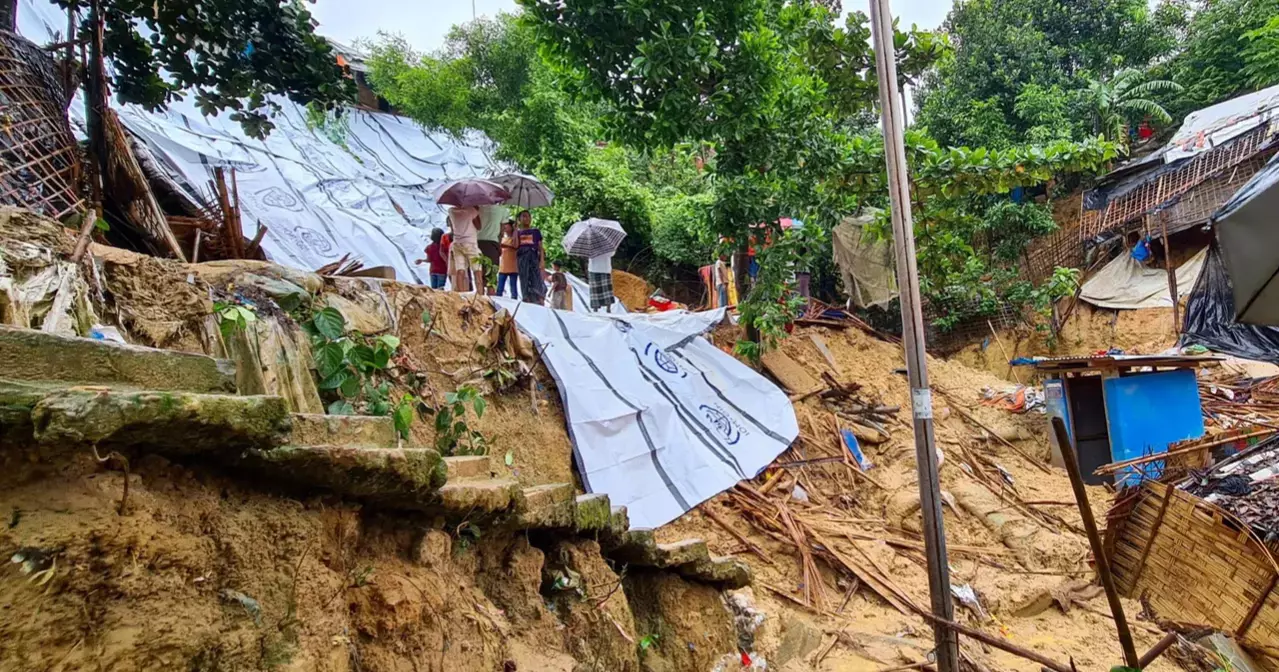
Prolonged heavy rainfall continues to wreak havoc across the Rohingya camps in Cox's Bazar, with the death toll reaching 10 as of Tuesday.
With heavy to very heavy rainfall forecast over the next 48 hours, the humanitarian situation remains highly volatile.
Heavy to very heavy rainfall continues across Cox's Bazar and the greater Chattogram Division, with saturated ground conditions sustaining a high risk of landslides, flash floods and localized waterlogging, particularly in the hilly refugee camps.
According to the Bangladesh Meteorological Department (BMD), these conditions are expected to persist over the next 48 hours.
The combination of persistent rainfall, saturated soil and unstable slopes continues to pose a high risk of further landslides, flash floods, shelter damage, infrastructure disruptions and displacement, particularly in the hilly camps of Ukhiya and Teknaf.
Humanitarian partners have been advised to remain on high alert, closely monitor official weather updates, intensify surveillance of high-risk locations and the worst-affected camps, and exercise caution during field operations, officials told UNB.
Humanitarian partners continue to work in close coordination with the Government of Bangladesh, including the Refugee Relief and Repatriation Commissioner (RRRC), local administration, the Fire Service and Civil Defence, and the Armed Police Battalion (APBN), to support search and rescue operations, conduct rapid assessments and coordinate emergency response efforts across the affected camps.
The latest incidents also highlight the severe operational constraints created by chronic camp congestion, reinforcing the need for continued advocacy on camp space optimization and, where feasible, additional land.
Expanding available space would facilitate the relocation of families from high-risk areas, improve drainage and access, and strengthen resilience against future monsoon-related disasters, according to the RCP Secretariat.
The ongoing emergency has also underscored the urgent need for increased funding under the 2026 Joint Response Plan (JRP), as humanitarian sectors continue to face significant financial shortfalls that are limiting their ability to sustain critical services and preparedness efforts.
The Access & Safety and Disaster Risk Management portfolio has received only 40 percent of its required funding, leaving a gap of US$23.2 million against total requirements of US$38.8 million.
Overall, the Shelter–CCCM appeal is just 42 percent funded, with US$73.9 million still needed.
Humanitarian agencies say immediate funding is essential to expand emergency slope stabilization, drainage and watershed management, access improvements, and specialized technical interventions to protect lives, reduce disaster risks and sustain humanitarian access throughout the remainder of the monsoon season.
Local cautionary signal number 3 remains in force for the maritime ports of Chattogram, Cox's Bazar, Mongla and Payra, while the BMD has forecast heavy (44-88 mm in 24 hours) to very heavy (more than 88 mm in 24 hours) rainfall across the Chattogram Division.
The BMD said the prevailing weather is linked to an active monsoon circulation associated with the Monsoon Land Depression, which weakened after moving northwest over south Jharkhand and adjoining Odisha.
Although the depression has moved away from Bangladesh, its associated monsoon circulation continues to influence weather conditions across the country.
The BMD weather station in Cox's Bazar recorded 129 mm of rainfall during the 24-hour period ending at 6:00 am on July 7, further saturating the ground and increasing the risk of additional landslides and localized flooding.
According to the RCP Daily Incidents Dashboard, the 160 reported incidents comprised 83 windstorm incidents, 52 landslides, 14 floods, three drowning incidents and two infrastructure hazards.
Outside the camps, one local resident reportedly died after a landslide triggered by a hill collapse struck his house in the Sattar Ghona area of Cox's Bazar Sadar Upazila.