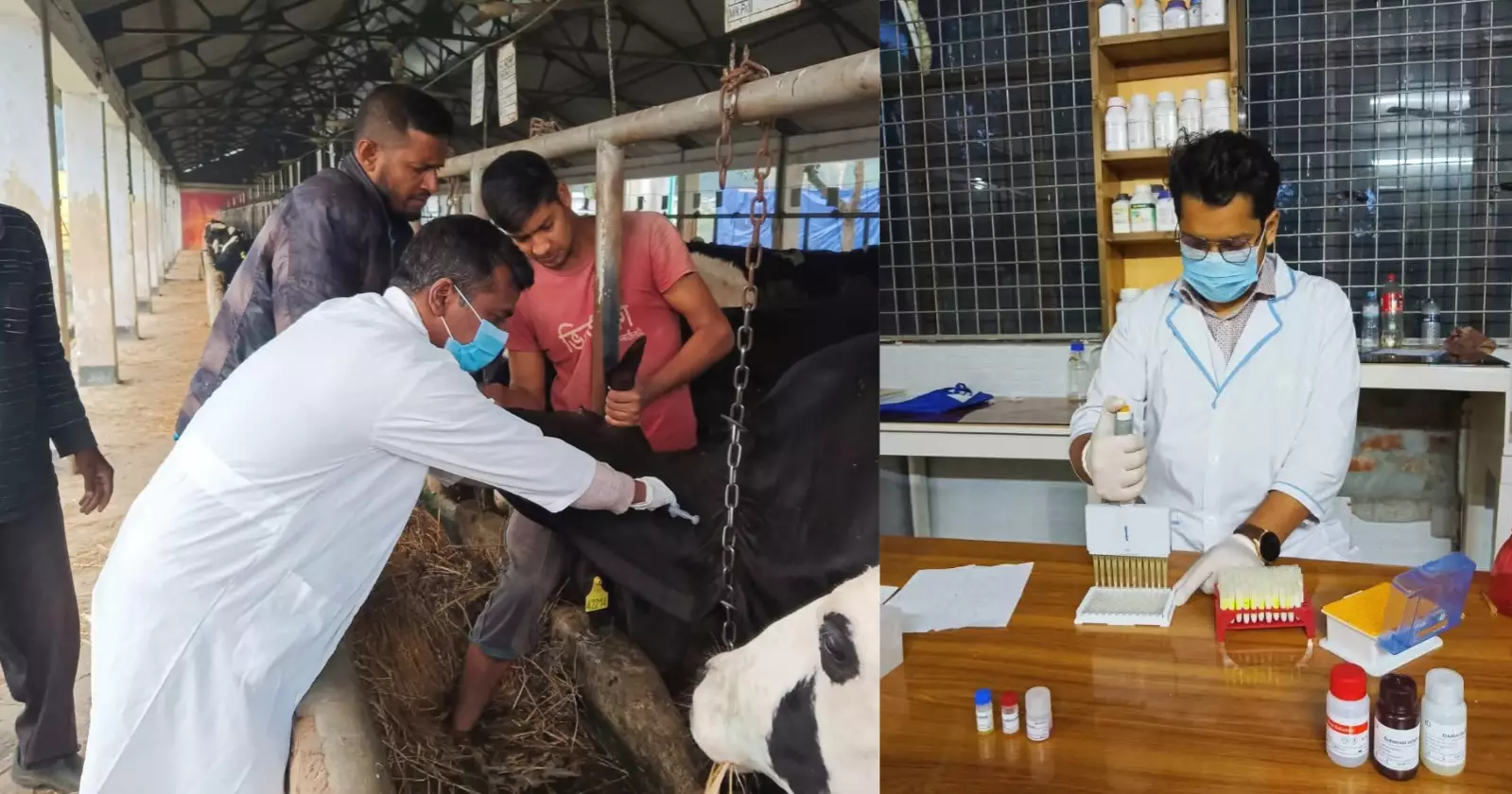
Dairy farmers in Bangladesh may be losing a significant amount of income every year without even realising it, as brucellosis, a largely overlooked livestock disease, silently reduces milk production in infected cows.
A two-year study by a team of researchers from Bangladesh Agricultural University (BAU) has found that a cow suffering from active brucellosis produces, on average, about one litre less milk a day than a healthy cow, while even cows carrying the disease without showing visible symptoms produce around half a litre less.
The researchers estimate that brucellosis could cause annual economic losses of around Tk 2.41 crore on average at large commercial dairy farms, with reduced milk production accounting for most of the losses.
The findings are particularly significant for Bangladesh, where ensuring adequate and nutritious food for a growing population remains a major challenge and milk plays an important role in meeting the nutritional needs of children, women and people of all ages.
Although the country’s dairy and dairy-products sector has been gradually moving towards self-sufficiency, brucellosis has emerged as a major obstacle to the sector’s growth, the researchers said.
The study was conducted on 2,696 lactating cows at 17 large commercial dairy farms in the country’s major milk-producing areas between January 2023 and December 2024.
The findings were recently published in the international research journal Animal Diseases.
Farmers generally suspect brucellosis when a cow suffers a miscarriage. But the researchers found that the disease can remain hidden in many cows without producing any obvious external signs.
“Our study found that a cow with active brucellosis produces an average of 1.01 litres less milk per day than a healthy cow. Even a cow with a hidden or latent infection, despite showing no external symptoms, produces 0.53 litres less milk daily,” said lead researcher Professor Dr AKM Anisur Rahman of BAU’s Department of Medicine.
Speaking to UNB, the research team said farmers often fail to recognise these hidden losses because the decline in milk production is gradual and the animals may otherwise appear healthy.
In active infections, the reduction in milk production can be one litre or more per cow per day, they said.
As a result, farmers may suffer substantial financial losses every day without knowing that brucellosis is responsible.
The researchers advised farmers to consult veterinarians and arrange testing without delay if they notice repeated miscarriages, retained placenta, failure to come into heat or repeated breeding failures among their cows.
Zeroing in on latency
Professor Anisur Rahman said cows are generally classified simply as either healthy or infected when studying brucellosis.
The BAU study, however, specifically identified latent infections as a separate category, allowing researchers to assess the economic impact of animals that appear healthy but are carrying the disease.
“Brucellosis cannot always be identified from external symptoms. In many cows, the disease remains hidden or latent. Although they may appear healthy, their milk production declines and the infection can later become active,” he said.
For the study, researchers collected information and milk samples from the nearly 2700 lactating cows, spread across 17 large commercial dairy farms.
Using modern laboratory tests and an advanced statistical approach known as Bayesian mixed-effects multinomial regression, the cows were classified into three groups- healthy, latently infected and actively infected.
Two experts from the University of Thessaly in Greece, Lefteris Meletis and Polychronis Kostoulas, worked jointly with the BAU research team on the advanced mathematical methods used to identify the disease.
The economic analysis found that brucellosis could cause average annual losses of about Tk 2.41 crore at large dairy farms, with reduced milk production making up the largest share of the losses.
Based on the research findings, the researchers estimated that dairy farmers in Bangladesh may unknowingly face losses amounting to around Tk 2.5 crore annually from the disease.
The study also assessed the costs and benefits of different measures that could be adopted to control brucellosis.
Professor Anisur Rahman said planned mass vaccination emerged as the most economically viable control measure.
“Our economic analysis shows that planned mass vaccination is the most profitable measure. For every Tk 1 invested in this approach, an average of Tk 8.14 in losses can be avoided,” he said.
On the other hand, identifying infected cows and removing them from farms can be costly for ordinary farmers, particularly in the absence of a government compensation scheme, he said.
Risk to human health
Brucellosis is not only an economic threat to the dairy sector but also a potentially dangerous zoonotic disease that can spread from animals to humans.
Dr Md Shafiul Alam, a member of the research team and a district livestock officer under the Ministry of Fisheries and Livestock, said people can become infected by drinking raw milk from infected cows or coming into contact with infected animals.
“Brucellosis is also a dangerous zoonotic disease for humans,” he told UNB.
He stressed the need for early identification of high-risk cows, regular disease surveillance and stronger reproductive health management to control brucellosis in Bangladesh.
He also called for wider research into the disease at small dairy farms across the country, saying studies should not remain limited to large commercial farms.
The research was conducted with funding from the government’s Livestock and Dairy Development Project (LDDP) and support from field-level officials of the Department of Livestock Services.
The research team was led by Professor Dr AKM Anisur Rahman of BAU’s Laboratory of Epidemiology and Preventive Medicine under the Department of Medicine.
Other members included BAU professors Dr Md Siddiqur Rahman and Dr M. Ariful Islam; district livestock officer and PhD student Dr Md Shafiul Alam; master’s students Md Nazmul Islam Lijan, Biswo Jyoti Adhikari, Shanta Islam and R.S. Mahmud Hasan; and Milk Vita veterinary officer and PhD student Muhammad Akhtaruzzaman.
The researchers said the findings highlight the need for a more systematic approach to controlling brucellosis, particularly as Bangladesh seeks to strengthen domestic milk production and improve food and nutrition security.
For dairy farmers, they said, the message is straightforward: a cow does not necessarily have to show obvious signs of illness for brucellosis to cause financial damage.
A seemingly healthy cow producing slightly less milk every day may already be costing a farm money — and, in some cases, the hidden losses can continue until the disease is detected.