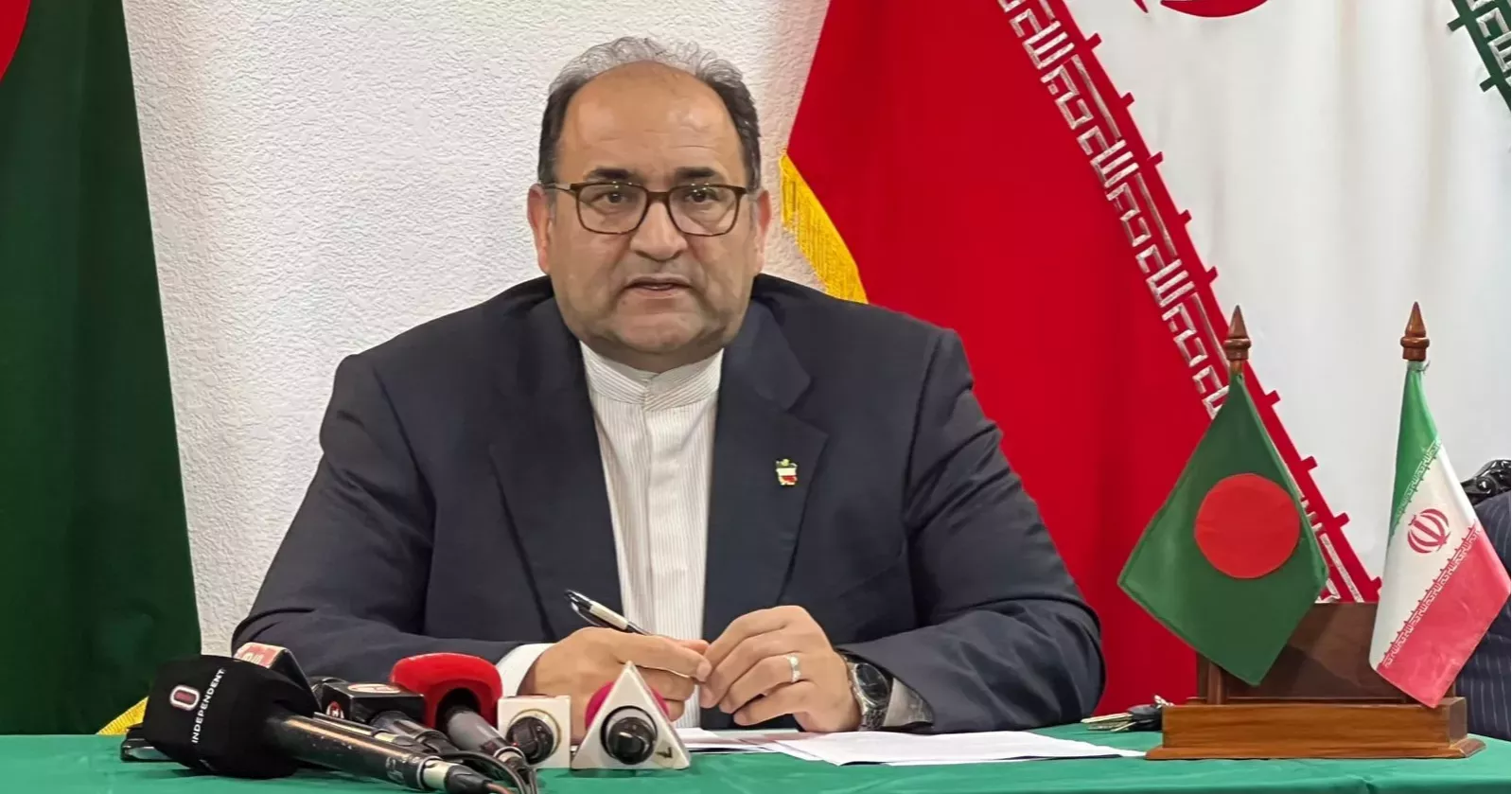
Iranian Ambassador to Bangladesh Dr Jalil Rahimi Jahanabadi has said the Strait of Hormuz will be reopened only if the United States lifts its naval blockade against Iran, guarantees no further attacks on Iranian territory and meets Tehran's other conditions.
He made the remarks while briefing reporters on the latest situation in the Middle East at his residence in Dhaka on Wednesday.
Responding to a question, the Ambassador alleged that the United States and Israel launched surprise attacks, killing Iran's supreme leader and at least 40 senior military and civilian officials, besides around 4,500 civilians and destroying many installations.
He said the attacks took place while negotiations were underway through Oman's mediation, prompting Iran to retaliate.
"No US base in the Middle East was spared from our attacks," he said, adding that Iran would respond in equal measure if the United States launches fresh attacks on its territory.
However, he said Iran has always opposed war and conflict, claiming that the country has no record of aggression against the territory of other nations, unlike the United States and Israel.
Describing Iran as the land of poets Sheikh Saadi, Hafez Shirazi and Maulana Rumi, he said the country represented a rich civilisation, culture and humanity and did not believe in war and violence.
Responding to another question, Jahanabadi said the possibility of the United States using nuclear weapons against Iran could not be ruled out, noting its past record of using such weapons.
He warned that Iran would deliver a proportionate response if attacked again.
On the movement of Bangladeshi vessels through the Strait of Hormuz, the Ambassador said the Bangladesh government is better placed to provide information on whether any Bangladeshi ships are currently crossing the waterway.
He said he has regularly informed Tehran since arriving in Dhaka that the people of Bangladesh were friends and brothers of Iran and held affection for the Iranian people.
"I have urged Tehran to pay attention to ensuring the safe passage of Bangladeshi ships," he said.
Regarding the Mecca agreement, the ambassador said Tehran did not consider any agreement among Muslim countries to be directed against Iran.
He said Iran has long advocated ensuring Middle Eastern security through cooperation among regional countries without the involvement of foreign powers.
On Saudi Arabia's longstanding conflict with Yemen's Houthi movement, he said the current problems between Riyadh and Yemen stemmed from Saudi Arabia's mistaken foreign policy, adding that a resolution depended on the Saudi government's approach.
He said Iran provided political and moral support to regional groups opposing the United States and Israel, including the Houthis and Hezbollah.