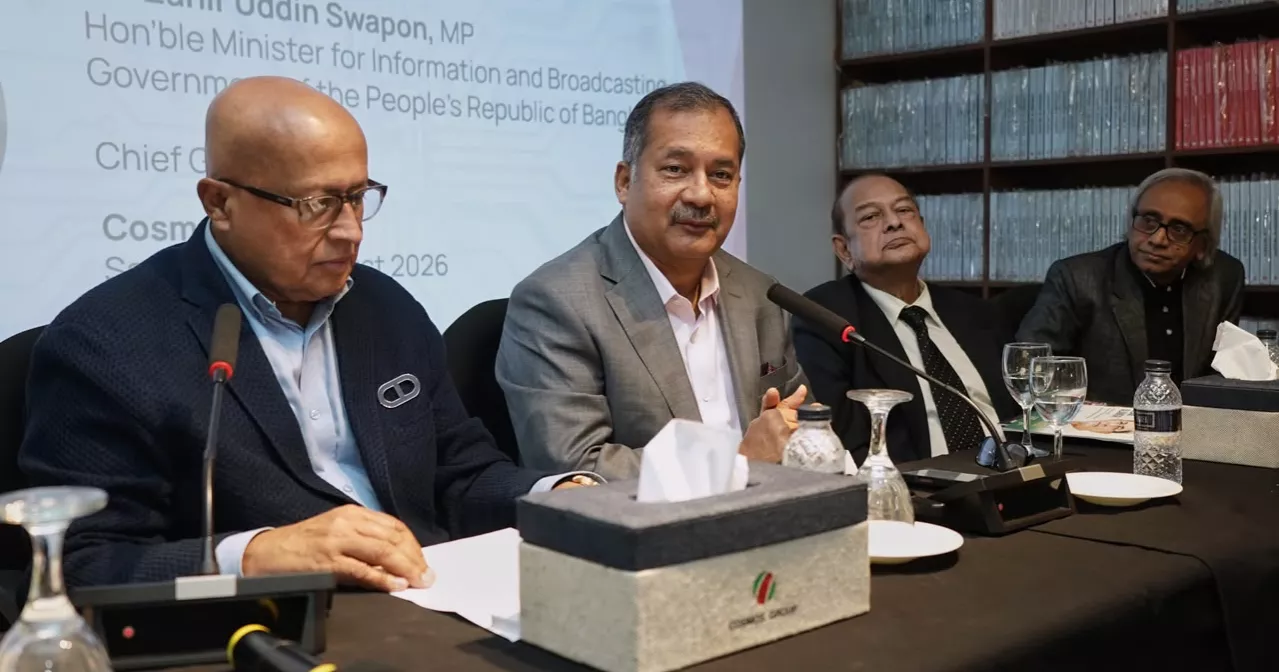
Zahir Uddin Swapon, who was Information and Broadcasting Minister till Friday night, on Saturday said the distinction between “yellow journalism” and responsible journalism is becoming increasingly blurred, posing a major challenge to the media industry.
“The gap between yellow and responsible journalism has become increasingly pronounced, while the line distinguishing the two is gradually disappearing,” he said.
Swapon made the remarks while inaugurating the annual District Correspondents’ Conference of United News of Bangladesh (UNB) 2026 at the Cosmos Centre in Malibagh in the morning as chief guest.
UNB Editor-in-Chief Enayetullah Khan welcomed the participants and thanked the district correspondents for attending the annual gathering despite their busy schedules.
Speaking about the changing media landscape, Swapon said readership of hard-copy newspapers is declining day by day as people are increasingly becoming device-oriented, while digital platforms have gained enormous dominance.
He pointed out that while there are countless information platforms, the number of actual sources of information remains limited.
“The entire sky has now become a platform, but the number of platforms and the number of sources is limited. There is a huge gap between the number of platforms and the number of sources,” he added.
Swapon said the major challenge for new media, existing media and media policymakers is to ensure that information brought from the source to a vast number of platforms maintains objectivity and that media institutions have the capacity to reflect that objectivity across platforms.
“I think that is the challenge of new media, the challenge of existing media and the challenge of media policymakers,” he said.
He called on “white” or responsible journalists to help stop yellow journalism and isolate parasitic media and digital junk from mainstream journalism.
He said during his experience over the past few months, he found those actively engaged with the media sector to be sincere and highly knowledgeable, but he felt there was a lack of adequate attention to some of the sector’s challenges.
He urged UNB authorities to consider how greater focus could be given to these issues.
Swapon identified another major challenge as the distinction between investigative skills and an intelligence-gathering mindset.
He said journalism should move from event reporting to knowledge-based reporting and eventually to comprehensive journalism.
Swapon suggested that if UNB keeps these issues clearly in focus, discussions and capacity-building programmes developed by the organisation would become increasingly productive.
Swapon also identified “objectivity versus instant sensation” as a major challenge created by digital media and the internet.
He said media houses naturally have an instinct to break news quickly, and he did not consider that wrong.
“But there needs to be checks and balances so that this instinct of a media house does not ultimately trap it in a cage of lack of objectivity because of the rush to give breaking news,” he said.
He warned that a media organisation’s hard-earned credibility could be damaged very quickly.
“The credibility and credentials of a media organisation are like glass. They can break or develop a crack in a single incident,” he said.
He noted that gaining credibility takes a long time, as a media outlet gradually builds trust, reliability and confidence among a large readership or audience.
“The success of a media house is to continue that journey and satisfy the audience’s hunger and thirst for objectivity every day,” he said.
However, he warned that this credibility could be lost quickly if a media outlet moves away from objectivity in an effort to create a sensation around a major public issue.
He suggested that media houses should have a mechanism to monitor changes in their audiences’ confidence levels through psychographic analysis.
Swapon called for a clear distinction between what he described as “parasitic media” and accountable media.
He said journalists who are committed to maintaining the dignity of the profession should work to stop yellow journalism and separate mainstream media from “parasitic media” and the “digital junk” being generated online.
He acknowledged that journalists and media houses could not accomplish this alone and said the government also had a role to play because the state controls governmental authority.
Swapon said he had tried to advance some work during his tenure as minister and expressed hope that his successor, Barrister Andaleeve Rahman Partho, would maintain continuity.
He also mentioned that he is likely to move as an adviser on media and related issues to the Prime Minister's Office.
Swapon also stressed the importance of the Wage Board for journalists.
He questioned how journalists engaged in a knowledge-based profession could lead respectable lives if their salary structures were not ensured.
“The information minister has been sitting here listening to you and giving huge speeches for so long. But there is no discussion of the real issue,” he said self-deprecatingly.
He said Bangladesh was not a regimented country where the state would provide everything and take responsibility for all sectors. Therefore, entrepreneurs in the country’s economic system must take responsibility for developing the media industry.
He said an entrepreneur has the right to decide whether to invest in the media industry, but once an investment is made, the entrepreneur must comply with labour laws and the Wage Board.
“Once they invest, they must follow the Wage Board. They must ensure the dignity, status, salary structure, job security and working environment of people employed in this profession, as well as gender equality and all other benchmarks of civilisation,” he said.
Swapon said if media owners failed to comply with such standards, journalists could legitimately question why the government had allowed them to operate a media business without ensuring compliance with the law.
Swapon also called for a clear editorial policy and appropriate regulatory framework for the media industry.
He said solving issues related to wages and working conditions would not be enough if media houses did not have clear editorial policies or if there were no legal mechanisms to monitor and regulate such policies.
Cosmos Foundation President and former Foreign Affairs Adviser of the caretaker government Dr Iftekhar Ahmed Chowdhury, Barrister Arman Bin Quasem MP, Dhaka Courier editor-at-Large Afsan Chowdhury, Principal Research Fellow at Cosmos Foundation Asad Latif, Prime Minister’s Speechwriter Mahfuzur Rahman, UNB acting editor and executive editor of Dhaka Courier Shayan S. Khan, Samakal Editor Shahed Muhammad Ali, Jamuna TV Chief Executive Officer Fahim Ahmed and Dhaka Stream Editor and Publisher Golam Iftekhar Mahmud, and Bangladesh Energy Regulatory Commission Chairman Jalal Ahmed also spoke.