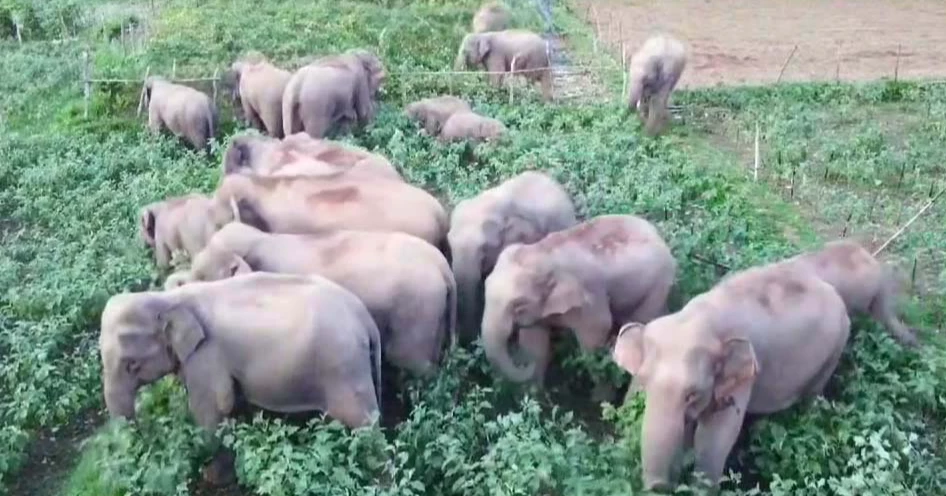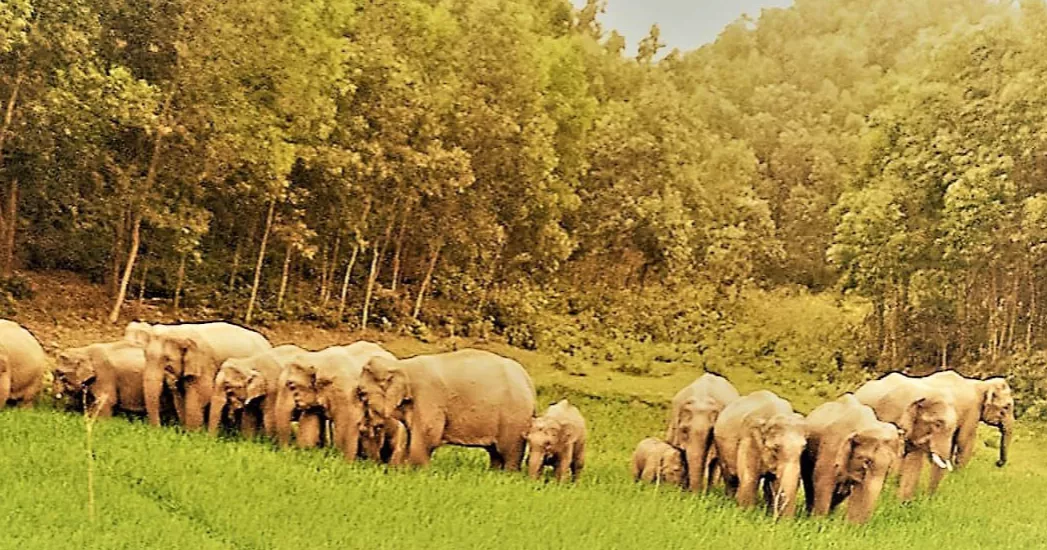
The number of wild elephants roaming the Garo Hills of Sherpur appears to be growing but the forests they depend on are steadily shrinking.
As trees are felled, forestland is occupied, sand and stone are extracted illegally, and streams and waterfalls dry up amid climate change the elephants are losing both habitat and food sources.
Hungry and thirsty herds are venturing out of the forests and into settlements and farmland in search of food and water, resulting in growing struggle for space between humans and elephants — a conflict that is proving deadly for both.
On World Elephant Day, observed on Aug 12, conservationists say the challenge is no longer simply to protect elephants from people but to create conditions in which the two can coexist.
The problem has been compounded by human ignorance and, more recently, what conservationists describe as the aggressive behaviour of some content creators who enter elephant habitats to film the animals, sometimes provoking or disturbing them.
As elephants raid crops and damage homes and other property, people have been killed or injured.
At the same time, elephants themselves are being shot, attacked with sharp weapons or killed after becoming trapped in electric fences.
From migrant visitors to permanent residents
For decades, herds of Asian elephants crossed the border from the forests of India’s Assam and Meghalaya and moved through the forests of Sherpur. But the elephants now found in the Garo Hills are no longer simply seasonal or “migrant” visitors.
A significant number are now believed to live and breed permanently in the area, making the conservation of their habitat an increasingly urgent priority.
Environmentalists and nature lovers said the time has come to establish a dedicated elephant sanctuary in the hill areas of Sherpur to protect the animals and reduce conflict with local communities.
This year’s World Elephant Day campaign carries the theme “United Around the World to Save the Lives of Elephants.” The campaign highlights qualities displayed by elephants in the wild — compassion, wisdom, strong family bonds and resilience — while encouraging people to embrace those values and promote responsible stewardship of wildlife.
In Sherpur, programmes were held in the three hill upazilas — Jhenaigati, Sreebardi and Nalitabari — to raise awareness about elephant conservation, coexistence and conflict prevention.
“Hati-r Khabarakhabar o Sachetanata” group, Sherpur Bird Conservation Society, the Forest Department and other organisations.
Elephant numbers rising
About a decade ago, an IUCN survey estimated that 120 to 125 elephants were present in Sherpur’s forests. All of them were classified as migrant elephants that crossed into Bangladesh from India.
Today, however, forest officials believe the population in the Garo Hills has increased significantly.
According to a Forest Department sources, at least 55 elephant calves are estimated to have been born in the area over the past three years. While around 100 to 120 elephants were previously seen roaming the Garo Hills, officials now estimate the number at between 180 and 200.
The increase is being attributed largely to continued breeding in the area. Although Asian elephants are under severe threat of extinction in Bangladesh, officials see the presence of calves in several herds as a positive sign for the species in the Garo Hills.
A recent drone survey reportedly spotted eight to 10 calves among a herd of 34 elephants inside the forest.
Forest officials said elephants generally give birth at intervals of about four years, but the availability of suitable habitat and food in parts of the Garo Hills appears to be supporting reproduction.
At the Balijuri Range in Sreebardi, elephants have been observed moving in three herds through relatively dense forest. Each herd is estimated to contain 30 to 35 elephants, including seven or eight calves.
Calves have also been spotted among herds roaming Batkuchi, Daodhara Katabari, Burunga, Kalapani and Madhutila in Nalitabari.
Sixteen years, 47 human deaths
The rise in elephant numbers, however, is taking place against a backdrop of intensifying human-elephant conflict.
According to Forest Department data, 47 people have died in human-elephant conflicts in the hill areas of Sreebardi, Jhenaigati and Nalitabari between 2010 and 2026.
Elephant attacks have also destroyed homes, trees, crops and other property worth several crore taka.
During the same period, 35 elephants have died. Most were killed by gunfire, sharp weapons or electric traps.
The latest human casualty occurred on Jan 7 this year, when a man collecting firewood in the Newatila area of Balijuri Hills in Sreebardi was killed in an elephant attack.
In another incident, on July 5 last year, a 15- to 16-year-old female elephant was found dead in the Katabari Hills of Nalitabari after apparently being killed by an electric trap.
Hunger and thirst drive elephants into settlements
Sujay Makar, president of the Sherpur Bird Club, said a fully grown elephant needs roughly 140 to 270 kilograms of food and 200 to 300 litres of water every day.
But deforestation, the drying up of streams and the encroachment of traditional elephant corridors have deprived the animals of essential resources, he said.
“As the forests lose their food and water sources, hungry and thirsty elephants are becoming disoriented and coming down into the plains,” Makar said.
The Forest Department estimates that around 120 elephants currently roam the 8,330-acre Balijuri Range. But officials acknowledge that the present condition of the forest is far from ideal for sustaining such a population.
The tendency of elephants to enter settlements has become particularly acute over the past 10 to 15 years, further escalating conflict.