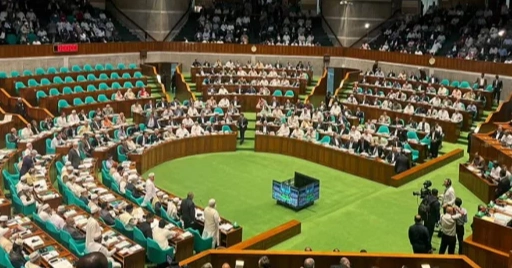
Both treasury and opposition bench lawmakers on Tuesday insisted "fallen fascist forces" were instigating the garment workers to fuel unrest in the ready-made garment (RMG) sector, using their legitimate demand for wage increases as a pretext to destabilise the country.
Describing the demand for a wage hike as rational, the MPs said they are in agreement with the "fair demand" for a wage increment.
The MPs across the board joined a general discussion on a motion over the unrest in the RMG sector, which was placed by opposition Jamaat-e-Islami lawmaker Muhammad Nazibur Rahman (Pabna-1) under the rule 147 of the Rules of Procedure in the House.
Participating in the discussion, Home Minister Salahuddin Ahmed said some people are deliberately trying to prolong the unrest by mixing with workers and using their legitimate demands as a tool, although both factory owners and workers' representatives have agreed to return to work and accept the minimum wage to be determined by the wage board through discussions.
“We are 100 percent in favour of the workers' legitimate demands. There is no government or opposition position on this issue,” said.
Opposition Leader Dr Shafiqur Rahman, joining the discussion, proposed forming a national task force involving the government, opposition parties, factory owners, workers' representatives and technical experts to address the crisis through coordinated efforts.
He said the RMG sector was the lifeblood of Bangladesh's economy, generating around 80 percent of its export earnings, worth $38-40 billion.
“If the government fails to resolve the problems in this sector on its own, it will bring a major disaster for the country. We want to save the country from such a disaster,” he said.
Shafiqur said the responsibility of protecting the national economy rested with all stakeholders, irrespective of their political affiliations.
He said a national task force would send a strong message to those instigating unrest from outside and help ease the prevailing situation.
The Opposition Leader also stressed the need to protect both factory owners and workers, saying the industry could not survive if owners failed to increase production and remain profitable.
Home Minister Salahuddin noted that the previous interim government had decided to reduce the interval for determining minimum wages through a wage board to three years from five years, meaning the first three-year period would expire in December next.
He said the government had noticed attempts to provoke workers around one and a half months before the expiry of the wage review period, initially through encouragement to block roads in Uttarkhan and Dakshinkhan areas near the airport.
The government and law enforcement agencies had shown considerable restraint in dealing with the situation, he said.
The Home Minister acknowledged that the global economic slowdown, the Middle East conflict and rising fuel prices had increased the cost of living, putting additional pressure on low-income and working-class people.
He said the government understood the difficulties faced by workers and that the wage board needed some time to determine a new minimum wage through a process of discussions.
However, referring specifically to unrest in Kaliakair, Gazipur, Savar, Ashulia, Hemayetpur and Uttara, he alleged that some people were deliberately keeping the situation volatile and attacking footwear and telephone industries despite agreements between workers and factory owners to resume production.
Salahuddin accused fallen fascist and mafia forces, particularly the Awami League, of trying to exploit the situation and create instability through arson attacks and violence.
He alleged that former ministers, MPs and leaders of the party had been issuing messages on social media from across the border, encouraging their followers to set fire to properties and create unrest.
The government, however, would not respond to such provocations by opening fire on ordinary people or peaceful protesters, he said.
“We believe in the presumption of innocence. We may exercise patience towards 10 offenders for some time, but we will not allow an innocent person to be shot,” the Home Minister said.
He said law enforcement agencies had been instructed to use force only when necessary for self-defence and to avoid excessive force.
Referring to violent unrest in Gopalganj, Salahuddin also warned that those involved in attacks on police stations, arson, assaults on law enforcers and attempts to create anarchy in the name of movements would be identified through video footage and other evidence and brought to justice.
He urged the people of Gopalganj not to fall into what he described as traps laid by a small group of miscreants instigating unrest from across the border.
Commerce Minister Khandakar Abdul Muktadir said Bangladesh had performed relatively well in non-traditional export markets despite a decline in RMG exports in the European Union and US markets.
He acknowledged workers' legitimate expectations for wage increases amid persistent inflation but cautioned that wage adjustments should be consistent with the industry's ability to compete with countries such as India, Indonesia and Vietnam.
Information and Broadcasting Minister Andaleeve Rahman also alleged that the Awami League was behind the unrest, saying the government and the people needed to remain united against any attempt to bring back fascist forces.
State Minister for Planning Md Zonayed Saki said the government supported the workers' legitimate demands, but urged them to remain alert so that no quarter could use their movement to destroy the industry.
NCP lawmaker Md. Abul Hasnat (Cumilla-4), better known as Hasnat Abdullah, said the workers’ movement for higher wages was justified, given the rising cost of living and mounting pressure on their families.
He also criticised the government for failing to manage the situation properly, saying the unrest had continued due to its mismanagement, extortion and graft, although these problems originated under the Awami League government.
Hasnat warned that Bangladesh was at risk of losing export orders to India and Vietnam if it failed to ensure stability, protect workers’ interests and create a favourable business environment for factory owners. He said both workers and owners would suffer if the situation continued.
Raising the motion, Muhammad Nazibur Rahman said the RMG sector accounts for more than 80 percent of Bangladesh's export earnings and directly employs around four million workers.
He said the ongoing energy crisis, inadequate gas supply, frequent power outages and limited diesel availability had reduced the sector's production capacity by 25-30 percent in April 2026, according to various surveys.
He also expressed concern over cancelled or reduced international orders, delayed shipments and recurring labour unrest, warning that these could undermine Bangladesh's competitiveness and reputation among international buyers.
The Jamaat lawmaker called for coordinated efforts by the government, factory owners, workers' organisations and other stakeholders to address workers' genuine demands while countering provocation, sabotage and instability.