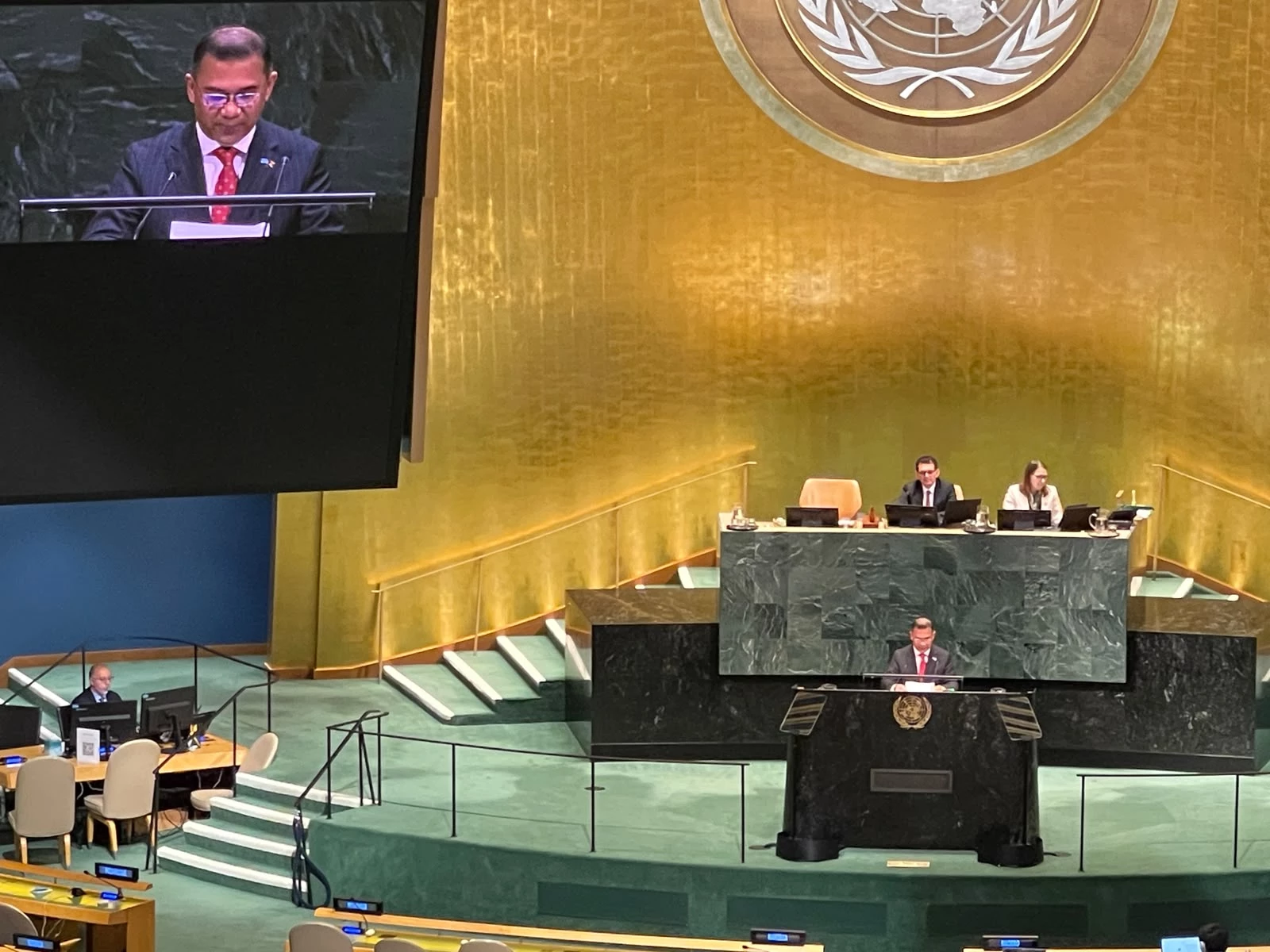
Prime Minister Tarique Rahman on Thursday told the international community that Bangladesh was pursuing a three-R strategy — Recovery, Restoration and Reconstruction — to rebuild the country after more than a decade-and-a-half of what he described as fascist rule and exploitation.
Addressing the general debate of the 81st session of the United Nations General Assembly at UN Headquarters in New York, he also called for resolving global conflicts through dialogue and diplomacy, while urging stronger international action on the Rohingya crisis, climate change, disarmament, migration and equitable access to technology.
“Bangladesh became free from fascism in 2024, bringing an end to more than one and a half decades of fascist rule and exploitation. Having freed itself from the scourges of enforced disappearances and killings, abductions, corruption, looting and money laundering that had become the norm under fascist rule, Bangladesh is now once again embarking on the path of democracy,” Tarique said.
He said an immense horizon of possibilities was now open before Bangladesh and the government had begun implementing extensive programmes to transform the country’s working-age population into skilled human resources by taking advantage of the demographic dividend.
Tarique said Bangladesh also wanted to develop as a “manufacturing hub” and sought support from development partners in this endeavour.
The government, he said, had allocated US$50 million in the current fiscal year to create opportunities for young entrepreneurs, researchers and innovators to implement start-up initiatives.
“Detailed measures have been taken to create extensive employment opportunities and develop Bangladesh as a ‘manufacturing hub’,” he said, seeking support from Bangladesh’s development partners in this endeavour.
The Prime Minister said more than half of Bangladesh’s population were women. and women were therefore at the forefront of all government plans for the country’s socio-economic transformation.
The government was giving priority to women’s education, employment and entrepreneurship, he said, adding that opportunities for cash financing for women, particularly in the small and medium-sized industries sector, had been expanded to support the creation of women entrepreneurs.
Tarique also said opportunities for free education for women up to the undergraduate level had been made available.
He said the government wanted to ensure not only electoral democracy but also the ‘democratisation of the economy’ so that the benefits of economic growth and prosperity reached every family and citizen.
To achieve this, the government had introduced support programmes for economically disadvantaged people through various social protection schemes, including the Family Card, Farmers’ Card, Sports Card and e-Health Card, he said.
“The government considers the ‘Family Card’, issued in the name of the female head of each household, to be a symbol of women’s economic empowerment,” Tarique said.
He said the government also planned to introduce a ‘Universal Card’ by integrating the cards introduced to provide support in every sector.
This was Tarique Rahman’s maiden address to the UN General Assembly. He delivered the speech in Bangla, as announced earlier by his office.
Standing on the same platform where his father, Shaheed President Ziaur Rahman, and mother, former Prime Minister Khaleda Zia, had addressed the world, Tarique said he was speaking for the interests of Bangladesh and its people and with the hope of a peaceful world community.
Paying tribute to the martyrs of Bangladesh’s Liberation War, he also recalled those killed and injured during the July-August 2024 mass uprising early on in his speech.
He said after a prolonged period of fighting fascism, Bangladesh had entrusted the Bangladesh Nationalist Party with the responsibility of governing the country through the February 12 national election, describing the people as the source of all political power.
The Prime Minister said human-made conflicts had created unrest, displacement and humanitarian crises in many parts of the world, while wars and conflicts were putting severe pressure on the global economy, energy security and inflation.
“We believe that any conflict should be resolved through dialogue, diplomatic processes and mutual cooperation,” he said.
He said equality, fairness, protection of mutual interests, respect and dignity should form the basis of bilateral and multilateral relations among states.
Tarique also reaffirmed Bangladesh’s commitment to general and complete disarmament, prevention of the proliferation of nuclear weapons and arms control.
He said Bangladesh would continue to support UN initiatives aimed at promoting global peace and humanity.
On the issue of Palestine, which featured as one of the earliest items in his speech, the Prime Minister said Bangladesh remained unwavering in its support for the legitimate demands of the Palestinian people, including their right to self-determination and to establish an independent State of Palestine.
Stronger support sought for Rohingyas
The Prime Minister said Bangladesh had been sheltering more than 1.2 million forcibly displaced Rohingyas from Myanmar for more than nine years, putting immense pressure on the country’s resources, environment, security and local communities.
He said the source of the Rohingya crisis lay in Myanmar and, therefore, its solution also lay there.
“The only solution to this problem is the safe return of the displaced Rohingya population to their homeland, Myanmar,” he said.
Tarique called for firm and effective support from the UN and the international community for a lasting solution to the crisis.
He also urged the continuation of life-saving humanitarian assistance for the Rohingyas until their repatriation, warning that failure to ensure justice for them could turn the situation into a humanitarian crisis in the near future.
Vulnerability to climate change
Highlighting Bangladesh’s vulnerability to climate change despite its limited contribution to global carbon emissions, the Prime Minister called for stronger global action at COP31 on climate justice, climate finance and adaptation support.
He said Bangladesh had launched a programme to plant 250 million trees across the country over the next five years and was emphasising clean and solar energy.
The PM also announced a programme to excavate 20,000 kilometres of canals across the country to help protect Bangladesh from floods and droughts.
The government, he said, had also begun implementing the Teesta Master Plan and the Padma Barrage project to increase freshwater flow to the Sundarbans and conserve water through large reservoirs.
He said Bangladesh had reaffirmed its commitment to transboundary water cooperation by signing the 1992 Water Convention.
Calls for fair access to AI and technology
Tarique said science and technology would shape the future, with artificial intelligence, biotechnology and other scientific advances creating new opportunities.
But he warned against allowing today’s digital divide to become tomorrow’s “artificial intelligence divide.”
He called for technology transfer, skills development and affordable access to modern technologies for developing countries.
“No country should be left behind in this advancement of science,” he said, calling on the UN to adopt an effective policy framework to ensure the positive use of artificial intelligence and social media.
Support for migrants and LDC transition
The Prime Minister said Bangladesh remained committed to ensuring regular, safe and orderly migration and called for stronger global cooperation to protect the rights, dignity and welfare of migrants.
As Bangladesh prepares to graduate from the UN’s Least Developed Countries category, he sought continued international support in financing, market access, technology transfer and capacity building to make the transition sustainable.
He also stressed the importance of trade facilitation, connectivity and regional cooperation, saying countries could help one another achieve prosperity through greater economic integration.
‘Bangladesh First: Bangladesh for All’
As he outlined his vision for Bangladesh, the Prime Minister said "a state can never become strong by keeping its citizens powerless."
He said Bangladesh wanted to establish a prosperous, self-reliant, welfare-oriented democratic state where people regardless of political affiliation, religion or race, could live safely with equal rights, respect and dignity.
“Bangladesh First: Bangladesh for All,” he said, outlining the government’s vision of a country where young people could pursue their dreams without fear, women could live with confidence and every child could realise their full potential.
The Prime Minister concluded by reaffirming Bangladesh’s unwavering support for the principles and values of the United Nations in the cause of world peace.
He addressed the 81st session of the UN General Assembly amid warm applause from delegates present at the UNGA Hall inside UN Headquarters in New York.
He took the podium at around 6:16pm local time to deliver Bangladesh’s national statement at the General Debate.
UNGA President and Bangladesh’s Foreign Minister Khalilur Rahman presided over the session, as part of which he introduced the PM and invited him to address the assembly.
Wearing a black suit and red tie, Tarique walked up to the podium and began his address.
It was also a significant moment for the Prime Minister as his late father, President Ziaur Rahman, and mother, former Prime Minister Khaleda Zia, had previously addressed the UN General Assembly from the same podium.