Bangladesh's garment factory rooftops could generate nearly 1,768 megawatt-peak (MWp) of solar power, yet only 3 percent of the sector's electricity currently comes from renewable sources, according to a new study by the Centre for Policy Dialogue (CPD) that maps a $188.2 million investment pipeline aimed largely at Chinese financiers.
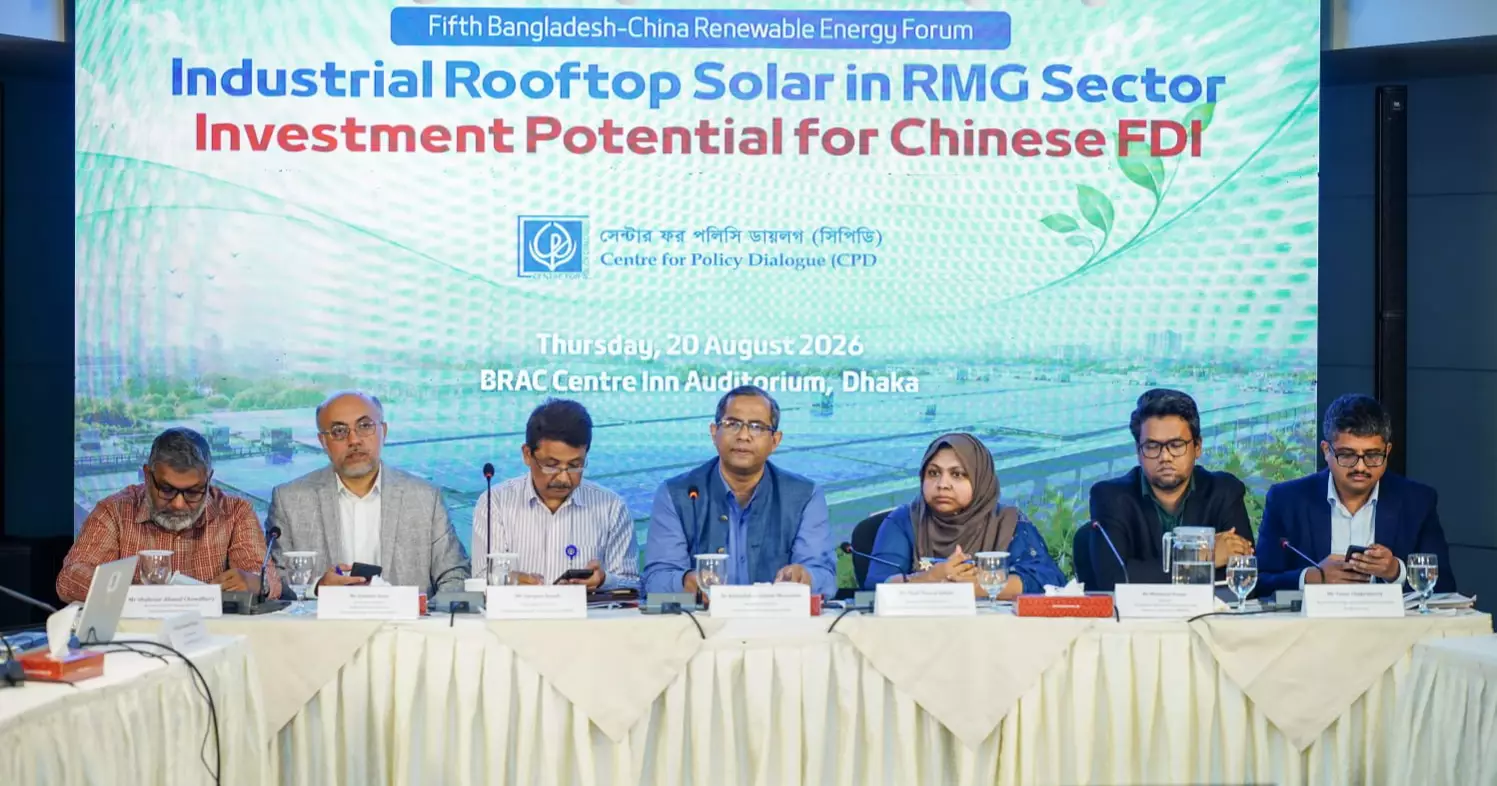
The findings were presented at "Industrial Rooftop Solar in RMG: Investment Potential for Chinese FDI," organised by CPD's Power and Energy Studies programme at BRAC Centre in Mohakhali on Thursday, as part of the 5th Bangladesh-China Renewable Energy Forum.
The study said Bangladesh's RMG sector, which earns roughly 85 percent of national export revenue, is currently running at 30-40 percent of capacity due to grid instability and gas shortages, even as global buyers including H&M, Inditex, Walmart, Gap and M&S tighten decarbonisation mandates.
The EU's Corporate Sustainability Due Diligence Directive (CSDDD) will require 35 percent renewable power procurement by 2035, the researchers said.
Despite this pressure, a survey of 878 factories in Gazipur and Narayanganj found only 3 percent of electricity consumed is renewable, well short of the 14 percent of demand that rooftop solar alone could theoretically cover, the study said.
Using satellite rooftop mapping and machine-learning demand modelling across 3,320 factories, researchers estimated total rooftop solar potential in the RMG and textile sector at 1,768.3 MWp, generated from over 9.7 million square metres of usable roof area.
Of 1,900 non-adopter factories screened through a proprietary "Technical-Economic-Contextual" scoring framework, 2,303 were found technically and financially viable, requiring a combined $188.2 million in capital.
Small factories, though individually the cheapest to electrify, account for the largest share of aggregate investment need, $75.7 million across 1,922 units, simply due to their sheer number.
The study grouped factories into four investability tiers, and found large factories are far more likely to be "Investment-Ready," while small factories carry almost all cases requiring structural or regulatory intervention.
The research said that access to concessional or "green" financing is not a marginal factor but determines whether an investment-ready tier exists at all. At blended financing rates of around 9.8 percent, roughly 509 factories qualify as investment-ready; at commercial rates of 10.5 percent or higher, that number drops to zero.
A sensitivity analysis found capital cost, tariff levels, interest rates and loan tenure each capable of swinging bankability by 74-81 percentage points, with the sector's median debt-service coverage ratio sitting precariously close to the 1.25x bankability threshold.
The report cited Ha-Meem Group's phased 12.2 MWp solar rollout, backed by concessional funding from IDLC, AFD and IDCOL, including a 20 percent principal waiver, as a model, noting its Kaliganj unit now runs entirely on solar during daytime hours and eliminated feeder-level load-shedding.
However, the case also exposed persistent bottlenecks: a 2.5-month wait for SREDA equipment approval and metering coordination gaps between the factory, REB and PGCB that caused billing disputes over back-fed power.
The study flagged high financing costs for SMEs, slow SREDA approvals, and a buyer-imposed rule reserving 20 percent of rooftop space for "helicopter evacuation", which researchers said contradicts official fire codes and unnecessarily caps generation capacity.
It also pointed to inconsistent net-metering practices across DESCO, DPDC and PBS, and the absence of a framework for third-party power wheeling between factories.
Recommendations included a blended green-financing facility combining IDCOL's 5-7 percent concessional debt with Chinese green capital, a BGMEA facilitation desk for factories partnering with vetted Chinese EPC firms, cluster-based aggregation of small and medium knitwear units in hubs like Narayanganj, and faster SREDA interconnection approvals.