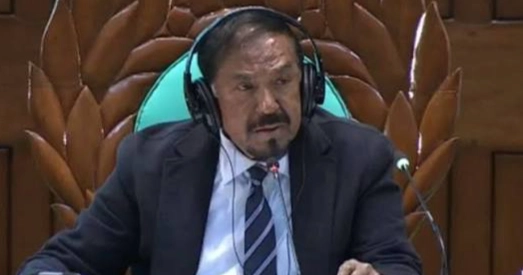
Speaker Hafiz Uddin Ahmad on Tuesday questioned the inclusion of state ministers and ruling whips in parliamentary standing committees, warning that the practice runs contrary to the convention of keeping committee chairmanship and membership largely with private members.
The Speaker raised the issue in Parliament immediately after Chief Whip Nurul Islam Moni formed five standing committees and reconstituted two others, with four whips holding state ministerial rank appointed as committee chairmen.
Addressing the chief whip, he said the “spirit” of parliamentary committees was that their chairmen should be private members, while ministers should serve as members.
“I have noticed that in several ministries, state ministers, whips and other high-ranking government office holders who enjoy government facilities have been included as members,” Hafiz Uddin said.
“There is no obstacle to this. But the spirit and practice of Parliament is that private members will serve on the committees, while a minister will also be a member,” he said.
The Speaker specifically asked the chief whip to take the matter into consideration when forming parliamentary committees in the future.
His remarks came after the government’s decision to give four whips, all enjoying the rank of state minister, chairmanship of important parliamentary committees.
Whip Rakibul Islam Bakul was made chairman of the Standing Committee on the Ministry of Road Transport and Bridges, while Whip Ruhul Quddus Talukder Dulu was appointed chairman of the committee on the Ministry of Science and Technology.
Whip Akhtaruzzaman Mia was made chairman of the committee on the Ministry of Textiles and Jute, and Whip GK Gouse was appointed chairman of the committee on the Ministry of Environment, Forest and Climate Change.
Meanwhile, State Minister for Local Government, rural Development and Co-operatives Mir Shahe Alam was made a member of the standing committees on the Ministry of Home Affairs and the Ministry of Finance.
The appointments have drawn attention because parliamentary standing committees are intended to provide legislative scrutiny and oversight of ministries.
The Speaker’s intervention highlights the importance attached to maintaining a degree of separation between the executive and parliamentary oversight functions.
Under established parliamentary practice, ministers and state ministers who are MPs are generally made members of the standing committee related to their own ministries. They are not ordinarily included in unrelated committees.
The Speaker therefore asked the chief whip to exercise greater caution in future committee formations, stressing that the parliamentary convention should be taken into account.