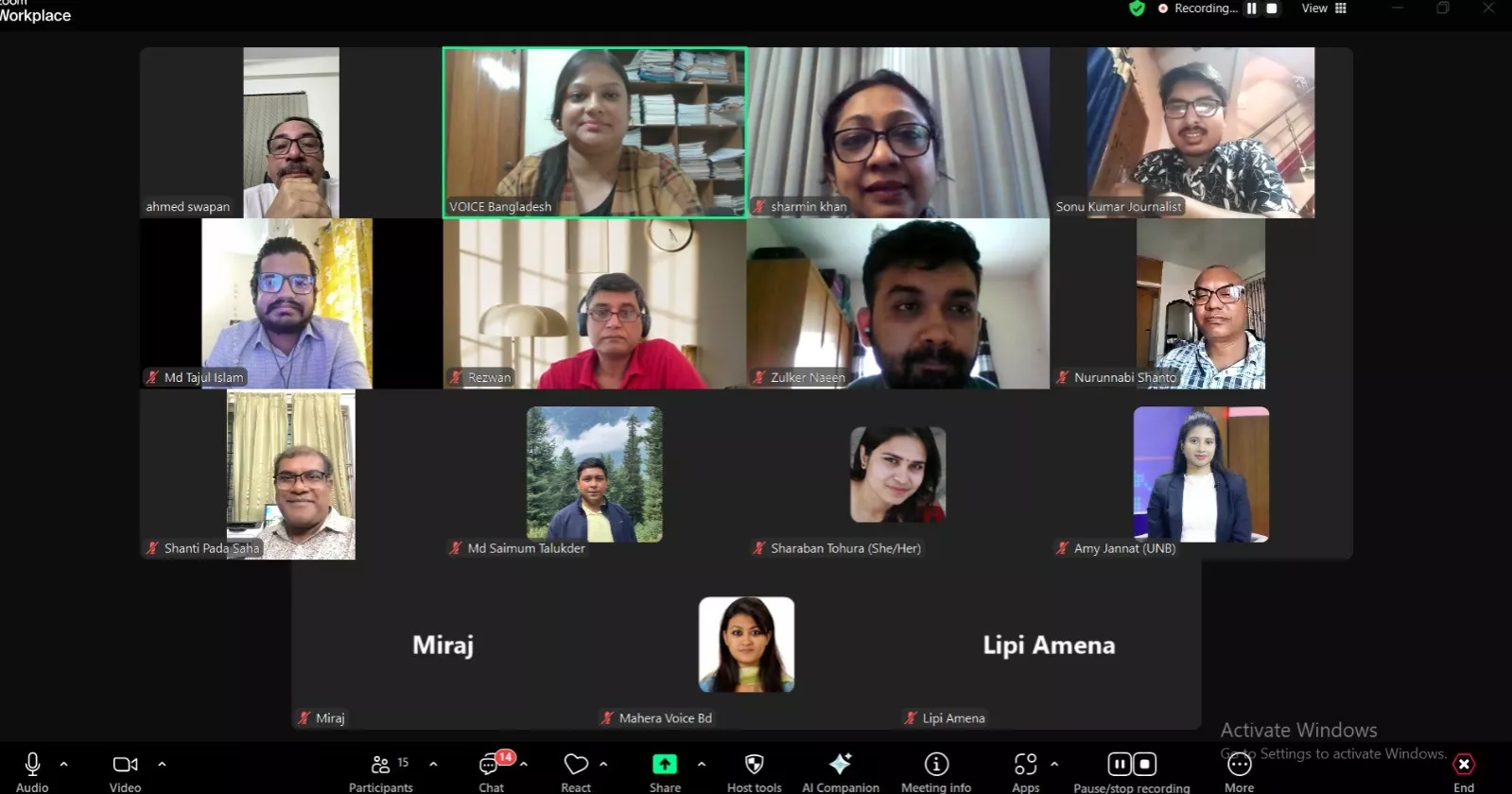
Speakers on Saturday urged the government to publish an update on the National Artificial Intelligence Policy 2024 and finalise it through a consultative process.
They made the call at a webinar titled “Artificial Intelligence and the Future of Journalism in Bangladesh,” organised by Voices for Interactive Choice and Empowerment (VOICE), a rights-based research and advocacy organisation marking the World Press Freedom Day 2025.
The panel featured journalists, civil society members, human rights defenders, legal experts, technologists and researchers.
They discussed that literacy around the use of AI must be ensured as there is a growing threat posed by the spread of 'deepfakes', misinformation, algorithmic bias, enhanced surveillance, and the risk of job displacement for human journalists.
Ahmed Swapan Mahmud, Executive Director of VOICE said, “Journalists, human rights activists, and civil society actors must be consulted for formulation of a people-friendly AI policy.”
Md Saimum Reza Talukder, Senior Lecturer at BRAC University’s School of Law, raised concerns about how keyword filtering is influenced by political decisions and how platforms are shadow-banning content, limiting its reach to audiences.
He called for AI regulation to be grounded in human safety, emphasising that local norms and values must be incorporated into AI policies. He also underscored the need for Bangladesh to be added to the global AI readiness index.
Book on ‘Pharmaceutical Quality Assurance and Artificial Intelligence’ launched
Highlighting an absence of AI policy in newsrooms, Rezwan Islam from Engage Media said, “AI is beneficial to research and helps save time but it cannot write an article as it does not have the experience and judgement of the journalist.”
Miraj Ahmed Chowdhury, Founder of Digitally Right, discussed the challenge of copyright in the context of AI, noting that the issue will be tool-specific for derivative content.
Sharabon Tohura, Consultant at Nijera Kori, highlighted how misinformation on platforms like YouTube is consumed by elderly people and can reach epidemic levels, stressing the need for digital literacy campaigns.
Sharmin Khan, Legal Consultant at the International Center for Not-for-Profit Law (ICNL), Minhaj Aman, Research Coordinator at Digitally Right, and Tajul Islam from The Business Standard also spoke at the webinar.