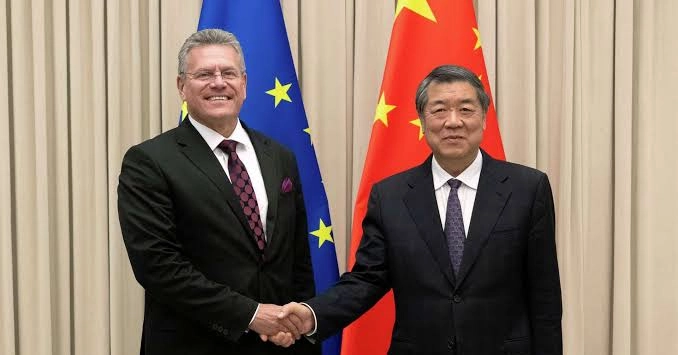
China and the European Union have reached a broad preliminary trade agreement following two days of negotiations aimed at easing growing tensions over trade imbalances, the EU’s trade commissioner said on Friday.
Although neither side disclosed full details of the proposed agreement, European Commissioner for Trade Maroš Šefčovič said it includes reduced tariffs on certain European products entering China and measures to improve the stability of rare earth supply chains.
According to Šefčovič, the arrangement could reduce Chinese electric and plug-in hybrid vehicle exports to the EU by as much as 50%. It could also lower tariffs on products from nearly every EU member state. However, the agreement must first receive approval from leaders of the bloc’s 27 countries.
He said the arrangement would prevent millions of Chinese vehicles from being exported to the European market.
The negotiations focused on addressing the factors contributing to China’s expanding trade surplus with the EU, which reached 360 billion euros (approximately $403 billion) last year.
In a statement published online, China’s Commerce Ministry said Chinese Commerce Minister Wang Wentao had expressed concern over the EU’s recent restrictive trade measures. Wang argued that China was not responsible for Europe’s economic challenges but should instead be viewed as a partner in addressing them.
Sigrid de Vries, head of the European Automobile Manufacturers’ Association, welcomed the apparent progress, saying the agreement could help prevent further uncertainty in the European market. She added that it could support an orderly transition to a new phase of Chinese participation in the European automotive sector, benefiting all parties over the long term.
Šefčovič said he would present the agreement to EU leaders at a meeting in Brussels next week and seek their approval.
He stressed that European leaders would need to be convinced that the arrangement was sufficiently effective before agreeing to further steps. He warned that Chinese competition could threaten entire European industrial sectors and thousands of jobs, adding that governments and the public expected a swift response.
Šefčovič also said the two sides had reached an understanding on improving China’s export licensing procedures for rare earth elements and permanent magnets. Additionally, the agreement could improve access to the Chinese market for a range of European products through lower most-favoured-nation tariffs.
These products include automotive components, olive oil and footwear, representing nearly 4 billion euros (around $4.5 billion) in current annual export value.
The next meeting between the two sides is scheduled to take place by video in January, followed by an in-person meeting in March.
Trade tensions continue to intensify
China has been urging the EU to end restrictions on imports of advanced semiconductor manufacturing equipment from China. These measures were introduced on national security grounds following pressure from Washington.
Šefčovič previously described this week’s negotiations as the culmination of three months of intensive discussions. He had set an October deadline for achieving meaningful progress towards balancing trade relations.
Earlier in the week, China’s Commerce Ministry called on the EU to avoid protectionist policies, warning that such measures could produce unintended consequences.
Trade friction between the two economic powers has increased in recent months, with both sides imposing or considering restrictions on imports from the other.
The EU has introduced measures to restrict imports of Chinese-made electric vehicles and EV batteries while also taking steps to protect its domestic steel industry. The bloc is further tightening rules on duty-free imports of small e-commerce parcels, a move largely affecting Chinese fast-fashion businesses.
Last week, China launched an anti-dumping investigation into imports of p-nitrotoluene from the EU, a chemical used in the production of dyes and pharmaceutical products.
Chinese officials and businesses have also expressed concern over reports that some EU member states are considering additional measures to shield domestic industries from foreign competition.
China's global trade surplus exceeds $1 trillion
Concerns about the rapid growth of Chinese exports to Europe and other international markets have intensified. Some analysts have described the trend as a potential second wave of the so-called “China shock,” referring to the economic impact of a surge in Chinese manufactured goods.
The concerns have grown as the United States, particularly since President Donald Trump returned to the White House, has increased tariffs and introduced other measures intended to reduce its substantial trade deficit with China.
Despite mounting resistance from trading partners, China recorded a global trade surplus of $1.2 trillion in 2025. Forecasts suggest the surplus could exceed $1 trillion again this year.
According to EU statistics, the bloc’s trade deficit with China widened to 103.3 billion euros (approximately $116 billion) in the second quarter. Imports from China reached 153.6 billion euros (about $172 billion), while European exports to the Chinese market totalled 50.3 billion euros (around $56 billion).
Meanwhile, Germany blocked the proposed sale of a major logistics company operating in the Port of Hamburg to Chinese state-owned shipping giant Cosco on Wednesday, citing national security concerns.
Germany’s economic ministry said the country welcomed foreign investment as Europe’s largest economy but warned that certain transactions could threaten national security. It argued that the proposed acquisition could increase economic dependence on China and weaken the resilience of supply chains in Germany and across the EU.