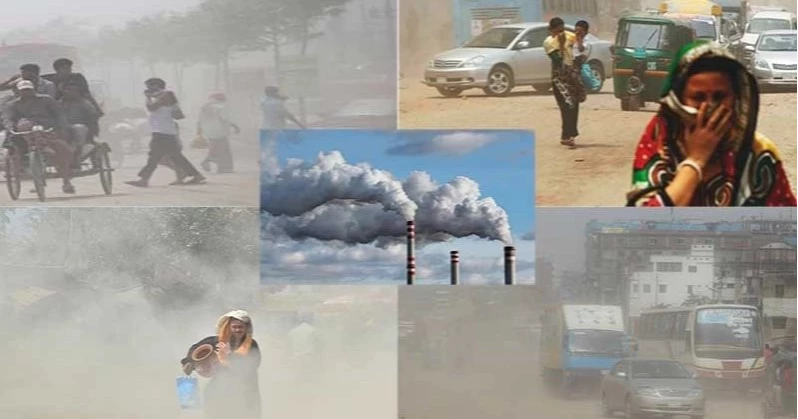
Dhaka's air quality remained in the ‘moderate’ category on Friday morning, with an Air Quality Index (AQI) score of 75.
The capital ranked 28th on the list of the world's most polluted cities at 11:45am, according to the AQI scale.
At the time, Pakistan's Lahore topped the list with an AQI score of 199, followed by Kinshasa in the Democratic Republic of the Congo with 175 and Malaysia's Kuching with 163.
On Thursday, Dhaka ranked 37th on the list, with an AQI score of 64 recorded at 10:22am.
An AQI between 50 and 100 is considered "moderate" with an acceptable air quality while AQI between 101 and 150 is considered ‘unhealthy for sensitive groups’, while a score between 151 and 200 is classified as ‘unhealthy’. AQI readings between 201 and 300 are termed ‘very unhealthy’, and anything above 301 is considered ‘hazardous’, posing serious health risks.
The AQI is a daily indicator of air quality, showing how clean or polluted the air is and the possible health effects people may experience.
In Bangladesh, the AQI is calculated based on five major pollutants: particulate matter (PM10 and PM2.5), nitrogen dioxide, carbon monoxide, sulphur dioxide and ozone.
Dhaka has long struggled with severe air pollution. Air quality usually worsens during winter and improves in the monsoon season.
According to the World Health Organization, air pollution causes around seven million deaths globally each year, mainly from stroke, heart disease, chronic respiratory diseases, lung cancer and acute respiratory infections.