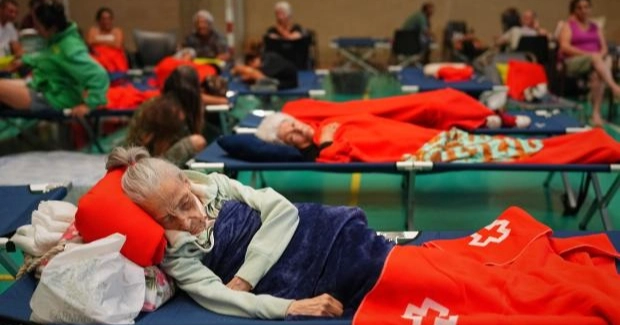
More than 200,000 people were forced to evacuate their homes in France and Spain on Friday as fast-moving wildfires swept across both countries, threatening communities near Bordeaux and Madrid.
Authorities said about 141,000 people were evacuated from southwestern France, while another 60,000 fled their homes in central Spain as firefighters struggled to contain multiple blazes fueled by extreme heat and dry conditions.
Officials in both countries said the fires spread so quickly that emergency crews were caught off guard. In Spain, firefighters said some blazes were too intense to tackle directly, while in France, some residents escaped by boat as flames reached the Atlantic coast.
Although dozens of firefighters were injured in France, no deaths had been reported in either country by Friday. Police went door-to-door urging people to leave as thick smoke and flames approached towns.
Fire moves toward Bordeaux
French Interior Minister Laurent Nunez said a major wildfire that began near the Cap Ferret peninsula was moving toward the city of Bordeaux after changing direction with the wind.
The fire has burned around 140 square kilometres of land, forcing about 110,000 people to evacuate in the Gironde region.
President Emmanuel Macron ordered the government to activate its national crisis response and instructed the military to assist emergency services.
Officials said the fire, which started on Wednesday near the Atlantic coast about 60 kilometres from Bordeaux, has destroyed 53 homes and a campsite. Forty-two firefighters have been injured.
Around 1,500 people were evacuated from the Cap Ferret peninsula by sea, using water taxis and larger boats to reach the nearby city of Arcachon.
A separate wildfire in the Landes department forced another 31,000 people to leave their homes. Authorities believe both French fires were caused accidentally.
France also requested assistance from European Union partners. Macron said Croatia, Portugal, the Czech Republic and Slovakia were sending firefighting aircraft and helicopters to help battle the blazes.
Spain declares national wildfire emergency
Spain declared a national wildfire emergency for the first time after fires near Madrid and in the neighboring province of Ávila forced tens of thousands of residents to evacuate.
Prime Minister Pedro Sánchez expressed support for affected families and said he would visit the fire-hit areas on Saturday.
The fires are being driven by a heatwave, with temperatures expected to exceed 39 degrees Celsius.
Two large fires west of Madrid merged into one massive blaze that burned about 30 square kilometres by Friday afternoon. Madrid regional leader Isabel Díaz Ayuso described it as the worst wildfire in the region's history.
Authorities also ordered about 20,000 more people to remain indoors as a precaution, while emergency crews focused on protecting the historic town of San Lorenzo de El Escorial.
In Ávila province, another wildfire has burned about 90 square kilometres. Police arrested one person and are investigating another after suspecting that heavy machinery may have sparked the blaze.
Residents described chaotic scenes as smoke and flames surrounded their communities before evacuation orders were issued.
A severe wildfire season
Spain has experienced one of its worst wildfire seasons in recent years.
Firefighters are still battling the country's second-largest wildfire on record in Guadalajara province, where about 320 square kilometres have burned over the past week.
Earlier this month, 13 people died in a wildfire in southern Spain, the country's deadliest such incident in recent memory.
Spain's Ecological Transition Ministry said about 1,140 square kilometres have burned nationwide so far this year—more than five times the area destroyed during the same period in 2025.
Experts say climate change, prolonged heatwaves and the abandonment of rural farmland have increased the risk of larger and more destructive wildfires, with vegetation now growing much closer to homes and villages.