
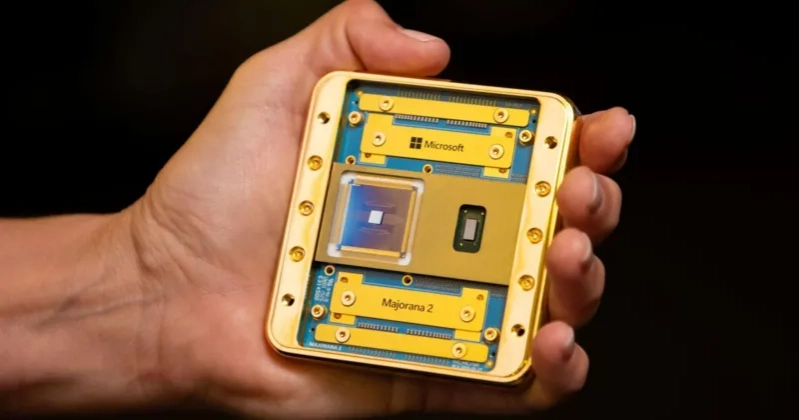
Microsoft has unveiled its second-generation quantum chip, Majorana 2, claiming it is 1,000 times more reliable than its predecessor and could pave the way for a commercially useful quantum computer within the next three years.
The company said the qubits on the new chip can remain stable for an average of 20 seconds, a significant improvement over the millisecond-level performance of the earlier Majorana 1 chip.
Qubits are the building blocks of quantum computers and have the potential to solve problems that are beyond the capabilities of today’s most powerful conventional computers. However, they are highly fragile and prone to errors caused by even minor environmental disturbances.
Microsoft compared the reliability improvement to the difference between a smartphone that needs daily charging and one that requires charging only once every few years.
“We will have a quantum machine in 2029 that can solve commercially viable, reasonable problems,” said Zulfi Alam, Corporate Vice President of Microsoft Quantum.
Despite the progress, the company acknowledged that substantial advances are still required. While Majorana 2 currently contains 12 qubits, a practical large-scale quantum computer would need millions.
The announcement comes amid an intense global race among technology companies and research institutions to develop scalable quantum computers capable of tackling complex scientific, industrial and environmental challenges.
Microsoft has spent two decades pursuing a quantum computing approach known as topological quantum computing. The technology is based on exploiting the properties of a theoretical quasiparticle called the Majorana particle, first proposed in the 1930s by Italian physicist Ettore Majorana.
The company’s research required the creation of a novel state of matter beyond the familiar solid, liquid and gas states.
According to Microsoft, the new chip improves on the original design partly by replacing aluminium with lead as a superconducting material.
Experts said the company’s timeline appears plausible if the technology performs as claimed.
Professor Paul Stevenson of the University of Surrey said Microsoft appeared to have made significant progress in developing viable topological qubits.
“If they succeed, they will leap from being a player with no production quantum computer, to being a serious player in the race to make the next generation of fault-tolerant machines,” he said.
Microsoft’s topological approach has previously faced criticism. In 2018, the company retracted a paper published in the journal Nature that claimed evidence for the existence of Majorana particles. The setback fuelled scepticism among some researchers.
The company released its first Majorana chip in 2025, but questions about its technology remained.
Addressing critics, Jason Zander, Executive Vice President of Microsoft Quantum and Discovery, defended the research.
“We stand behind it 100%,” he said, adding that the company welcomes scientific scrutiny and has shared detailed data with experts and the US defence research agency DARPA as part of a quantum technology development programme.
However, some scientists remain cautious because a research paper accompanying the announcement has not yet undergone peer review.
Microsoft believes future quantum computers could help solve major global challenges, including removing microplastics from the environment and developing more efficient fertilisers for agriculture.
Zander said quantum computers, artificial intelligence and human expertise could work together to accelerate scientific discovery.
Quantum computing remains one of the most challenging fields in technology because qubits are extremely sensitive to temperature changes, vibrations and other environmental factors.
Although many companies are pursuing scalable quantum machines, no organisation has yet demonstrated a fully practical large-scale quantum computer.
Some experts also argue that conventional computers may continue improving for years, potentially delaying the need for widespread quantum computing applications.
#From BBC