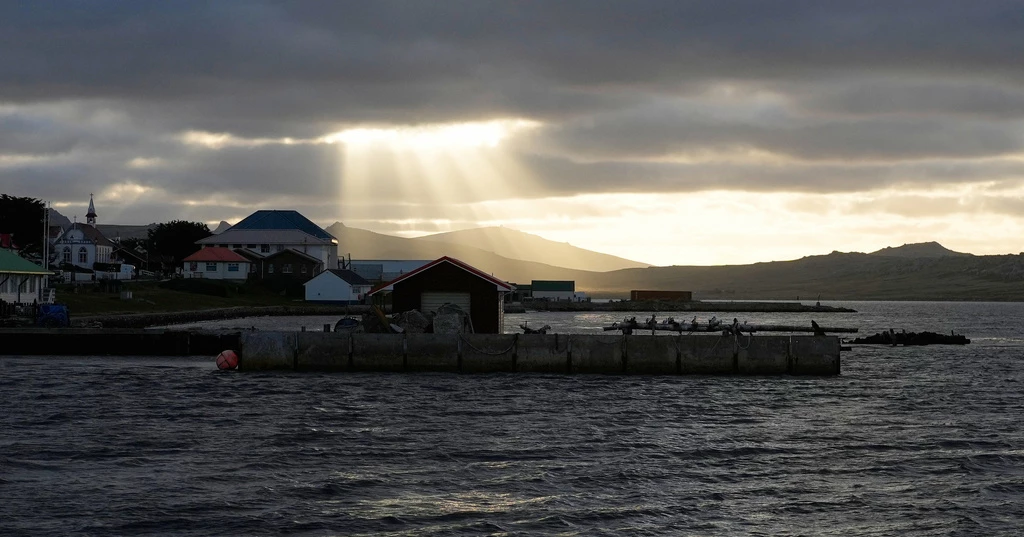
An Argentine federal judge on Wednesday ordered British and Israeli companies to suspend development of an oilfield near the Falkland Islands, creating a new legal front in the decades-old sovereignty dispute between Argentina and Britain that Argentine President Javier Milei has intensified in recent weeks.
The injunction issued by Judge Mariel Borruto, a copy of which was obtained by The Associated Press, targets the Sea Lion oil project about 220 kilometers (140 miles) north of the British-controlled islands in the South Atlantic.
The order bars drilling, offshore installations and port construction until Argentine authorities can conduct an environmental assessment and make a decision.
In practice, however, the ruling is unlikely to stop the project's progress. Borruto acknowledged that enforcement “depends on international cooperation and the conduct” of the two companies involved — Israel's Navitas Petroleum and Britain's Rockhopper Exploration.
Both companies have already said they intend to continue with the project despite Milei's threats to impose tougher sanctions on them and other businesses operating around the islands.
Rockhopper declined to comment, while Navitas did not immediately respond to a request for comment on the injunction.
Commercial oil production from Sea Lion is expected to begin in 2028, raising the stakes in a territorial dispute that led Argentina and Britain into a brief but bloody war in 1982.
For the islands' roughly 3,500 residents, the oil project could transform an economy that has long relied on fishing. Argentina, which refers to the islands as the Malvinas, considers the oil resources its own and opposes foreign companies extracting them.
Argentina's claim to the archipelago, located about 480 kilometers (300 miles) off its coast, is enshrined in the country's constitution and remains a deeply rooted part of its national identity, receiving support across political divisions.
Trump comments add uncertainty
U.S. President Donald Trump, a close ally of Argentina's libertarian president, has introduced further uncertainty into the dispute in recent weeks.
Citing Britain's lack of support for his war against Iran, Trump has suggested that Washington could reconsider its traditionally neutral position on the sovereignty of the islands.
Speaking to reporters in Dublin on Saturday, Trump again questioned whether Britain would be able to retake the Falklands as it did following Argentina's 1982 invasion under military rule.
“I don't know if they're going to be willing to travel that far,” he said.
Milei seized on what he described as “winds of change” following Trump's comments earlier this month. In a national address on Sept. 3, he announced measures against companies developing oilfields around the islands.
He said the projects represented a “clear and urgent danger” to Argentina's sovereignty claim and pledged to use all “diplomatic, economic, judicial and legal tools” available to defend it.
His government is preparing legislation to expand sanctions against companies involved in oil projects around the islands. It has also filed three criminal complaints against Tel Aviv-listed Navitas and nine other companies and their executives, accusing them of violating Argentine law by conducting oil operations without authorization from Argentina.
The potential impact of the charges on the Sea Lion project remains unclear.
Britain rejects Argentina's legal campaign
Britain has responded defiantly to Argentina's legal actions, arguing that the people living in the Falklands should determine the territory's status.
It points to a 2013 referendum in which island residents overwhelmingly voted to remain a British territory.
“Argentine domestic law does not apply within the Islands,” the British government said Tuesday in guidance intended to reassure businesses operating there.
Wednesday's ruling by the federal court in Tierra del Fuego, Argentina's southernmost province, came from a separate civil lawsuit filed by environmental lawyers and veterans of the 1982 war.
The plaintiffs are seeking to prevent environmental damage from the oil project. Their complaint cites potential ecological risks including chemical pollution, underwater noise, increased ship traffic and possible oil spills.
Borruto warned that allowing drilling and construction to continue could cause changes to the marine ecosystem that might be difficult to reverse.
“The risk is neither hypothetical nor remote,” she wrote, noting that work on the project's infrastructure had already begun.