
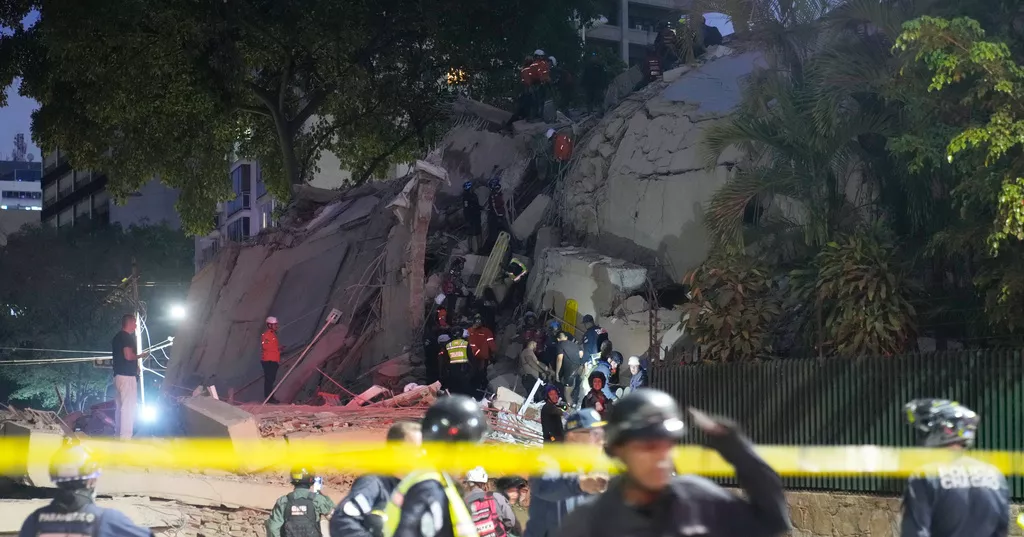
Two powerful earthquakes struck Venezuela in quick succession on Wednesday evening, causing widespread damage, collapsing buildings and forcing residents to flee into the streets in panic.
The quakes, measuring 7.2 and 7.5 in magnitude, were felt across a vast area, prompting evacuations in cities as far away as Brazil’s Amazon region, nearly 1,700 kilometers from Caracas.
In a brief address late Wednesday, acting President Delcy Rodríguez said the earthquakes caused damage in several states but did not provide details on the number of affected buildings, injuries or deaths.
She said the country's main gateway, Simón Bolívar International Airport, suffered significant damage and was temporarily closed. Classes across affected areas were also suspended for several days.
“We urge our population to remain calm,” Rodríguez said, calling for national unity as emergency services responded to the disaster.
She directed healthcare workers to report to hospitals to assist the injured, while the Education Ministry announced that some schools would be converted into temporary shelters and donation centers.
In the coastal state of Falcon, Governor Víctor Clark said 32 people had been hospitalized and 15 others remained trapped under debris more than four hours after the quake.
According to the United States Geological Survey, the first earthquake struck west of Morón, a Caribbean coastal community about 168 kilometers west of Caracas, at a depth of 22 kilometers. The agency later revised the quake’s magnitude from 7.1 to 7.2.
Just one minute later, a second and stronger 7.5-magnitude earthquake hit about 16 kilometers southwest of Morón at a depth of 10 kilometers.
The earthquakes, among the strongest recorded in Venezuela in more than a century, struck shortly after 6 p.m. Residents evacuated swaying buildings in Caracas, where entire walls collapsed in some areas and clouds of dust rose above neighborhoods.
Many people remained outdoors for hours after the tremors, with fallen power poles, debris and damaged buildings blocking roads. Some parts of the capital also experienced power outages and disruptions to mobile phone services.
“It started off gently and then gradually grew, and in the end, we all had to leave our houses and gather outside,” Caracas resident Hector Ricci said.
Rodríguez declared a state of emergency and announced the suspension of metro and natural gas services in Caracas. She also urged citizens to report damage through a government mobile application.
Communication disruptions added to the anxiety of families, including many with relatives among the more than 7.7 million Venezuelans who have left the country during its prolonged economic and political crisis.
Opposition leader María Corina Machado, who is living in exile, expressed solidarity with those affected and called for calm and unity.
Interior Minister Diosdado Cabello said the tremors were felt in several states and described the situation in Caracas' Altamira district as particularly serious, with reports of collapsed homes and buildings.
He urged residents to remain outdoors because aftershocks could further weaken damaged structures.
“The building really shook from side to side. The force was incredibly strong,” Caracas resident Roberto Gamas said. “Everything in the apartment fell, but thankfully we were able to get out.”
Messages of support quickly emerged from around the world. US Deputy Secretary of State Christopher Landau said Washington was coordinating assistance efforts, while Nayib Bukele and Daniel Noboa also offered aid and expressed solidarity with Venezuela.
The earthquakes were also felt in parts of Brazil and Colombia, though no major damage or injuries were immediately reported in those countries.
The US Pacific Tsunami Warning Center briefly issued tsunami alerts after the quakes but later canceled them.
Strong earthquakes are relatively uncommon in Venezuela. Although the country lies near several fault lines at the boundary of the South American and Caribbean tectonic plates, it experiences far fewer major earthquakes than Pacific coast nations such as Mexico and Chile, which sit along the seismically active Ring of Fire.