
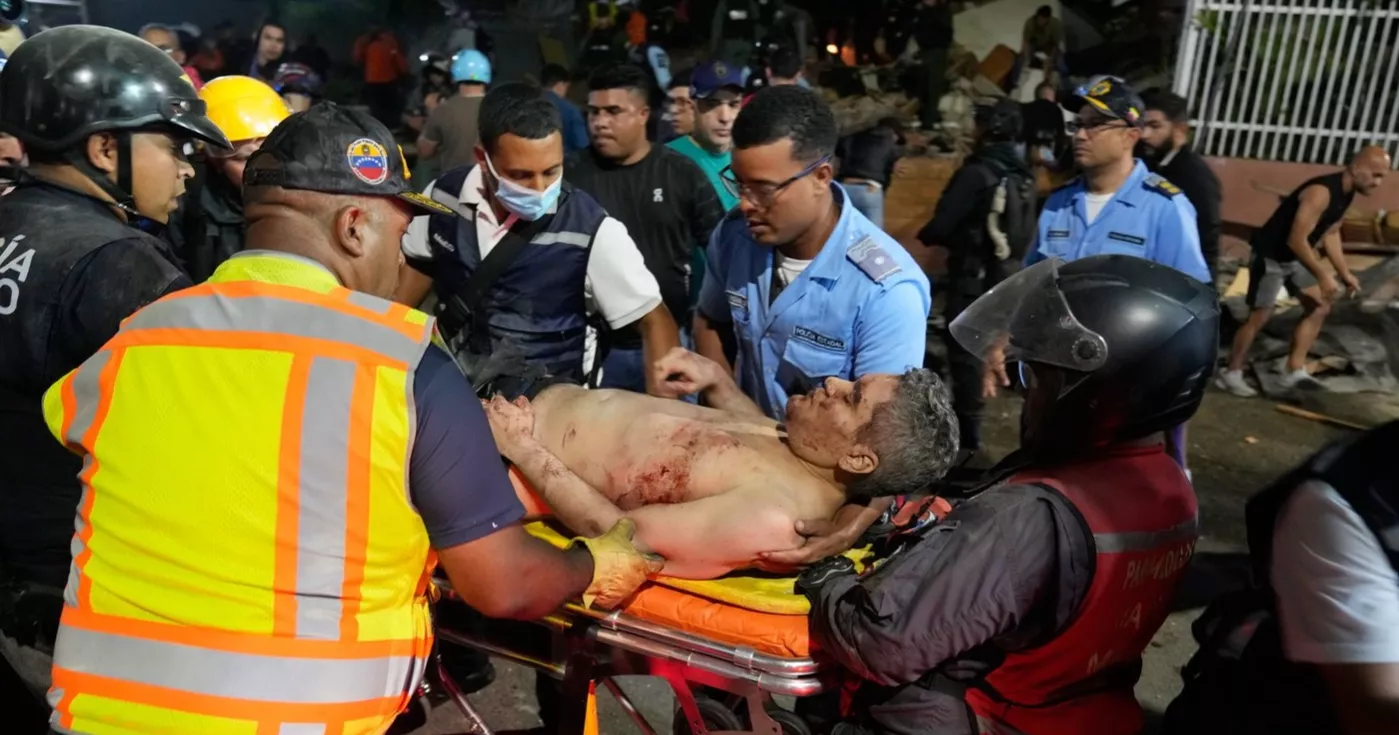
Venezuela was grappling with the aftermath of two powerful earthquakes that struck within minutes of each other on Wednesday evening, killing at least 32 people and injuring more than 700, authorities said.
Acting President Delcy Rodríguez declared a state of emergency, warning that the death toll could rise as rescue teams continue searching through collapsed buildings and reach hard-hit areas.
The 7.2 and 7.5 magnitude earthquakes struck shortly after 6 pm, causing widespread destruction across several states. Officials said the casualty figures released on Thursday did not include the coastal state of La Guaira, which suffered the most severe damage.
“Dozens of buildings have collapsed there, about 30 kilometers (19 miles) north of Caracas, and we are currently carrying out intensive rescue operations to save lives,” Rodríguez said.
The quakes, among the strongest recorded in Venezuela in more than a century, were felt across much of the country and beyond, with tremors reaching parts of Brazil’s Amazon region nearly 1,700 kilometers from Caracas.
State television showed rescue workers pulling three dust-covered children alive from the rubble in La Guaira. Authorities also reported damage to a hospital in Tucacas, northwest of the capital.
The earthquakes forced the closure of Simón Bolívar International Airport, Venezuela’s main gateway, and disrupted metro and natural gas services in Caracas. School classes were suspended for several days, while some educational institutions were designated as temporary shelters and aid distribution centres.
“We urge our population to remain calm,” Rodríguez said. “We urge unity.”
According to the US Geological Survey (USGS), the first quake, initially measured at magnitude 7.1 and later revised to 7.2, struck off the Caribbean coast west of Morón at a depth of 22 kilometres.
Just one minute later, a stronger 7.5 magnitude earthquake hit the same area at a depth of 10 kilometres, with its epicentre located southwest of Morón.
In Falcon state, Governor Víctor Clark said at least 32 people had been hospitalised and 15 others remained trapped in the hours following the disaster.
As rescue operations intensified, several countries offered assistance, including the United States, Brazil, Argentina, Mexico, Chile, Ecuador, Bolivia, Panama, Uruguay and El Salvador.
US Secretary of State Marco Rubio said Washington was dispatching search-and-rescue teams, medical supplies and humanitarian assistance to Venezuela.
Rodríguez later confirmed she had spoken with Rubio by phone and thanked several world leaders for expressing support and solidarity.
Jeremy P. Lewin, US undersecretary of state for foreign assistance, said a disaster response team had been mobilised to coordinate relief efforts with Venezuela’s interim government.
Rodríguez also announced that rescue personnel from Qatar, Mexico and El Salvador were expected to arrive in Venezuela to assist emergency operations.
El Salvador President Nayib Bukele expressed support for Venezuelans, saying, “We send you all our solidarity and our prayers. Stay strong, Venezuela.”
Ecuadorian President Daniel Noboa said humanitarian aid was being dispatched immediately, while Bolivia and Brazil also pledged support.
Television footage showed emergency workers using heavy equipment to search collapsed structures. In Caracas, residents fled swaying buildings as walls crumbled and clouds of dust filled the air.
Many people remained outdoors for hours amid fears of aftershocks, while damaged infrastructure left parts of the capital without electricity and mobile phone service.
“It started off gently and then gradually grew, and in the end, we all had to leave our houses, go outside and gather together,” said Caracas resident Hector Ricci.
Another resident, Roberto Gamas, described the experience as terrifying.
“The building really shook from side to side. Unreal. The force was incredibly strong,” he said.
The communication blackout added to anxiety among families, especially those separated from relatives abroad. More than 7.7 million Venezuelans have left the country during years of economic and political turmoil.
Opposition leader María Corina Machado, speaking from exile, urged Venezuelans to remain strong and united during the crisis.
Interior Minister Diosdado Cabello said the tremors were felt across several states and urged people to stay alert for aftershocks.
“We understand that some people may be desperate, but we are acting according to protocols to activate aid and rescue efforts to help those who need it most,” he said.
The earthquakes were also felt in parts of Brazil and Colombia, though no major damage or casualties were reported there. Several tsunami alerts issued after the quakes were later withdrawn.
Although Venezuela lies near several fault lines, major earthquakes are relatively uncommon compared with countries such as Mexico and Chile, which sit along the seismically active Pacific Ring of Fire.