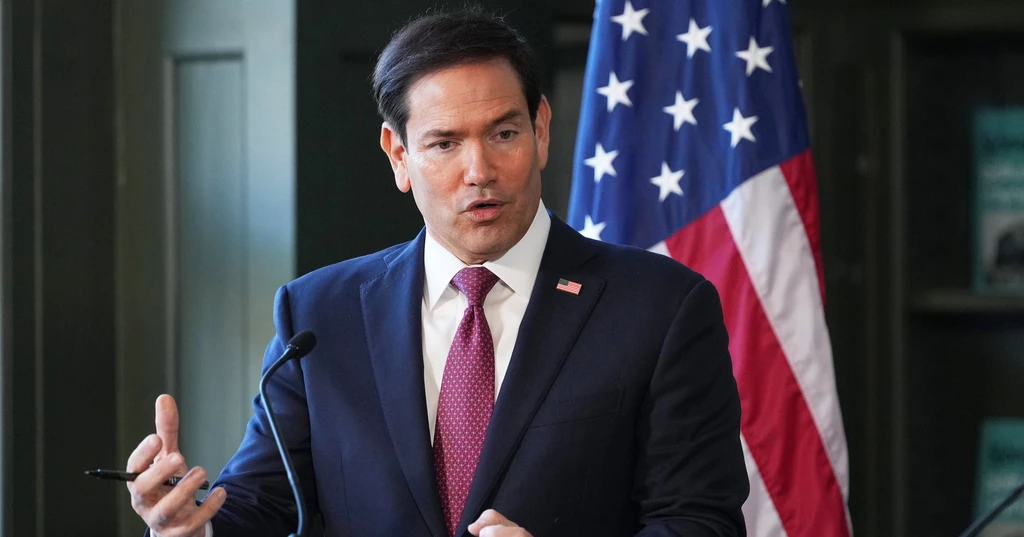
US Secretary of State Marco Rubio sought to reassure NATO ally Iceland on Tuesday that President Donald Trump's administration has no plans involving the island, while stressing shared concerns over Arctic security amid rising tensions with Russia.
Rubio highlighted the importance of diplomacy in resolving conflicts as he began a three-nation tour of NATO allies, including Greece and Portugal, amid concerns in Europe about the Trump administration's sometimes abrasive approach toward traditional partners.
He met Icelandic Foreign Secretary Thorgerdur Katrín Gunnarsdóttir at Reykjavik's Hofdi House, where US President Ronald Reagan and Soviet leader Mikhail Gorbachev held their landmark 1986 summit widely seen as helping bring an end to the Cold War.
“The house symbolizes diplomacy’s role in ending the Cold War and defeating communism,” Rubio said in a social media post following the meeting, held days before the summit's 40th anniversary.
Rubio and Gunnarsdóttir played down differences between the two allies and stressed their intention to strengthen military and commercial cooperation.
Rubio also made clear that Washington would not take any action in Iceland without its consent.
“We would be open to having those conversations to see what we can do together,” he said, referring to potential cooperation. He noted that the United States maintained a permanent military presence at Iceland's Keflavik base until 2006, when changing priorities led to its closure.
“ We have tremendous respect for the people. We have respect for the country in the role it plays, and it has for a very long time,” Rubio said.
Iceland had grown uneasy about Trump's intentions after a map posted online showed the US flag extending across North America and into Iceland and Greenland. Concerns continued even after Washington reached an agreement last month to increase its presence in Greenland, apparently ending Trump's earlier push for full US control of the Danish territory.
Following Rubio's talks with Gunnarsdóttir and Prime Minister Kristrún Frostadóttir, however, tensions appeared to have eased.
Gunnarsdóttir said the issue had been largely, if not completely, resolved. “We remain focused on the future,” she said.
Rubio said he was not in Iceland to discuss social media posts, adding, “Everything is very positive.”
Before leaving Washington, Rubio said his trip was aimed at advancing “our shared priorities: a secure Arctic, stronger commercial and energy ties, and closer defense cooperation.”
Iceland, a NATO member without a standing army, is located about 180 miles (290 kilometers) from Greenland. Gunnarsdóttir had earlier summoned US Ambassador Billy Long after the map was posted, saying it was unacceptable.
Long himself has faced controversy in Iceland. Before taking up his post in August, thousands of Icelanders signed a petition urging the prime minister to reject him after he joked earlier this year about Iceland becoming the 52nd US state and him becoming its governor. He later apologized.
Another Trump-era ambassador to Iceland, Jeffrey Ross Gunter, also drew criticism during Trump's first term after seeking armed bodyguards in relatively low-crime Reykjavik.
Rubio's next stop is Athens, where another US ambassador, Kimberly Guilfoyle, has faced allegations of misconduct and impropriety.
US Rep. Gregory Meeks, the ranking Democrat on the House Foreign Affairs Committee, said he would investigate the allegations and could seek Guilfoyle's dismissal if they were substantiated.
The Wall Street Journal reported that Guilfoyle told guests at a reception that Washington could undermine the Greek government, promoted the interests of a Greek construction and energy company and allowed its lobbyist to attend private diplomatic meetings.
Guilfoyle, a former Fox News host and California prosecutor who was previously engaged to Donald Trump Jr., has denied wrongdoing. Rubio has defended her, calling her an “incredible advocate” for Trump's agenda in Greece and Europe.
The Trump administration views Greece as an important partner in promoting and exporting US-produced liquefied natural gas to southeastern and central Europe.