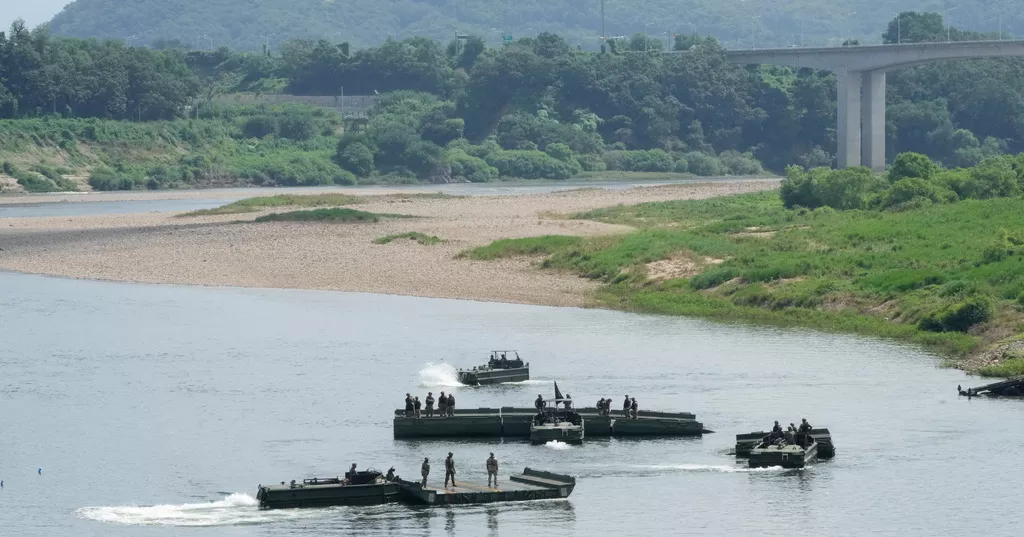
South Korean and U.S. militaries have agreed to shorten their ongoing joint exercises at Washington’s request, South Korean officials said Wednesday, a move that likely reflects President Donald Trump’s efforts to reengage with North Korean leader Kim Jong Un but could raise concerns about the allies’ defense readiness.
Trump had directed his Pentagon chief to “substantially reduce” the allies’ annual Ulchi Freedom Shield exercises shortly before they began Monday for an 11-day schedule. Trump cited what he described as a good relationship with Kim and South Korea’s decision not to join the U.S. war against Iran.
South Korea’s military said in a statement that the current drills with the United States will end Friday instead of Aug. 27, as originally scheduled. The allies also agreed to scale back some of their joint field training exercises.
The military said South Korea and the United States would discuss and implement various measures to meet the objectives of the exercises and maintain combined defense capabilities.
Many experts have warned that Trump’s decision could weaken the combined U.S.-South Korean defense posture and eventually undermine their decades-old alliance.
Ulchi Freedom Shield is primarily a computer-simulated command post exercise designed to improve the allies’ ability to respond to a potential North Korean attack. The two countries normally conduct a series of field training exercises alongside the command post drills.
The exercises, along with a similar drill held in the spring, are a key component of the U.S.-South Korea alliance, which dates back to the 1950-53 Korean War. However, North Korea has long viewed the drills as preparations for an invasion and has responded with provocative missile tests. Just days before this month’s exercises began, North Korea launched two ballistic missiles into the sea.
The current drills were reportedly planned in two phases. The first phase, running through Friday, focuses on defensive operations simulating North Korean attacks, while the second phase, originally scheduled through Aug. 27, was intended to practice counteroffensive operations. North Korea is particularly sensitive to exercises involving counteroffensive scenarios.
North Korea has not responded directly to Trump’s overture. However, its state-run Korean Central News Agency, or KCNA, published a commentary early Wednesday condemning the U.S.-South Korean exercises as “frantic” and “extremely dangerous” and vowing to thwart what it called hostile actions by its rivals.
“The dangerous escalation of the war drills staged by the U.S. and its vassal forces is posing a more serious threat to the security rights” of North Korea, the commentary said. It added that North Korea would continue exercising its right to self-defense to “completely neutralize the enemies’ military threat.”
Many experts said Kim, emboldened by advances in North Korea’s nuclear program and expanding military cooperation with Russia, is unlikely to respond positively to Trump’s outreach anytime soon unless Washington offers greater concessions.
In response to Trump’s previous efforts to reach out, Kim suggested last year that he could return to negotiations only if the United States abandons denuclearization of North Korea as a precondition for diplomacy.
Trump and Kim met three times between 2018 and 2019, but their high-level diplomacy eventually collapsed over disagreements surrounding Pyongyang’s demand for extensive sanctions relief in exchange for limited steps toward denuclearization.
On Monday, South Korean President Lee Jae Myung’s office expressed hope that the “friendly relationship” between Trump and Kim could lead to “meaningful dialogue” between the two countries and help promote peace on the Korean Peninsula.
The statement drew strong criticism from South Korean conservatives, who accused Lee’s government of placing the possible resumption of Trump-Kim diplomacy ahead of security concerns arising from Trump’s decision to scale back the exercises.