
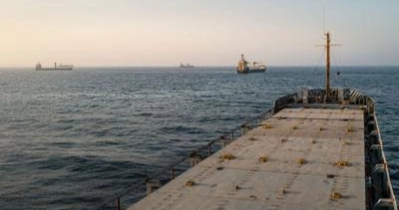
The United States carried out military strikes against Iran on Friday after a drone attack targeted a cargo vessel in the Strait of Hormuz the previous day. The incident marks the biggest challenge so far to a temporary agreement reached just a week earlier, under which both nations had agreed to work toward ending months of conflict and reopening the strategically important waterway.
President Donald Trump said the drone attack breached the ceasefire agreement. Before the operation, he hinted at a possible response by telling reporters, “You’ll find out.”
According to U.S. Central Command, the strikes targeted Iranian missile and drone facilities, along with coastal radar installations.
Speaking at the White House before the operation, Trump criticized Iran for launching "four shots" the day before. When questioned about why military action was being taken despite ongoing diplomatic talks with Tehran, he replied that Iran was “a little bit different” before ending the news conference.
Earlier on Friday, Ebrahim Azizi, chairman of Iran’s parliamentary national security commission, defended Iran’s actions in a social media post. He emphasized that Iran governs the Strait of Hormuz and urged others to “respect the rules,” arguing that Iran’s actions represented “ceasefire management,” not a violation of the truce.
Vice President JD Vance later urged Iran to resolve disputes through dialogue, saying the country should “pick up the phone.” However, he warned that any acts of violence would receive a forceful response.
A U.S. official, speaking anonymously to The Associated Press, said the military operation concluded roughly an hour after Central Command announced the strikes.
The latest escalation followed Thursday’s attack on a container ship near Oman. The United Kingdom Maritime Trade Operations (UKMTO) reported that the vessel was struck by a projectile, although no injuries were reported. The incident occurred shortly after Iran warned ships against using certain routes through the strait.
The attack comes as Washington and Tehran continue negotiations aimed at securing a lasting peace agreement. Despite the interim accord, Iran has continued to assert control over the Strait of Hormuz, a critical global shipping route.
The cargo ship was attacked while a United Nations maritime agency was relocating stranded vessels through an alternative route close to Oman’s coastline instead of the central section of the strait. Following the incident, the International Maritime Organization suspended the evacuation effort, saying operations would not resume until the safety of remaining ships could be guaranteed.
According to IMO Secretary-General Arsenio Dominguez, approximately 115 vessels have successfully exited the strait in recent days, while about 500 remain in the area.
The alternative shipping corridor was expected to ease pressure on global trade and reduce Iran’s leverage in ongoing negotiations with the United States.
The two countries are still discussing the final terms of a broader agreement, including safe passage through the Strait of Hormuz and the future of Iran’s highly enriched uranium stockpile. Under the interim agreement, both sides have 60 days to reach a comprehensive deal.
Shipping Industry Faces Fresh Uncertainty
The drone strike has raised new concerns within the shipping industry after signs of improving commercial activity in the Gulf.
Marine intelligence company Windward said the incident represented the first major setback to growing confidence in the Strait of Hormuz. Although shipping has continued—with 43 vessel transits recorded after the attack—the company noted that the pace of recovery has slowed.
Before the attack, 78 ships passed through the strait on Wednesday, the highest daily figure since the conflict began, though still below the prewar average of more than 130 vessels.
According to Lloyd’s List Intelligence, at least two oil tankers changed course while attempting to use the U.N.-supported route near Oman after Iran insisted that ships follow Tehran-approved navigation paths. Despite the disruption, more than two dozen vessels were still using the southern route on Friday.
Israel and Lebanon Move Toward Peace
Separately, Israel and Lebanon announced a new framework agreement on Friday that officials described as an important step toward peace after months of hostilities involving Israeli forces and the Lebanese militant group Hezbollah.
Lebanon’s ambassador to the United States, Nada Hamadeh, said the agreement aims to help displaced citizens return home while promoting peace, security, and prosperity across Lebanon.
Israeli Prime Minister Benjamin Netanyahu welcomed the development, calling it a major achievement. He said Israeli forces would continue to remain in the security zone in southern Lebanon until Hezbollah is fully disarmed and no longer poses a threat to Israel.