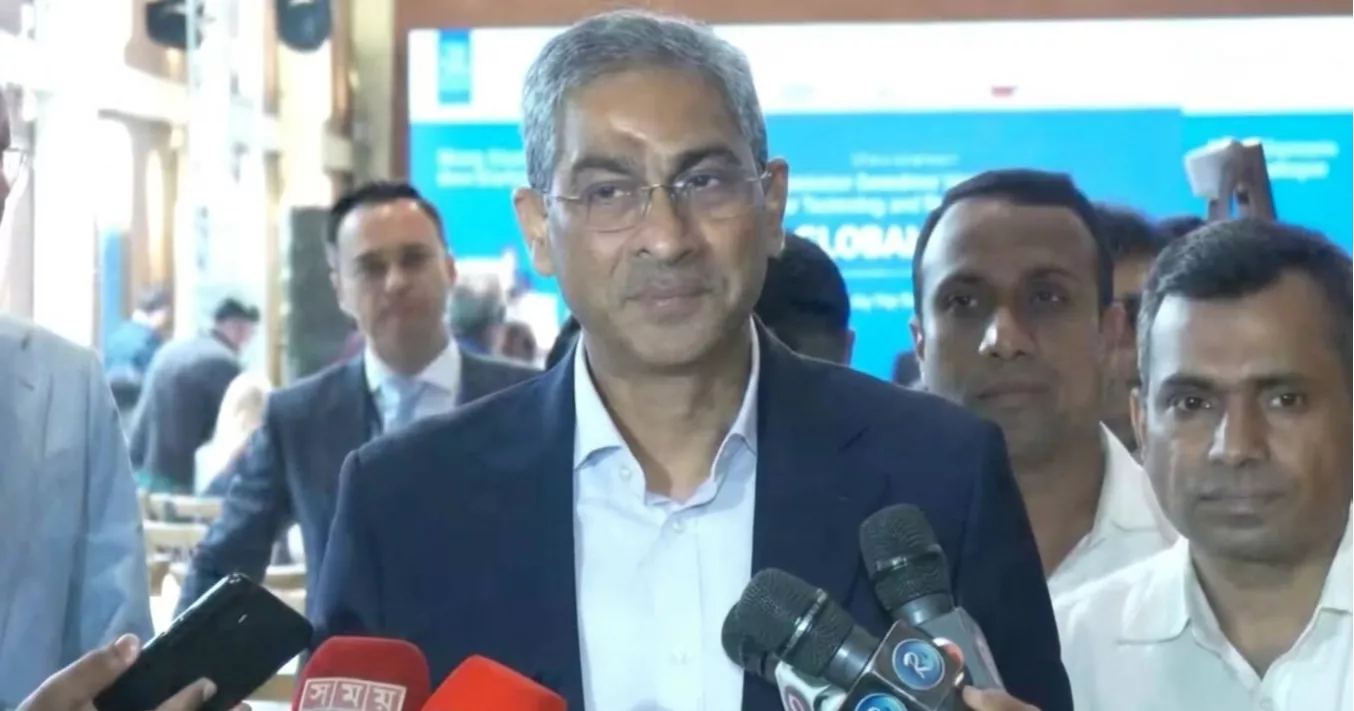
Water Resources Minister Md Shahiduddin Chowdhury Anee on Thursday said Bangladesh wants a new agreement with India on Ganges water sharing, not a renewal of the existing treaty that is set to expire this year. Specifically, Dhaka will be seeking to insert a guarantee clause to protect the country’s interests and ensure its required share of water.
“We certainly want a new agreement. We want to conclude it while protecting the interests of our country,” he said.
The minister made the remarks while talking to reporters after attending an event titled “High Level Event on Bangladesh Rivers Pollution Control, Conservation and Management of the Rivers Surrounding Capital Dhaka,” organised by the Team Europe Union at Aloki in Gulshan.
The minister said the first agreement, signed in 1977, was initially for five years and was subsequently continued for periods of around four to five years. It had a guarantee clause specifying how Bangladesh would receive its share of water.
He said another agreement was signed in 1996 for 30 years, but the guarantee clause was not included in that agreement.
“Even then, we continued it in the interest of the country and to maintain friendship, regardless of which government was in power. It was a continuous process,” he said.
The existing 30-year agreement is due to expire on December 12 this year, and the Joint Rivers Commission (JRC) has already started working on the issue, Anee said.
“We are very hopeful that the agreement will be concluded through good friendship between the two countries. We have a strong proposal to include the guarantee clause anew,” he said.
The minister said Bangladesh, being a downstream country, needs water at the right time and in the required quantity during both the dry and monsoon seasons.
“There should be a guarantee clause so that, based on our entitlement, we receive the right water at the right time,” he said.
He said a lack of water during the dry season could severely affect agriculture and fish production and ultimately hamper the country’s economic development.
“If there is no water during the dry season and there is no guarantee for receiving it, we will suffer greatly,” Anee said.
He said excessive water flow during the monsoon could also cause widespread flooding, riverbank erosion and damage to homes and settlements along rivers and canals.
“If a guarantee clause specifies how much water will flow at what time and in how many cusecs, we will receive water according to our requirements,” he said.
Anee also said the government has already obtained several domestic and international feasibility studies, including technical assistance, for the proposed Teesta Barrage project.
The Bangladesh-India Ganga/Ganges Water Treaty is expiring in December this year.
The Ganges Water Treaty was signed on December 12, 1996 for a period of 30 years.
Bangladesh and India share 54 rivers, including the Ganges, or Ganga.