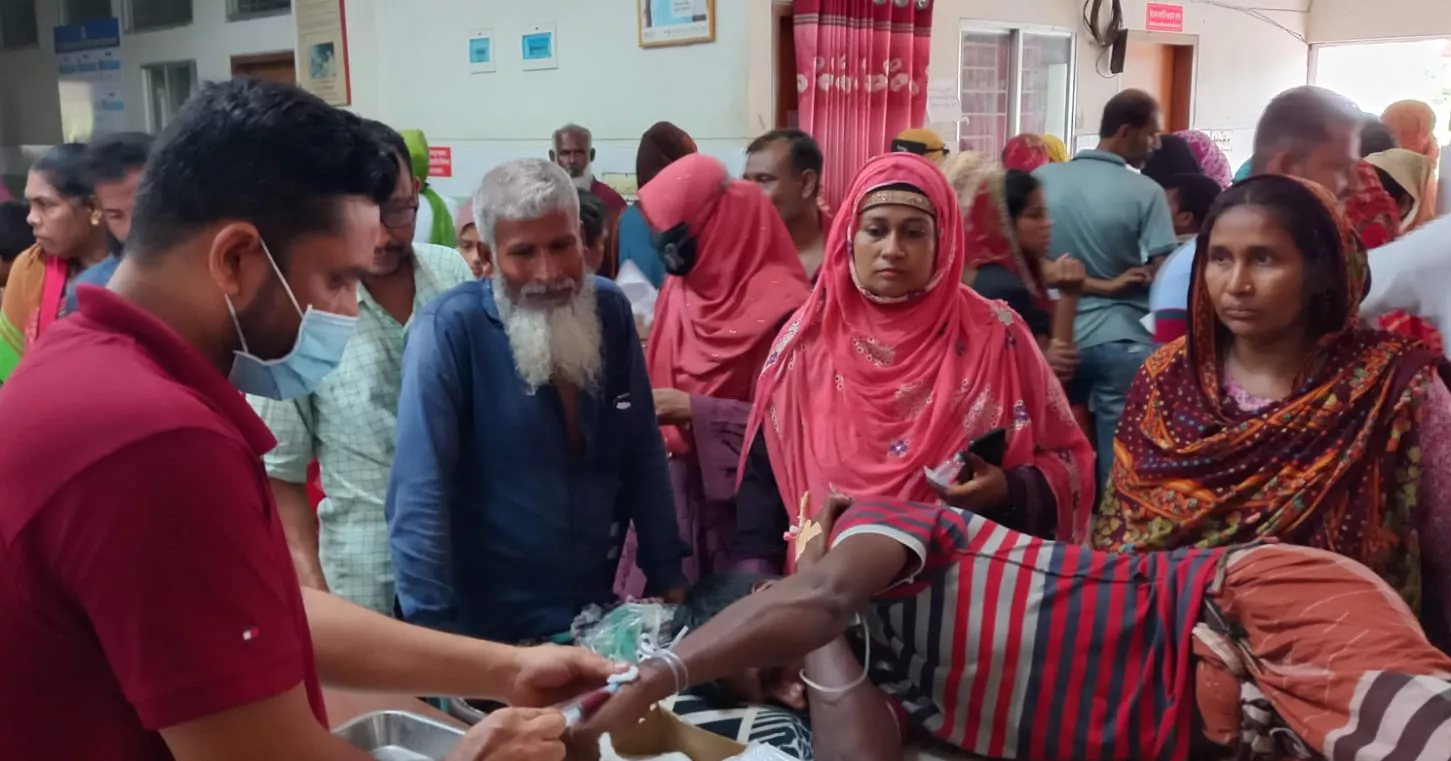
Dengue cases are rising rapidly in the southwestern district of Bagerhat, with more than 200 patients hospitalised over the past two months, prompting health authorities to designate parts of two upazilas as high-risk "red zones."
The outbreak has been particularly severe in Morrelganj and neighbouring Kachua upazilas, where the mosquito-borne disease has spread across several villages, putting local residents under growing anxiety.
According to the district officials, 218 dengue patients were admitted to hospitals between May and June 25, while one person has died from the disease.
However, health officials warned that the true scale of the outbreak is likely much larger than official figures indicate, as many patients continue to receive treatment at private hospital and clinics without being included in government records.
They attribute the outbreak to stagnant water left behind in canals under the Bangladesh Water Development Board (BWDB) following canal excavation works.
Earthen embankments built during the project reportedly blocked water flow, creating ideal breeding grounds for Aedes mosquitoes.
Civil Surgeon Dr ASM Mahbubul Alam said several unions in Morrelganj and Kachua have experienced widespread dengue transmission since May.
"We have identified Kachua and Morrelganj as red zones. Stagnant water in BWDB canals has created favourable conditions for Aedes mosquito breeding, leading to the rapid spread of dengue," he said.
The civil surgeon added that they have ensured adequate dengue testing kits at hospitals and that patients requiring advanced treatment are being referred to Khulna.
Hospitals under pressure
According to the Civil Surgeon's office, 10 to 15 dengue patients are being admitted to hospitals every day, while another 60 to 70 people with fever are seeking medical care.
Official data show that of the 218 patients admitted since May, 186 have recovered and been discharged, while 32 remained hospitalised as of June 25. One elderly patient, aged 75, has died from dengue during the period.
A visit to the 250-bed Bagerhat District Hospital on Thursday revealed overcrowded wards, with some dengue patients receiving treatment on the floor due to a shortage of beds.
Doctors and nurses were seen struggling to cope with the increasing patient load as people of all ages, including children and elderly patients, sought treatment for high fever and other dengue symptoms.
Hospital Superintendent Dr Asim Kumar Samaddar said the hospital has opened a dedicated dengue corner to manage the influx.
"Every day, around 30 to 40 patients are admitted, while another 35 to 40 patients with dengue-like symptoms receive treatment at the outpatient department," he said.
Apart from the district hospital, patients are also being treated at upazila health complexes, private hospitals and clinics across the district.
Families struggle amid rising infections
Many families said they were facing financial hardship as multiple members had fallen ill.
Sabana Begum, a resident of Bhandarkhola village in Kachua upazila, was anxiously waiting outside the pathology department after admitting her husband, a day labourer, with dengue.
"My husband developed fever four days ago. Tests confirmed dengue and he was admitted on Wednesday night. We have no one else at home, and I do not know how we will manage his treatment or support our family," she said.
Sabana claimed several households in her village have multiple dengue patients, with some families reporting up to five infected members.
Another resident, Mahidul Islam of Bishkhali village in Kachua, said his 75-year-old mother was admitted to the district hospital three days ago but had shown little improvement.
"Almost every household in our village has dengue patients. People are terrified, and many are shifting patients to private clinics hoping for better treatment," he said.
Patients from Morrelganj echoed similar concerns.
Samsur Rahman, 55, from Putia village, said he spent nearly a week in hospital undergoing repeated medical tests.
Meanwhile, Shipra Bakshi, 43, of Ramchandrapur village in Morrelganj, was transferred to a private hospital in Khulna after developing complications.
Her husband Shibu Bakshi said many villages surrounding their area were witnessing widespread infections.