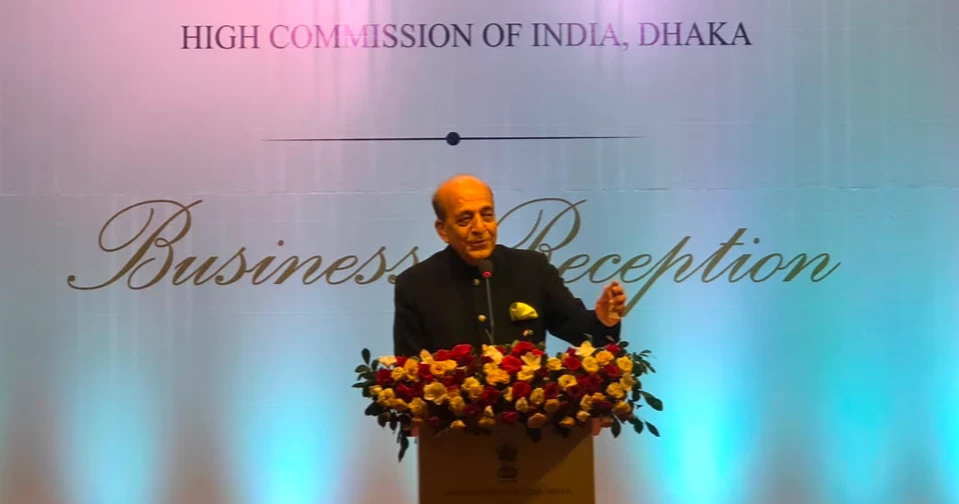
Indian High Commissioner to Bangladesh Dinesh Trivedi on Tuesday night called on Bangladesh and India to move beyond their differences and work together to build a relationship based on “mutual and unconditional trust,” saying the aspirations of the two countries’ young generations should guide the future of bilateral ties.
“We need to get ourselves together. Move on. I’m not telling you to forget the past, but keep the past and sort out the differences of the past. But move on. Don’t get stagnant,” he said.
The High Commissioner made the remarks while addressing a reception hosted in honour of leading Bangladeshi business leaders and a visiting delegation of the Confederation of Indian Industry (CII) at The Westin Dhaka.
State Minister for Foreign Affairs Shama Obaed Islam, Director General Chandrajit Banerjee and Indian Deputy High Commissioner Pawan Badhe also spoke at the reception.
High Commissioner Trivedi said both Bangladesh and India are aspirational countries, with their young people looking for opportunities, prosperity and a better future.
“It’s aspirant Bangladesh and it’s aspirant India,” he said, stressing the need for the two countries to work together to create opportunities for the younger generation.
Referring to his arrival in Bangladesh, the High Commissioner said, “The day I came in, I just walked in. This is one of the symbols, I think, that we are together.”
High Commissioner Trivedi said the foundation of any long-lasting relationship is “mutual and unconditional trust”.
“Friends really understand each other’s issues, and we are not friends if we don’t understand,” he said.
Acknowledging that there are issues between the two neighbours, he said such differences can be resolved through engagement and dialogue.
“I can tell you I fully understand there are issues, but these issues can definitely be sorted out once the Prime Minister of Bangladesh (Tarique Rahman) and our Prime Minister Narendra Modi meet,” he said.
The Indian envoy also conveyed what he described as an assurance from Prime Minister Narendra Modi regarding a future visit by the Bangladesh Prime Minister to India.
“After meeting the Prime Minister here, I went straight to Delhi and had a great meeting with our Prime Minister. He (PM Modi) just mentioned one thing: we need to meet,” he said.
“You can tell them on my behalf that you have the Prime Minister of India’s assurance that when the Prime Minister of Bangladesh visits India, he will have such an honourable reception as he deserves,” he added, quoting the Indian Prime Minister.
The visit, Trivedi said, would be “a memorable visit” whose benefits would ultimately reach people and businesses on both sides.
Highlighting the importance of economic and people-to-people ties, the High Commissioner said the private sector has a crucial role in bridging differences between the two countries.
“No government in the world can provide everything. It always needs the private sector,” he said, expressing gratitude to business communities on both sides.
He identified people-to-people relations, employment, education and health as key areas where Bangladesh and India can deepen cooperation.
“People all over the world have a big role to play in bridging this gap,” he said, referring to the business community’s role in strengthening bilateral ties.
The High Commissioner said India’s “Neighbourhood First” policy reflects the importance New Delhi attaches to its relationship with Bangladesh.
“Why did he send me? For one simple reason: we have a lot of respect, we have a lot of affection and we have a lot of need with a neighbour. And our policy is Neighbourhood First,” he said.
Trivedi acknowledged that the two countries have gone through “hiccups” in their relationship, but said such difficulties should not undermine their longstanding bonds.
“We have all gone through hiccups here and then. I think that’s quite natural; that also happens in a family. But that doesn’t mean that we move away,” he said.
“We have shared history, we have shared culture, and this is where we need to foster,” Trivedi added.
The High Commissioner also praised Bangladesh’s Prime Minister, describing him as “a people’s person” and noting that Indian Prime Minister Narendra Modi was the first to congratulate him after his landslide electoral victory and the first to invite him to India.
He said the recent high-level engagements, including visits by India’s external affairs minister and speaker as well as his own posting in Dhaka, reflected India’s eagerness to strengthen ties.
“We are eagerly waiting and I’m so hopeful. There are issues, there is no doubt about it,” he said. At the same time, Trivedi said differences are natural in a vibrant democracy.
“If issues are not there, then it’s not democracy; it’s something other than democracy,” he said.
He said Indian officials have been working closely with Bangladesh’s ministers in recent weeks to address differences and understand the concerns of the Bangladeshi people.
“We deeply understand the concerns of brothers and sisters of Bangladesh,” he said, while stressing that the relationship should be viewed as “a partnership of equals”.
“These concerns can only be mitigated once you meet,” Trivedi said.
Turning to Bangladesh’s youth, the High Commissioner said the country’s new generation had gone through significant struggle and sacrifice and deserved an opportunity to achieve peace and prosperity.
“This is a new Bangladesh, and this new Bangladesh has the youth. And youth has also gone through a lot of struggle and a lot of sacrifice,” Trivedi said.
“Our objective obviously is to have peace and prosperity, and the youth must get that opportunity,” he added.
Trivedi said such opportunities could be created through closer cooperation between Bangladesh and India.
“Bangladesh First and we have the goals are same. There is just no difference,” he said.
Urging the business communities of both countries to join the journey of closer cooperation, the High Commissioner said, “Let’s have this journey together.”
Trivedi expressed hope that the relationship between Bangladesh and India would enter a new phase.
“This would be a golden chapter in the history of the relationship between India and Bangladesh, because we have a lot to share with you,” he said.
Trivedi referred to the shared cultural heritage of the two countries and called for a renewed “melody of relationship”.
“Let’s have this melody of relationship,” he said, expressing confidence that the relationship could become “golden” and long-lasting.
The high-level Indian business delegation from the Confederation of Indian Industry (CII) is scheduled to leave Dhaka on Wednesday morning, an official told UNB.
Discussions during the visit focused on addressing issues of mutual interest and mutual benefit, identifying emerging areas of cooperation, and facilitating greater engagement between businesses of the two countries.
Both sides explored opportunities for greater economic and commercial cooperation between the two countries.
The delegation, led by Chandrajit Banerjee, Director General, CII, comprises 14 business leaders representing prominent Indian companies and institutions, including Bharat Biotech, Infravision Foundation, Godrej Industries, Arvind Limited, LMW Global, Mahindra Group, Larsen & Toubro (L&T), Forbes Marshall, Numaligarh Refinery Limited, Apollo Hospitals and Indian Oil Corporation, along with officials from the CII Secretariat.
During the visit, the delegation met senior members of the government of Bangladesh.