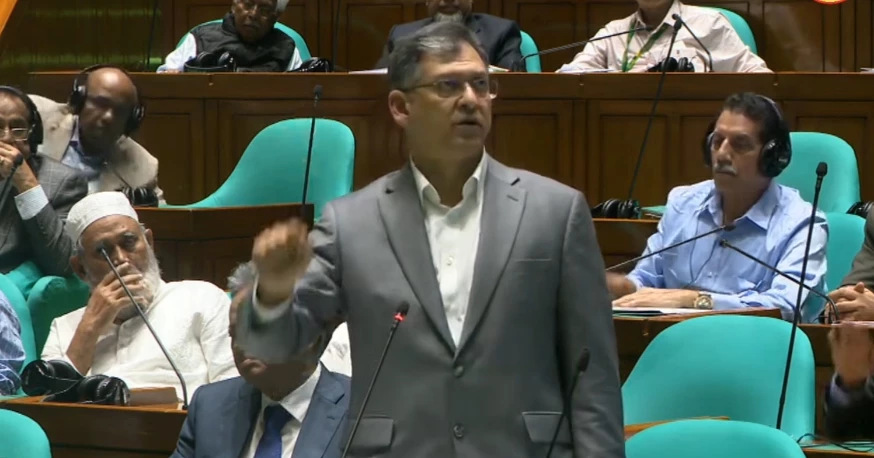
Home Minister Salahuddin Ahmed on Tuesday said the "ousted fascist and mafia forces" had been reduced to "Awami League Tungipara Limited".
“However, the fallen fascist forces will not be allowed to return to politics in Bangladesh,” he said, joining a general discussion on a motion over the ongoing crisis in the garment sector in Parliament.
The motion was placed under Rule 147 of the Rules of Procedure by Bangladesh Jamaat-e-Islami lawmaker Muhammad Nazibur Rahman (Pabna-1).
The minister accused the fallen forces of orchestrating arson and violence, including an attack on a police station in Gopalganj, and instigating unrest in the ready-made garment (RMG) sector from across the border.
"They could only attack a police station there (in Tungipara) and the home of one of our MPs. They also attacked shops of our supporters, those of the BNP and its affiliated organisations. This is their character. Setting fire is their habit. Burning people alive is their habit," he said.
Salahuddin alleged that former ministers, MPs and "so-called leaders" of the Awami League had in recent days been sharing video messages on social media from across the border, urging people to set fire to villages.
"They have never practised politics. Democracy is not in their DNA," he said, accusing the party of terrorism, killings, extortion, oppression and genocide during its 15-16 years in power.
The minister said the government would not respond in the similar kind. "We are a government of a democratic nature and culture. The people of this country no longer want to see protesters killed on the streets," he said.
"We believe in the principle of protecting the innocent. If necessary, we will show patience towards 10 criminals for some time, but an innocent person must not be shot," he added.
Salahuddin said law enforcement agencies had been instructed to use necessary force in the exercise of the right of private defence, but not excessive force.
Responding to the opposition leader's query about steps taken, he said around 200 members of law enforcement agencies, including two additional superintendents of police, an assistant superintendent of police and the officer-in-charge, were present at Tungipara Police Station.
“Had the government ordered it, they could have caused heavy casualties,” the minister said, adding that members of the Special Response Battalion, Border Guard Bangladesh (BGB) and police were waiting four to five kilometres away while trying to persuade the public to disperse peacefully.
He warned that those who had called for an attack on the police station through mosque loudspeakers should not assume that the authorities lacked recordings, videos, footage or audio.
"Today or tomorrow, every miscreant will be identified and brought under the law," Salahuddin said, naming those who attacked the police station, assaulted law enforcers, torched vehicles or created anarchy in the name of a movement.
He urged the people of Gopalganj to stand with "democratic forces" and not fall into the trap of miscreants inciting from across the border.
Referring to remarks that Awami League leaders might return in December, the minister said the government wanted them to return lawfully under the extradition treaty.
He said although he understood there was no scope for appeal against the International Crimes Tribunal (ICT) verdict, any such matter would be for the courts to decide.
Salahuddin said such statements were endangering party activists still hiding in forests and remote areas.
On the RMG unrest, he said the interim government had decided to form a wage board every three years, instead of every five, to set the minimum wage. The three-year period would be completed in December, he said.
According to the minister, around a month and a half before that, "one party" began inciting workers from outside the border without reason, using the wage board issue to block the road in Uttara in Dhaka.
He said authorities had held talks with labour leaders with great patience and kept one side of the road open. He also referred to a recent fire at a pharmaceutical factory in Gazipur.
Salahuddin said the government fully agreed with the workers' "legitimate demand", adding that there was no government-opposition division on the issue.
He said the Middle East war and other factors had caused a global economic slowdown and fuel price hikes, making life harder for low-income and working people.
The minister said the wage board needed some time to determine the minimum wage and that this was a matter of process.
Owners and workers' leaders, in separate talks, had agreed to return to work and accept the wage board's decision, he said.
Salahuddin said despite such an understanding, unrest continued in Kaliakair, Gazipur, Savar, Ashulia, Hemayetpur, Uttara and other areas, with attacks even on footwear and telephone industries.
He alleged that "some who call themselves workers" had mixed with the labourers to keep the unrest alive.
The minister also strongly condemned an alleged attempted attack on the opposition chief whip, who is on a foreign visit, by "some conspirators of the Awami League's fascist forces".
He urged the embassy and the authorities of the country concerned to take appropriate legal action.