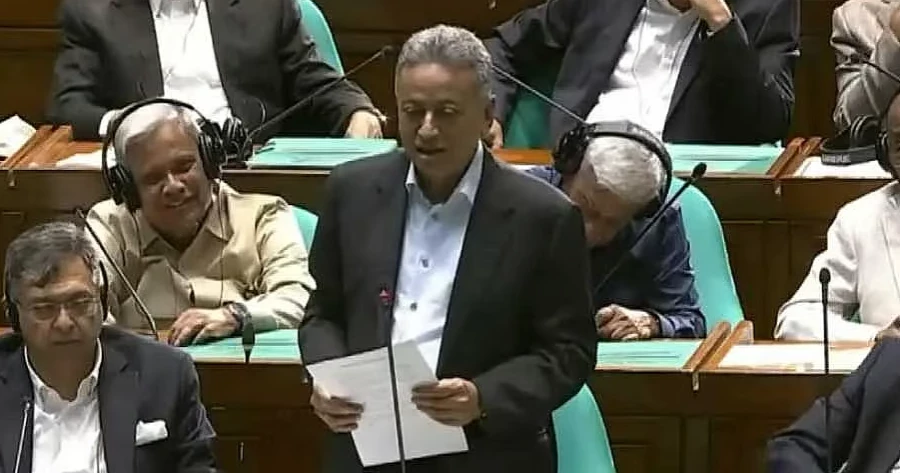
Finance and Planning Minister Amir Khosru Mahmud Chowdhury on Monday said Bangladesh will graduate from the group of least developed countries (LDCs) on 24 November 2029, after the United Nations General Assembly unanimously approved a three-year extension of the country's preparatory period.
The finance minister said this while responding to a call-attention notice raised by reserved-seat MP Sultana Jasmine in Parliament.
He said that, under the UN decision, Bangladesh was originally due to graduate on 24 November 2026, after the five-year preparatory period. However, the post-Covid economic pressure, the Russia-Ukraine war, the Middle East conflict, the political changes of July 2024 and problems in the financial sector had hindered the reforms and preparations needed.
"Leading chamber associations of the private sector asked the government to extend the preparatory period," he said.
The government then asked the UN Office of the High Representative for the Least Developed Countries, Landlocked Developing Countries and Small Island Developing States (UN-OHRLLS) to prepare an impartial report on Bangladesh's readiness.
Its Graduation Readiness Assessment report highlighted gaps in preparedness and the serious disruption to the preparatory period.
On 8 February 2026, the government formally requested the UN Committee for Development Policy (CDP) to extend the period by three years, up to 24 November 2029. The UN General Assembly unanimously approved the request on 29 October 2026.
Calling graduation a matter of joy and pride, the minister cautioned that it would also bring challenges, as Bangladesh currently enjoys several international support measures (ISMs) as an LDC.
He said Bangladesh had used duty-free market access most successfully, ranking first among all LDCs in utilising the facility, according to a World Trade Organization (WTO) report.
Bangladesh's pharmaceutical industry has also achieved unprecedented success by using flexibilities under the WTO TRIPS Agreement, and now meets 98 percent of domestic demand at affordable prices.
"But after graduation, Bangladesh will no longer be able to enjoy these special facilities, which may create a number of challenges," he said.
National roadmap
Amir Khosru Mahmud said the government had already prepared a National Roadmap for Smooth, Sustainable and Irreversible LDC Graduation 2026-29 for the extended period. The earlier Smooth Transition Strategy (STS) is also being revised in light of the changed circumstances.
The roadmap prioritises five transformational pillars: macroeconomic stability, trade and market access, productivity and industrialisation, human resource development and skills, and good governance and partnerships.
It identifies 21 major action areas, with lead and co-lead agencies and implementation timelines set for each, and 15 high-impact action areas for the private sector. These include technology upgrading, compliance with labour standards, skills development, export diversification, green investment and public-private collaboration.
The roadmap also provides for a review of progress in the final phase, closing remaining gaps and a final graduation readiness assessment.
A National Graduation Monitoring and Coordination Committee, chaired by the finance minister, has been formed to oversee implementation. It will review progress, coordinate work, remove obstacles and give policy directions. The committee will meet at least once a month and has already held two meetings.
A public-private joint task force, led by the Economic Relations Division (ERD) secretary and including representatives of both sectors, is also working to ease business, trade and investment.
Changing financing landscape
The minister said graduation would change the nature of development financing, with concessional finance gradually shrinking and borrowing costs rising. The gap between interest rates on multilateral development loans and market rates is also narrowing.
He said Tk 1,27,520 crore had to be earmarked in the 2026-27 budget for interest payments alone.
Against this backdrop, the government is restructuring the public financing architecture and moving towards alternative financing to keep development funding steady after graduation.
The 2026-27 budget caps the deficit at 3.6 percent of GDP. The government aims to keep the deficit sustainable through higher revenue in the medium term, restore discipline in debt management and bring debt risk back from moderate to low. The Medium-Term Debt Management Strategy is being updated and debt sustainability analyses are being conducted regularly.
Government borrowing from the banking system will be reduced gradually, and the budget will be financed cost-effectively through domestic revenue, concessional foreign finance and market-based instruments.
To diversify foreign financing, the government is assessing the feasibility of issuing a sovereign bond for the first time. Alongside dollar bonds, Panda and Samurai bonds are also under consideration.
Capital market reforms
Finance Minister Khosru said the government had taken steps to turn the capital market into the main platform for long-term financing and ease pressure on banks. This is meant to remove the maturity mismatch arising when banks fund large long-term investments with short-term deposits.
Large investments are being encouraged to raise equity and debt directly from the capital market. Other measures included expanding the corporate bond market; introducing municipal bonds for local government and urban infrastructure; increasing the use of bonds, sukuk and infrastructure funds for long-term public and private projects; and raising the participation of institutional investors, including pension funds, insurers, asset management companies and mutual funds.
The government, the finance minister said, has also moved to launch a Bangladesh-dedicated equity fund in Hong Kong to attract international capital as equity rather than debt. He said it would create no direct debt liability.
The minister said these initiatives would help offset the impact of shrinking concessional finance after graduation and boost private investment and foreign direct investment (FDI).
He said that through proper implementation of the roadmap and the revised STS, and by strengthening public financing through alternative financing, debt management and capital market reforms, Bangladesh would be able to tackle all potential challenges and make LDC graduation smooth and sustainable.